Thank you for visiting SNEWPapers!
Sign up free
The Enquirer
Richmond, Henrico County, Virginia
What is this article about?
President Thomas Jefferson transmits a report from surveyor B. Henry Latrobe on 1804 construction progress for the President's House and Capitol in Washington, detailing repairs, expenditures totaling $57,665.72, challenges faced, and recommendations for future appropriations exceeding $50,000.
Clipping
OCR Quality
Full Text
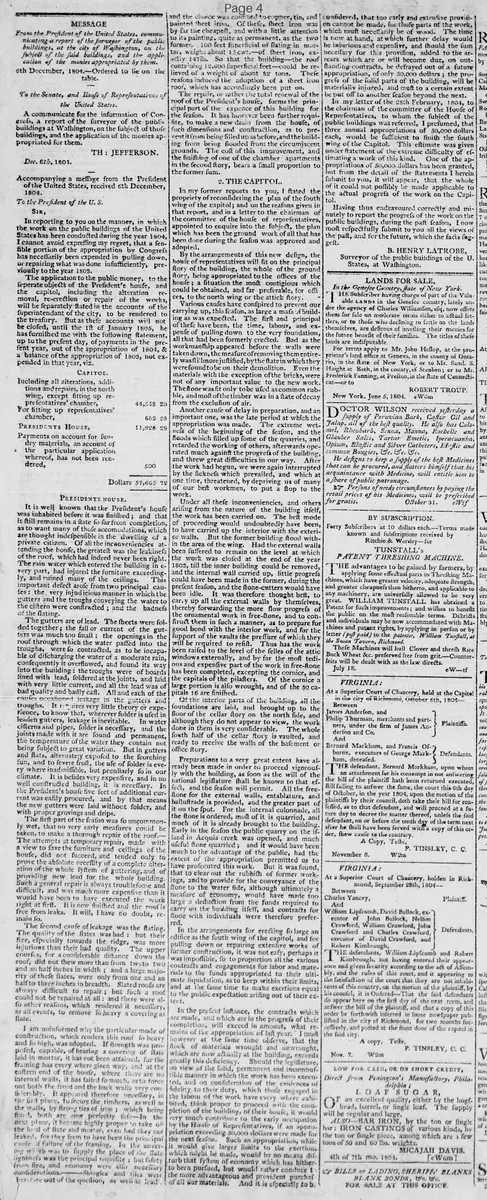
From the President of the United States, communicating a report of the Surveyor of the public buildings, at the city of Washington, on the subject of the said buildings, and the application of the monies appropriated by them.
6th December, 1804.—Ordered to lie on the table.
To the Senate, and House of Representatives of the United States:
A communication for the information of Congress, a report of the surveyor of the public buildings at Washington, on the subject of those buildings, and the application of the monies appropriated for them.
TH: JEFFERSON.
Dec. 6th, 1804.
Accompanying a message from the President of the United States, received 6th December, 1804.
To the President of the U. S.
SIR,
In reporting to you on the manner, in which the work on the public buildings of the United States has been conducted during the year 1804, I cannot avoid expressing my regret, that a sensible portion of the appropriation by Congress has necessarily been expended in pulling down, or repairing what was done insufficiently, previously to the year 1804.
The application to the public money, to the separate objects of the President's house, and the capitol, including the alteration removal, re-erection or repair of the works, will be separately stated in the accounts of the superintendent of the city, to be rendered to the treasury. But as these accounts will not be closed, until the 1st of January 1805, he has furnished me with the following statement, up to the present day, of payments in the present year, out of the appropriation of 1804, & a balance of the appropriation of 1803, not expended in that year, viz.
CAPITOL.
Including all alterations, additions and repairs, in the north wing, except fitting up representatives' chamber,
44,549 20
For fitting up representatives' chamber,
689 28
President's House,
11,928 29
Payments on account for sundry materials, an account of the particular application whereof, has not been rendered,
500
Dollars 57,665 72
President's House.
It is well known that the President's house was inhabited before it was finished: and that it till remains in a state so far from completion, as to want many of those accommodations, which are thought indispensable in the dwelling of a private citizen. Of all the inconveniencies attending the house, the greatest was the leakiness of the roof, which had indeed never been right. The rain water which entered the building in every part, had injured the furniture exceedingly, and ruined many of the ceilings.
This important defect arose from two principal causes: the, very injudicious manner in which the gutters and the troughs conveying the water to the cistern were constructed; and the badness of the slating.
The gutters are of lead. The sheets were folded together; the fall or current of the gutters was much too small: the openings in the roof through which the water passed into the troughs, were so contracted, as to be incapable of discharging the water of a moderate rain, consequently it overflowed, and found its way into the building: the troughs were of boards lined with lead, soldered at the joints, and laid with very little current, and all the lead was of bad quality and badly cast. All and each of the causes occasioned leakage in the gutters and troughs. It requires very little theory or experience, to know that, wherever solder is used in leaden gutters, leakage is inevitable. In water cisterns and pipes, solder is necessary, and the joints made with it are sound and permanent, the temperature of the water they contain not being subject to great variation. But in gutters and flats, alternately exposed to the scorching sun, and to severe frost, the use of solder is every where inadmissible, but peculiarly so in our climate. It is besides very expensive, and in no well constructed building, it is necessary. In the President's house five feet of additional current was easily procured, and by that means the new gutters were laid without solder, and with proper groovings and drips.
The first part of the season was so uncommonly wet, that no very early measures could be taken, to make a thorough repair of the roof.—The attempts at temporary repair, made with a view to save the furniture and ceilings of the house, did not succeed, and tended only to prove the absolute necessity of a complete alteration of the whole system of guttering, and of providing new lead for the whole building. Such a general repair is always troublesome and difficult, and was much more expensive than it would have been to have executed the work right at first. It is now finished and the roof is free from leaks. It will, I have no doubt, remain so.
The second cause of leakage was the slating. The quality of the slates was bad: but their size, especially towards the ridge, was more injurious than their bad quality. The upper courses, for a considerable distance down the roof, did not shew more than from two to two and an half inches in width; and a large majority of these slates, were only from one and an half to three inches in breadth. Slated roofs are always difficult to repair: but such a roof could not be repaired at all: and there were also other reasons, which rendered it necessary, at all events, to remove so heavy a covering as slate.
I am uninformed why the particular mode of construction, which renders this roof so heavy and so high, was adopted. If strength was proposed, capable, of bearing a covering of slate laid in mortar, it has not been attained, for the framing has every where given way, and at the cistern end of the house, where there are no internal walls, it has failed so much, as to force out both the front and the back walls very considerably. It appeared therefore necessary, in the first place, to secure the timbers, as well as the walls, by strong ties of iron; which being fixed, both are now perfectly safe—In the next place, it became highly proper to take off the load of slate and mortar, even had they not leaked. for they seem to have been the principal cause of failure of the framing. In the covering which was to supply the place of the slate lightness was the principal requisite; but safety from fire, and economy were also necessary considerations.—Shingles and tiles were put out of the question, as well as lead.
and the choice was confined to copper, tin, and painted sheet iron. Of these, sheet iron was by far the cheapest, and with a little attention to its painting, quite as permanent, as the two former. 100 feet superficial of slating in mortar, weighs about 15 cwt.—of sheet iron, exactly 147 lb. So that the building—the roof containing 12,600 superficial feet—could be relieved of a weight of about 52 tons. These reasons induced the adoption of a sheet iron roof. which has accordingly been put on.
The repair, or rather the total renewal of the roof of the President's house, forms the principal part of the expense of this building for the season. It has however been further requisite, to make a new drain from the house. of such dimensions and construction, as to prevent it from being filled up as before, and the building from being flooded from: the circumjacent grounds. The cost of this improvement, and the finishing of one of the chamber apartments in the second story, bears a small proportion to the former sum.
2. THE CAPITOL.
In my former reports to you, I stated the propriety of reconsidering the plan of the south wing of the capitol; and on the reasons given in that report, and in a letter to the chairman of the committee of the house of representatives, appointed to enquire into the subject, the plan which has been the ground work of all that has been done during the season was approved and adopted.
By the arrangements of this new design, the house of representatives will sit on the principal story of the building, the whole of the ground story, being appropriated to the offices of the house; a situation the most contiguous which could be obtained, and far preferable, for offices, to the north wing or the attic story.
Various causes have conspired to prevent our carrying up, this season, as large a mass of building as was expected. The first and principal of these have been, the time, labour, and expense of pulling down to the very foundation, all that had been formerly erected. Bad as the workmanship appeared before the walls were taken down, the measure of removing them entirely was still more justified, by the state in which they were found to be on their demolition. Even the materials with the exception of the bricks, were not of any important value to the new work. The stone was fit only to be used as common rubble, and most of the timber was in a state of decay from the exclusion of air.
Another cause of delay in preparation, and an important one, was the late period at which the appropriation was made. The extreme wetness of the beginning of the season, and the floods which filled up some of the quarries, and retarded the working of others, afterwards operated much against the progress of the building, and threw great difficulties in our way. After the work had begun, we were again interrupted by the sickness which prevailed, and which at one time, threatened, by depriving us of many of our best workmen, to put a stop to the work.
Under all these inconveniencies, and others arising from the nature of the building itself, the work has been carried on. The best mode of proceeding would undoubtedly have been, to have carried up the interior with the exterior walls. But the former building stood within the area of the wing. Had the external walls been suffered to remain on the level at which the work was closed at the end of the year 1803, till the inner building could be removed, and the internal wall carried up, little progress could have been made in the former, during the present season, and the stone-cutters would have been idle. It was therefore thought best, to carry up all the external walls by themselves, thereby forwarding the more slow progress of the ornamental work in free-stone, and to construct them in such a manner, as to prepare for good bond with the interior work, and for the support of the vaults the pressure of which they will be required to resist. Thus has the work been raised to the level of the sills of the attic windows externally, and by far the most tedious and expensive part of the work in free-stone has been completed, excepting the cornice, and the capitals of the pilasters. Of the cornice a large portion is also wrought, and of the so capitals 16 are finished.
Of the interior parts of the building, all the foundations are laid, and brought up to the floor of the cellar story on the north side, and although they do not appear to view, the work done in them is very considerable. The whole south half of the cellar story is vaulted, and ready to receive the walls of the basement or office story.
Preparations to a very great extent have already been made in order to proceed vigorously with the building, as soon as the will of the national legislature shall be known to that effect, and the season will permit. All the free-stone for the external walls, entablature, and balustrade is provided, and the greater part of it on the spot. For the internal colonnade, all the stone is ordered, most of it is quarried, and much of it is already brought to the building. Early in the season the public quarry on the island in Acquia creek was opened, and much useful stone quarried; and it would have been much to the advantage of the public, had the extent of the appropriation permitted us to have prosecuted this work. But it was found, that to clear out the rubbish of former workings, and to provide for the conveyance of the stone to the water side, although ultimately a measure of economy, would have made too large a deduction from the funds required to carry on the building itself, and contracts for stone with individuals were therefore preferred.
In the arrangements for erecting so large an edifice as the south wing of the capitol, and for pulling down or repairing extensive works of former construction, it was not easy, perhaps it was impossible, so to proportion all the various contracts and engagements for labor and materials to the funds appropriated to their ultimate liquidation, as to keep within their limits, and at the same time to make exertions equal to the public expectation arising out of their extent.
In the present instance, the contracts which are made, and which are in the progress of their completion, will exceed in amount, what remains of the appropriation of last year. I must however at the same time observe, that the stock of materials wrought and unwrought, which are now actually at the building, exceeds greatly this deficiency. Should the legislature, on view of the solid, permanent and incombustible manner in which the work has been executed, and on consideration of the evidences of fidelity to their duty, which those engaged in the labour of the work have every where exhibited, think proper to proceed with the completion of the building, of their house, it would very much contribute to the early occupation by the House of Representatives, if an appropriation exceeding 50,000 dollars were made for the next season. Such an appropriation, while it would give larger limits to the exertions which might be made, would by no means disturb that system of economy which has hitherto been pursued, but would rather conduce to the more advantageous and provident purchase of all our materials. And it is especially to be considered, that too early and extensive provision cannot be made, or those parts of the work, which must necessarily be of wood. The time is now at hand, at which further delay would be injurious and expensive. and should the sum necessary for this provision. added to the arrears which are or will become due, on outstanding contracts, be defrayed out of a future appropriation, of only 50,000 dollars ; the progress of the solid parts of the building, will be materially injured, and must to a certain extent be put off to another season beyond the next.
In my letter of the 25th February, 1804, to the chairman of the committee of the House of Representatives, to whom the subject of the public buildings was referred, I presumed, that three annual appropriations of 50,000 dollars each, would be sufficient to finish the south wing of the Capitol. This estimate was given under statement of the extreme difficulty of estimating a work of this kind. One of the appropriations of 50,000 dollars has been granted, but from the detail of the statements I herein submit to you, it will appear, that the whole of it could not possibly be made applicable to the actual progress of the work on the Capitol.
Having thus endeavoured correctly and minutely to report the progress of the work on the public buildings, during the past season, I now most respectfully submit to you all the views of the past, and for the future, which the facts suggest.
B. HENRY LATROBE,
Surveyor of the public buildings of the U. States, at Washington.
What sub-type of article is it?
What keywords are associated?
What entities or persons were involved?
Where did it happen?
Domestic News Details
Primary Location
City Of Washington
Event Date
Dec. 6th, 1804
Key Persons
Outcome
expenditures totaled $57,665.72 for repairs and construction on capitol and president's house; roof of president's house renewed with sheet iron; capitol south wing progress includes external walls to attic sills, interior foundations; recommends appropriation over $50,000 for next season.
Event Details
Report details 1804 construction efforts on public buildings in Washington, including roof repairs on President's House due to leaks from poor gutters and slating, replaced with sheet iron; Capitol south wing redesigned, old work demolished, new external walls raised, interiors prepared; challenges from weather, delays, sickness; appropriations from 1803-1804 used, with call for future funding.