Thank you for visiting SNEWPapers!
Sign up free
The National Republican And Cincinnati Daily Mercantile Advertiser
Cincinnati, Hamilton County, Ohio
What is this article about?
Colonel Bond's address at Chillicothe's canal celebration recounts Ohio's history from 1787 wilderness and Native conflicts, through settlement by pioneers like Gen. Massie in 1796, to statehood in 1803 and completion of 372 miles of canals by 1830s, contrasting with European works and crediting leaders like Gov. Brown.
Merged-components note: Dateline introduces and refers to the Colonel Bond's address story, forming a single logical unit.
Clipping
OCR Quality
Full Text
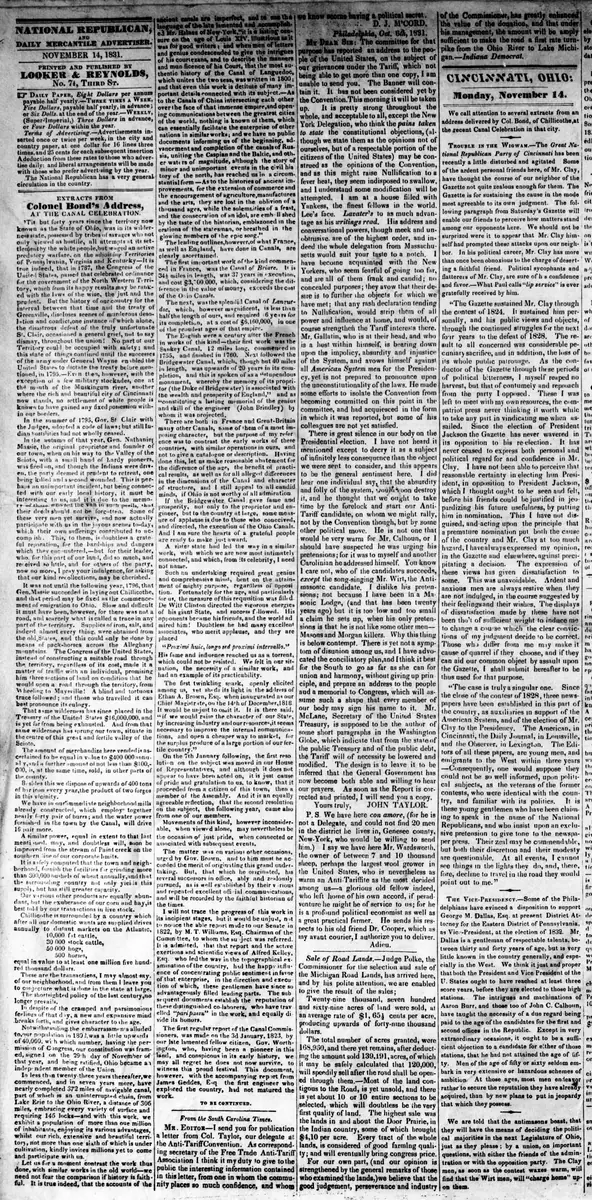
Colonel Bond's Address.
AT THE CANAL CELEBRATION.
"Tis but forty years since the territory now known as the State of Ohio, was in its wilderness state, possessed by tribes of savages who not only viewed as hostile, all attempts at its settlement by the white people, but waged an active predatory warfare, on the adjoining Territories of Pennsylvania, Virginia and Kentucky. It is true indeed, that in 1787, the Congress of the United States, passed that celebrated ordinance for the government of the North Western Territory, which from its happy results may be ranked with the laws of the wise, the just and the prudent. But the history of our country for the interval between that time and the treaty of Greenville, discloses scenes of murderous desolation and conflict, one instance of which alone, the disastrous defeat of the truly unfortunate St. Clair, occasioned a general grief, not to say dismay, throughout the union! No part of our Territory could be occupied with safety: and this state of things continued until the successes of the army under General Wayne enabled the United States to dictate the treaty before mentioned, in 1795. Even then, however, with the exception of a few military stockades, one at the mouth of the Muskingum river, another where the rich and beautiful city of Cincinnati now stands, no settlement of white people is known to have gained any fixed possession within our borders.
In the summer of 1795, Gov. St. Clair with the Judges, adopted a code of laws; but still Indian hostilities had not wholly ceased.
In the autumn of that year, Gen. Nathaniel Massie, the original proprietor and founder of our town, when on his way to the Valley of the Scioto, with a small band of hardy pioneers, was fired on, and though the Indians were driven, the party deemed it prudent to retreat, one being killed and a second wounded. This is perhaps an unimportant incident, but being connected with our early local history, it must be interesting to us, and it is due to the memory of those who led the van in such perils, that their deeds should not be forgotten. Some of these very men yet survive, and now actually participate with us in the joyous scenes to-day, which their own sufferings contributed to accomplish. This, to them, is doubtless a grateful reparation, for the hardships and dangers which they encountered. But for their leader, who, for this part of our land, did so much, and received so little, and for others of the party, now no more, I pray your indulgence, for asking that our kind recollections, may be cherished.
It was not until the following year, 1796, that Gen. Massie succeeded in laying out Chillicothe, and that period may be fixed as the commencement of emigration to Ohio. Slow and difficult it must have been, however, for there was not a road, and scarcely what is called a trace in any part of the territory. Supplies of iron, salt, and indeed almost every thing, were obtained from the old States, and this could only be done by means of pack-horses across the Alleghany mountains. The Congress of the United States, instead of constructing a suitable road through the territory, regardless of its cost, made it a matter of traffic with an individual, promising him three sections of land on condition that he would open a road through the territory, from Wheeling to Maysville! A blind and tortuous trace followed: and those who travelled it can best pronounce its eulogy.
That some wilderness has since placed in the Treasury of the United States $16,000,000, and is yet far from being exhausted. And from that same wilderness has sprung our town, situate in the centre of this great and fertile valley of the Scioto.
The amount of merchandise here vended is ascertained to be equal in value to $400,000 annually, and a further amount of not less than $100,000, is, at the same time, sold, in other parts of the county.
Besides this we dispose of upwards of 400 tons of bar iron every year, the product of two forges in this vicinity.
We have in our immediate neighborhood mills already constructed, which employ together nearly forty pair of burrs; and the water power furnished in the town by the Canal, will drive 16 pair more.
A similar power, equal in extent to that last mentioned, may, and doubtless will, soon be improved from the stream of Paint creek on the southern line of our corporate limits.
It is safely computed that the town and neighborhood, furnish the facilities for grinding more than 300,000 bushels of wheat annually, and that the surrounding country not only yields this supply, but has still greater capacity.
Our various other products are equally abundant, but the exuberance of our corn and hay, is best told by our transactions in live stock.
Chillicothe is surrounded by a country which after all our domestic wants are supplied drives annually to distant markets on the Atlantic,
10,000 fat cattle.
30,000 stock cattle,
50,000 hogs,
500 horses,
equal in value to at least one million five hundred thousand dollars.
These are the transactions, I may almost say, of our neighborhood, and from them I leave you to conjecture what is done in the state at large.
The short-sighted policy of the last century, no longer prevails.
In despite of the cramped and parsimonious feelings of that day, a new and expansive mind breaks forth, and gives character to the age.
Notwithstanding the embarrassments alluded to, our population in 1802, was a little upwards of 40,000, with which number, having the permission of Congress, our constitution was framed, signed on the 29th day of November of that year, and being ratified, Ohio became an independent member of the Union.
In less than twenty-three years thereafter, we commenced, and in seven years more, have nearly completed 372 miles of navigable canal, part of which is an uninterrupted chain, from Lake Erie to the Ohio River, a distance of 306 miles, embracing every variety of surface and requiring 146 locks—and with this work, we exhibit a population of more than one million of inhabitants, enjoying its various advantages, whilst our rich, extensive and beautiful territory, not more than one sixth of which is under cultivation, kindly invites millions yet to come and participate with us.
Let us for a moment contrast the work thus done, with similar works in the old world—we need not fear the comparison if history is faithful. It is true indeed, that the accounts of the ancient canals are imperfect, and to use the language of the late lamented and accomplished Mr. Haines of New York it is astonishing certainty on the age of Louis XIV: illustrious age was for good writers: and when men of letters and genius condescended to give the intrigues of his courtezans, and to describe the manners and munificence of his Court, that the most authentic history of the Canal of Languedoc, which unites the two seas, was written in 1800; and that even this work is destitute of many important details connected with its subject. As to the Canals of China intersecting each other over the face of that immense empire, and opening communications between the greatest cities of the world, nothing is known of them, which can essentially facilitate the enterprise of other nations in similar works; and we have no public documents informing us of the beginning, advancement and completion of the canals of Russia, uniting the Caspian and the Baltic, and other waters of magnitude, although the story of minor and unimportant events in the civil history of the north, has reached us in a circumstantial form. As to the histories of ancient improvements, for the extension of commerce and the encouragement of agriculture, manufactures and the arts, they are lost in the oblivion of a thousand ages, while the solemnities of a feast, and the consecration of an idol, are embellished by the taste of the historian, emblazoned in the orations of the statesman, or breathed in the glowing numbers of the epic song."
The leading outlines, however, of what France, as well as England, have done in Canals, are clearly ascertained.
The first important work of the kind commenced in France, was the Canal of Briare. It is 34 miles in length, was 37 years in execution, and cost $3,000,000, which, considering the difference in the value of money, exceeds the cost of the Ohio Canals.
The next, was the splendid Canal of Languedoc, which, however magnificent, is less than half the length of ours, and required 6 years for its completion, at a cost of $6,160,000, in one of the proudest ages of that empire.
The English were a century after the French in works of this kind—their first work was the Sankey Canal, 12 miles long, commenced in 1755, and finished in 1760. Next followed the Bridgewater Canal, which, though but 40 miles in length, was upwards of 20 years in its completion, and this is spoken of as a "stupendous monument, whereby the memory of its proprietor (the Duke of Bridgewater) is associated with the wealth and prosperity of England," and as "constituting a lasting memorial of the genius and skill of the engineer (John Brindley) by whom it was projected."
There are both in France and Great-Britain many other Canals, some of them of a most imposing character, but the purpose of my reference was to contrast the early works of these countries, with similar operations in ours, and not to give a catalogue or description. Having done this, let us make reasonable abatement for the difference of the age, the benefit of practical results, as well as for all alleged differences in the dimensions of the Canal and character of structure, and I still appeal to all candid minds, if Ohio is not worthy of all admiration.
If the Bridgewater Canal, gave fame and prosperity, not only to the proprietor and engineer, but to the Country at large, some measure of applause is due to those who conceived, and directed, the execution of the Ohio Canals.
And I am sure the hearts of a grateful people are ready to make just award.
A sister state had led the way in a similar work, with which we are now most intimately connected, and which, from its celebrity, I need not name.
Such an undertaking required great genius and comprehensive mind, bent on the attainment of mighty purpose, regardless of opposition. Fortunately for the age, and particularly for us, the measure of this requisition was filled.
De Witt Clinton directed the vigorous energies of his giant State, and success followed. His opponents became his friends, and the world admired him! Doubtless he had many excellent associates, who merit applause, and they are placed
"Proximi huic, longo sed proximi intervalla."
His fame and influence reached us as a torrent, which could not be resisted. We felt in our situation, the necessity of a similar work, and had an example of its practicability.
The first twinkling spark, openly elicited among us, yet sheds its light in the address of Ethan A. Brown, Esq. when inaugurated as our Chief Magistrate, on the 14th of December, 1818.
It would be unjust to omit it. It is there said, "if we would raise the character of our State by increasing industry and our resources, it seems necessary to improve the internal communications, and open a cheaper way to market, for the surplus produce of a large portion of our fertile country."
On the 7th January following, the first resolution on the subject was moved in our House of Representatives, and although it does not appear to have been acted on, it is just cause of pride and gratulation to us, to know, that it proceeded from a citizen of this town, then a member of the Assembly. And it is an equally agreeable reflection, that the second resolution on the subject, the following year, came also from one of our members.
Movements of this kind, however inconsiderable, when viewed alone, may nevertheless be the occasion of just pride, when connected or associated with subsequent events.
The matter was on various other occasions, urged by Gov. Brown, and to him must be accorded the merit of originating this grand undertaking. But, that which he originated, his several successors in office, ably and zealously pursued, as is well established by their various and repeated excellent official communications, and will be recorded by the faithful historian of the times.
I will not trace the progress of this work in its incipient stages, but it would be unjust, not to notice the able report made to our Senate in 1822, by M. T. Williams, Esq. Chairman of the Committee, to whom the subject was referred.
It is admitted, that that report and the active exertions and scientific views of Alfred Kelley, Esq. who led the way in the topographical examination of the country, had the happy influence of concentrating public sentiment in favor of that enterprise, in the direction and execution of which, these gentlemen have since so advantageously filled leading parts. The subsequent documents establish the reputation of these distinguished co-laborers, who have travelled "pari passu" in the work, and equally divide its honors.
The first regular report of the Canal Commissioners, was made on the 3d January, 1823, by our late lamented fellow citizen, Gov. Worthington, who, having been a pioneer in this land, and conspicuous in its early history, we may all regret he does not now survive, to witness this proud festival. This document, however, with the accompanying report from James Geddes, Esq. the first engineer who explored the country, had not matured the work.
TO BE CONTINUED.
CINCINNATI, OHIO:
Monday,
November 14.
We call attention to several extracts from an address delivered by Col. Bond, of Chillicothe, at the recent Canal Celebration in that city.
What sub-type of article is it?
What themes does it cover?
What keywords are associated?
What entities or persons were involved?
Where did it happen?
Story Details
Key Persons
Location
State Of Ohio, Chillicothe, Valley Of The Scioto
Event Date
1787 To 1823
Story Details
Colonel Bond recounts Ohio's transformation from Native-inhabited wilderness and conflicts (e.g., St. Clair's defeat, Greenville Treaty 1795) to pioneer settlements starting 1796 with Massie founding Chillicothe, statehood 1803, economic growth, and canal development inspired by New York, led by Brown and others, contrasting with European canals.