Thank you for visiting SNEWPapers!
Sign up free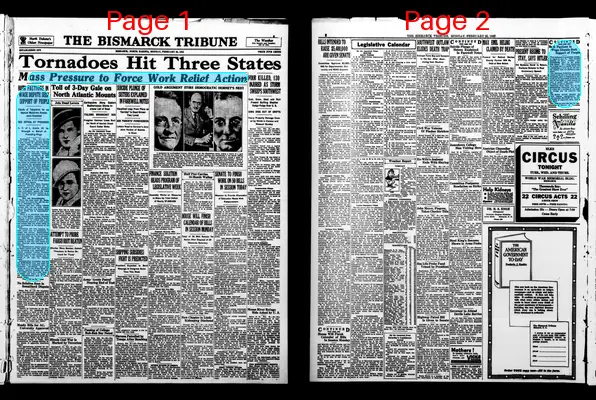
The Bismarck Tribune
Bismarck, Mandan, Burleigh County, Morton County, North Dakota
What is this article about?
In Washington on Feb. 25, political battle intensifies over McCarran amendment mandating prevailing wages on public works relief bill, opposed by President Roosevelt; Senate vote 44-43 sends bill back to committee amid expected public pressure campaigns from both sides, including A.F. of L. support for higher wages.
Merged-components note: Continuation of the story 'Pressure to Force Work Relief Action' from page 1 to page 2. Original label on page 1 was 'story'; merged under 'domestic_news' as it fits political and economic news.
Clippings
1 of 2
OCR Quality
Full Text
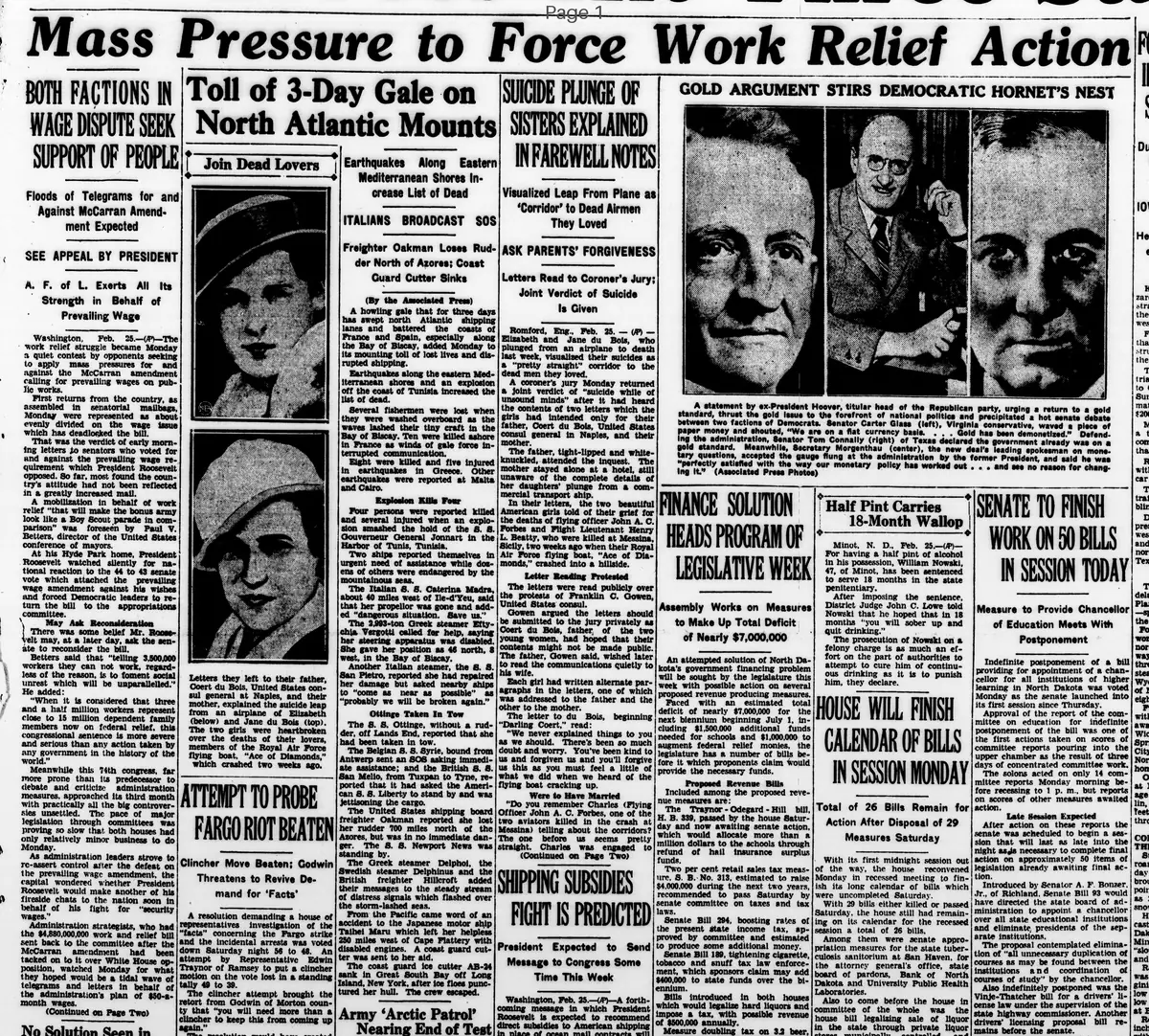
BOTH FACTIONS IN WAGE DISPUTE SEEK SUPPORT OF PEOPLE
Floods of Telegrams for and Against McCarran Amendment Expected
SEE APPEAL BY PRESIDENT
A. F. of L. Exerts All Its Strength in Behalf of Prevailing Wage
Washington, Feb. 25.-(AP)--The work relief struggle became Monday a quiet contest by opponents seeking to apply mass pressures for and against the McCarran amendment calling for prevailing wages on public works.
First returns from the country, as assembled in senatorial mailbags, Monday were represented as about evenly divided on the wage issue which has deadlocked the bill.
That was the verdict of early morning letters to senators who voted for and against the prevailing wage requirement which President Roosevelt opposed. So far, most found the country's attitude had not been reflected in a greatly increased mail,
A mobilization in behalf of work relief "that will make the bonus army look like a Boy Scout parade in comparison" was foreseen by Paul V. Betters, director of the United States conference of mayors.
At his Hyde Park home, President Roosevelt watched silently for national reaction to the 44 to 43 senate vote which attached the prevailing wage amendment against his wishes and forced Democratic leaders to return the bill to the appropriations committee.
May Ask Reconsideration
There was some belief Mr. Roosevelt may, at a later day, ask the senate to reconsider the bill.
Betters said that "telling 3,500,000 workers they can not work, regardless of the reason, is to foment social unrest which will be unparallelled."
He added:
"When it is considered that three and a half million workers represent close to 15 million dependent family members now on federal relief. this congressional sentence is more severe and serious than any action taken by any government in the history of the world."
Meanwhile this 74th congress, far more prone than its predecessor to debate and criticize administration measures, approached its third month with practically all the big controversies unsettled. The pace of major legislation through committees was proving so slow that both houses had only relatively minor business to do Monday.
As administration leaders strove to re-assert control after the defeat on the prevailing wage amendment, the capital wondered whether President Roosevelt would make another of his fireside chats to the nation soon in behalf of his fight for "security wages."
Administration strategists, who had the $4,880,000,000 work and relief bill sent back to the committee after the McCarran amendment had been tacked on to it over White House opposition, watched Monday for what they hoped would be a tidal wave of telegrams and letters in behalf of the administration's plan of $50-a-month wages.
(Continued on Page Two)
CONTINUE from page one
Both Factions in Wage Dispute Seek Support of People
They indicated these protests already had begun to come in. They counted especially on states, counties and municipalities eager to get public works money. Their plan apparently was to keep the huge public works bill in committee a while to let the protests register with the McCarran supporters.
The American Federation of Labor, a leader in the drive for the McCarran amendment, gave no indication of any change in its announced intention to exert all the might it could muster in behalf of public works wages equaling those of private industry.
Chairman Glass (Dem., Va.) of the appropriations committee had yet to set a date for a meeting on the relief bill, though one was expected this week.
The senate tackled Monday its second regular appropriation bill, which provides $98,000,000 for the departments of commerce, state, justice and labor.
The house set aside the day for consideration of District of Columbia measures.
What sub-type of article is it?
What keywords are associated?
What entities or persons were involved?
Where did it happen?
Domestic News Details
Primary Location
Washington
Event Date
Feb. 25
Key Persons
Outcome
senate vote 44 to 43 attached mccarran amendment for prevailing wages against president's wishes; bill returned to appropriations committee; expected floods of telegrams for and against; a.f. of l. exerting strength for prevailing wage
Event Details
Opponents and supporters of McCarran amendment apply mass pressures via telegrams and letters; early mail to senators evenly divided; President Roosevelt opposed prevailing wage requirement; mobilization by mayors foreseen; administration hopes for protests from states, counties, municipalities for $50-a-month wages; A.F. of L. pushes for wages equaling private industry; 74th Congress slow on major legislation