Thank you for visiting SNEWPapers!
Sign up free
Editorial
November 12, 1888
Los Angeles Daily Herald
Los Angeles, Los Angeles County, California
What is this article about?
An editorial defends Los Angeles' climate against criticism from the Boston Globe, arguing it is healthier and more equable than Boston's, especially for respiratory diseases, citing temperature ranges, humidity, and mild winters that attract invalids seeking recovery.
Clipping
OCR Quality
95%
Excellent
Full Text
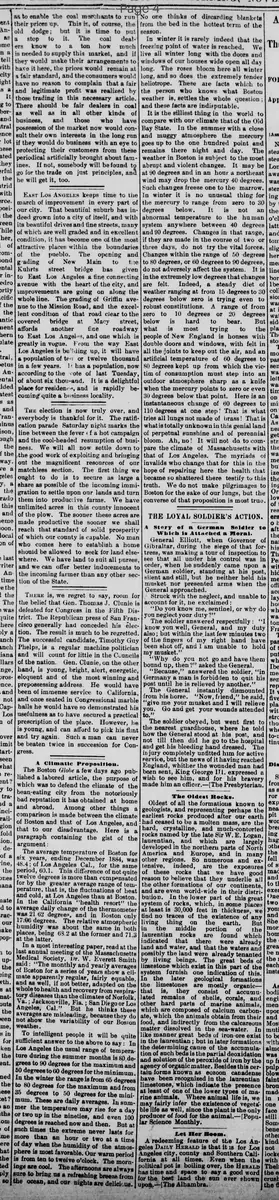
The Boston Globe a few days ago published a labored article, the purpose of which was to defend the climate of the bean-eating city from the notoriously bad reputation it has obtained at home and abroad. Among other things a comparison is made between the climate of Boston and that of Los Angeles, and that to our disadvantage. Here is a paragraph containing the gist of the argument:
The average temperature of Boston for six years, ending December 1884, was 48.4; of Los Angeles Cal., for the same period, 60.1. This difference of not quite twelve degrees is more than compensated for by the greater average range of temperature, that is, the fluctuations of heat and cold, at Los Angeles than at Boston. In the California "health resort" the average daily change of the thermometer was 21.62 degrees, and in Boston only 17.06 degrees. The relative atmospheric humidity was about the same in both places, being 63.2 at the former and 71.3 at the latter.
In a most interesting paper, read at the last annual meeting of the Massachusetts Medical Society, Dr. W. Everett Smith said: "The monthly and yearly averages of Boston for a series of years show a climate apparently regular, fairly equable, and as well, if not better, adapted on the whole to health and recovery from respiratory diseases than the climates of Norfolk, Va.; Jacksonville, Fla.; San Diego or Los Angeles, Cal." But he thinks these averages are misleading, because they do not show the variability of our Boston weather.
To intelligent people it will be quite sufficient answer to the above to say: In Los Angeles the usual range of temperature during the summer months is 80 degrees to 90 degrees for the maximum and 50 degrees to 60 degrees for the minimum. In the winter the range is from 65 degrees to 80 degrees for the maximum and from 35 degrees to 50 degrees for the minimum. These are daily averages. In summer the temperature may rise for a day or two up in the nineties, and even 100 degrees is reached now and then. But at such times the extreme never lasts for more than an hour or two at a time of day when the humidity of the atmosphere is most favorable. Our warm period is from ten to twelve o'clock. The mornings are cool. The afternoons are always sure to bring us a refreshing breeze from the ocean, and our nights are delicious.
No one thinks of discarding blankets from the bed in the hottest term of the season.
In winter it is rarely indeed that the freezing point of water is reached. We live all winter long with the doors and windows of our houses wide open all day long. The roses bloom here all winter long, and so does the extremely tender heliotrope. These are facts which to the person who knows what Boston weather is, settles the whole question; and these facts are indisputable.
It is the silliest thing in the world to compare with our climate that of the Old Bay State. In the summer with a close and muggy atmosphere the mercury goes up to the one hundred point and remains there night and day. The weather in Boston is subject to the most abrupt and violent changes. It may be at 90 degrees and in an hour a northeast wind may drop the mercury 40 degrees. Such changes freeze one to the marrow. In winter it is no unusual thing for the mercury to range from zero to 30 degrees below. It is not an abnormal temperature to the human system anywhere between 40 degrees and 90 degrees. Changes in that range, if they are made in the course of two or three days, do not try the vital forces. Changes within the range of 50 degrees to 80 degrees, or 60 degrees to 90 degrees, do not adversely affect the system. It is in the extremely low degrees that changes are felt. Indeed, a steady diet of weather ranging at from 15 degrees to 30 degrees below zero is trying even to robust constitutions. A range of from zero to 10 degrees or 20 degrees below is hard to bear. But what is most trying to the people of New England is houses with double doors and windows, with felt in all the joints to keep out the air, and an artificial temperature of 60 degrees to 70 degrees kept up from which the victim of consumption must step into an outdoor atmosphere sharp as a knife when the mercury points to zero or even 30 degrees below that point. Here is an instantaneous change of 60 degrees to 100 degrees at one step! That is what tries all lungs not made of brass! That is what is totally unknown in this genial land of perpetual sunshine and of perennial bloom. Ah, no! It will not do to compare the climate of Massachusetts with that of Los Angeles. The myriads of invalids who change that for this in the hope of repairing here the health that became so shattered there testify to this truth. We do not make pilgrimages to Boston for the sake of our lungs, but the converse of that proposition is most true.
The average temperature of Boston for six years, ending December 1884, was 48.4; of Los Angeles Cal., for the same period, 60.1. This difference of not quite twelve degrees is more than compensated for by the greater average range of temperature, that is, the fluctuations of heat and cold, at Los Angeles than at Boston. In the California "health resort" the average daily change of the thermometer was 21.62 degrees, and in Boston only 17.06 degrees. The relative atmospheric humidity was about the same in both places, being 63.2 at the former and 71.3 at the latter.
In a most interesting paper, read at the last annual meeting of the Massachusetts Medical Society, Dr. W. Everett Smith said: "The monthly and yearly averages of Boston for a series of years show a climate apparently regular, fairly equable, and as well, if not better, adapted on the whole to health and recovery from respiratory diseases than the climates of Norfolk, Va.; Jacksonville, Fla.; San Diego or Los Angeles, Cal." But he thinks these averages are misleading, because they do not show the variability of our Boston weather.
To intelligent people it will be quite sufficient answer to the above to say: In Los Angeles the usual range of temperature during the summer months is 80 degrees to 90 degrees for the maximum and 50 degrees to 60 degrees for the minimum. In the winter the range is from 65 degrees to 80 degrees for the maximum and from 35 degrees to 50 degrees for the minimum. These are daily averages. In summer the temperature may rise for a day or two up in the nineties, and even 100 degrees is reached now and then. But at such times the extreme never lasts for more than an hour or two at a time of day when the humidity of the atmosphere is most favorable. Our warm period is from ten to twelve o'clock. The mornings are cool. The afternoons are always sure to bring us a refreshing breeze from the ocean, and our nights are delicious.
No one thinks of discarding blankets from the bed in the hottest term of the season.
In winter it is rarely indeed that the freezing point of water is reached. We live all winter long with the doors and windows of our houses wide open all day long. The roses bloom here all winter long, and so does the extremely tender heliotrope. These are facts which to the person who knows what Boston weather is, settles the whole question; and these facts are indisputable.
It is the silliest thing in the world to compare with our climate that of the Old Bay State. In the summer with a close and muggy atmosphere the mercury goes up to the one hundred point and remains there night and day. The weather in Boston is subject to the most abrupt and violent changes. It may be at 90 degrees and in an hour a northeast wind may drop the mercury 40 degrees. Such changes freeze one to the marrow. In winter it is no unusual thing for the mercury to range from zero to 30 degrees below. It is not an abnormal temperature to the human system anywhere between 40 degrees and 90 degrees. Changes in that range, if they are made in the course of two or three days, do not try the vital forces. Changes within the range of 50 degrees to 80 degrees, or 60 degrees to 90 degrees, do not adversely affect the system. It is in the extremely low degrees that changes are felt. Indeed, a steady diet of weather ranging at from 15 degrees to 30 degrees below zero is trying even to robust constitutions. A range of from zero to 10 degrees or 20 degrees below is hard to bear. But what is most trying to the people of New England is houses with double doors and windows, with felt in all the joints to keep out the air, and an artificial temperature of 60 degrees to 70 degrees kept up from which the victim of consumption must step into an outdoor atmosphere sharp as a knife when the mercury points to zero or even 30 degrees below that point. Here is an instantaneous change of 60 degrees to 100 degrees at one step! That is what tries all lungs not made of brass! That is what is totally unknown in this genial land of perpetual sunshine and of perennial bloom. Ah, no! It will not do to compare the climate of Massachusetts with that of Los Angeles. The myriads of invalids who change that for this in the hope of repairing here the health that became so shattered there testify to this truth. We do not make pilgrimages to Boston for the sake of our lungs, but the converse of that proposition is most true.
What sub-type of article is it?
Science Or Medicine
What keywords are associated?
Los Angeles Climate
Boston Weather
Health Resort
Temperature Comparison
Respiratory Diseases
Climate Variability
What entities or persons were involved?
Boston Globe
Dr. W. Everett Smith
Massachusetts Medical Society
Los Angeles
Boston
Editorial Details
Primary Topic
Defense Of Los Angeles Climate Superiority Over Boston For Health
Stance / Tone
Strongly Pro Los Angeles Climate, Critical Of Boston Weather Variability
Key Figures
Boston Globe
Dr. W. Everett Smith
Massachusetts Medical Society
Los Angeles
Boston
Key Arguments
Boston's Climate Averages Are Misleading Due To High Variability
Los Angeles Has Milder Daily Temperature Ranges And Lower Extremes
Winter In Los Angeles Rarely Freezes, Allowing Open Windows And Blooming Flowers
Boston Experiences Violent Temperature Swings And Severe Cold, Harmful To Health
Invalids Migrate From Massachusetts To Los Angeles For Recovery