Thank you for visiting SNEWPapers!
Sign up free
Gilpin Observer
Central City, Gilpin County, Colorado
What is this article about?
Court martial convened in Denver on October 19 to try Colorado National Guard General John Chase on charges of perjury and disobedience of orders filed by Adjutant General Sherman Bell, related to the release of prisoner W. F. Davis from Cripple Creek. Objections to a member overruled; Chase pleads not guilty.
Clipping
OCR Quality
Full Text
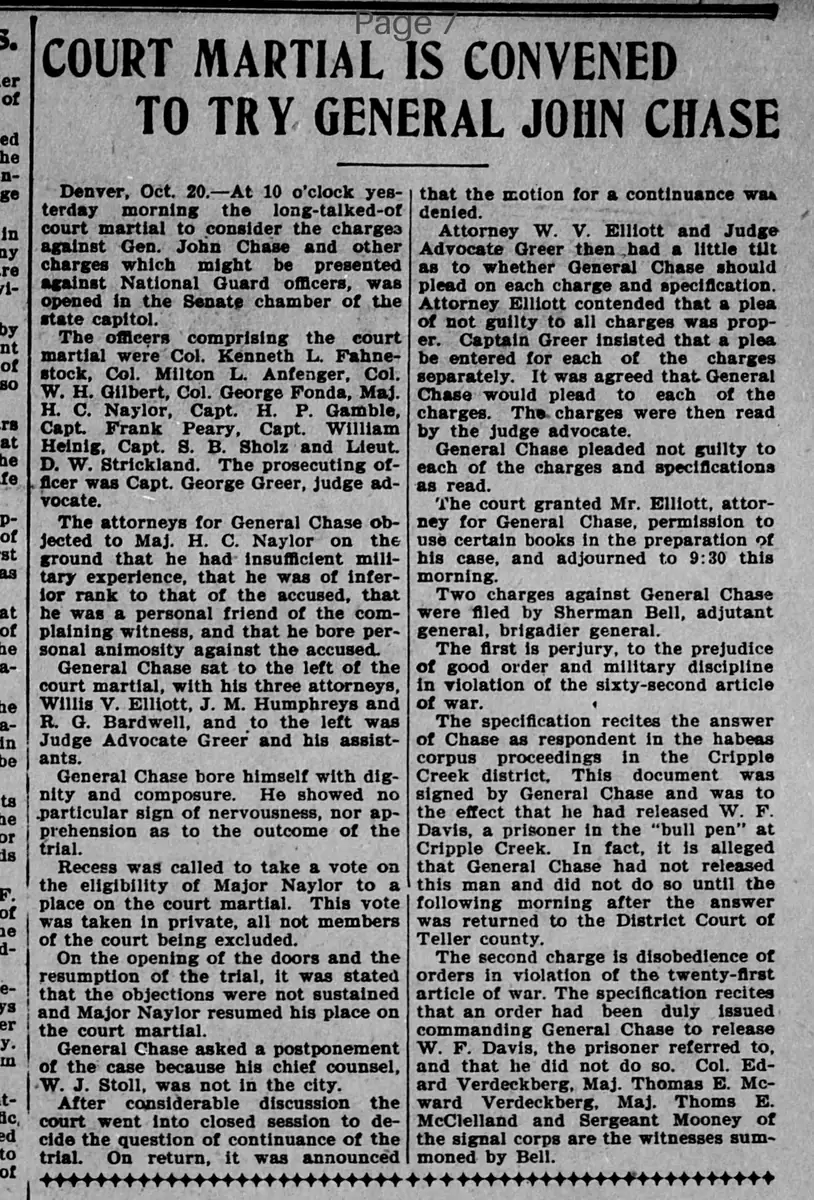
TO TRY GENERAL JOHN CHASE
Denver, Oct. 20.-At 10 o'clock yesterday morning the long-talked-of court martial to consider the charges against Gen. John Chase and other charges which might be presented against National Guard officers, was opened in the Senate chamber of the state capitol.
The officers comprising the court martial were Col. Kenneth L. Fahnenstock, Col. Milton L. Anfenger, Col. W. H. Gilbert, Col. George Fonda, Maj. H. C. Naylor, Capt. H. P. Gamble, Capt. Frank Peary, Capt. William Heinig, Capt. S. B. Sholz and Lieut. D. W. Strickland. The prosecuting officer was Capt. George Greer, judge advocate.
The attorneys for General Chase objected to Maj. H. C. Naylor on the ground that he had insufficient military experience, that he was of inferior rank to that of the accused, that he was a personal friend of the complaining witness, and that he bore personal animosity against the accused.
General Chase sat to the left of the court martial, with his three attorneys, Willis V. Elliott, J. M. Humphreys and R. G. Bardwell, and to the left was Judge Advocate Greer and his assistants.
General Chase bore himself with dignity and composure. He showed no particular sign of nervousness, nor apprehension as to the outcome of the trial.
Recess was called to take a vote on the eligibility of Major Naylor to a place on the court martial. This vote was taken in private, all not members of the court being excluded.
On the opening of the doors and the resumption of the trial, it was stated that the objections were not sustained and Major Naylor resumed his place on the court martial.
General Chase asked a postponement of the case because his chief counsel, W. J. Stoll, was not in the city.
After considerable discussion the court went into closed session to decide the question of continuance of the trial. On return, it was announced that the motion for a continuance was denied.
Attorney W. V. Elliott and Judge Advocate Greer then had a little tilt as to whether General Chase should plead on each charge and specification.
Attorney Elliott contended that a plea of not guilty to all charges was proper. Captain Greer insisted that a plea be entered for each of the charges separately. It was agreed that General Chase would plead to each of the charges. The charges were then read by the judge advocate.
General Chase pleaded not guilty to each of the charges and specifications as read.
The court granted Mr. Elliott, attorney for General Chase, permission to use certain books in the preparation of his case, and adjourned to 9:30 this morning.
Two charges against General Chase were filed by Sherman Bell, adjutant general, brigadier general.
The first is perjury, to the prejudice of good order and military discipline in violation of the sixty-second article of war.
The specification recites the answer of Chase as respondent in the habeas corpus proceedings in the Cripple Creek district. This document was signed by General Chase and was to the effect that he had released W. F. Davis, a prisoner in the "bull pen" at Cripple Creek. In fact, it is alleged that General Chase had not released this man and did not do so until the following morning after the answer was returned to the District Court of Teller county.
The second charge is disobedience of orders in violation of the twenty-first article of war. The specification recites that an order had been duly issued commanding General Chase to release W. F. Davis, the prisoner referred to, and that he did not do so. Col. Edward Verdeckberg, Maj. Thomas E. McClelland and Sergeant Mooney of the signal corps are the witnesses summoned by Bell.
What sub-type of article is it?
What themes does it cover?
What keywords are associated?
What entities or persons were involved?
Where did it happen?
Story Details
Key Persons
Location
Denver, Colorado; Cripple Creek District
Event Date
October 19
Story Details
Court martial opens in Denver's state capitol to try General John Chase on charges of perjury and disobedience of orders filed by Sherman Bell regarding the delayed release of prisoner W. F. Davis from Cripple Creek's bull pen. Objections to Major Naylor overruled; continuance denied; Chase pleads not guilty to each charge.