Thank you for visiting SNEWPapers!
Sign up free
The Key West Citizen
Key West, Monroe County, Florida
What is this article about?
Effective October 1, 1958, military dependents living with sponsors must obtain special permits for civilian medical care under the revised Dependents Medical Care Program due to congressional budget limits for fiscal year 1959. Treatment is prioritized at military facilities when available; certain services like maternity and elective surgery are restricted without permits.
Clipping
OCR Quality
Full Text
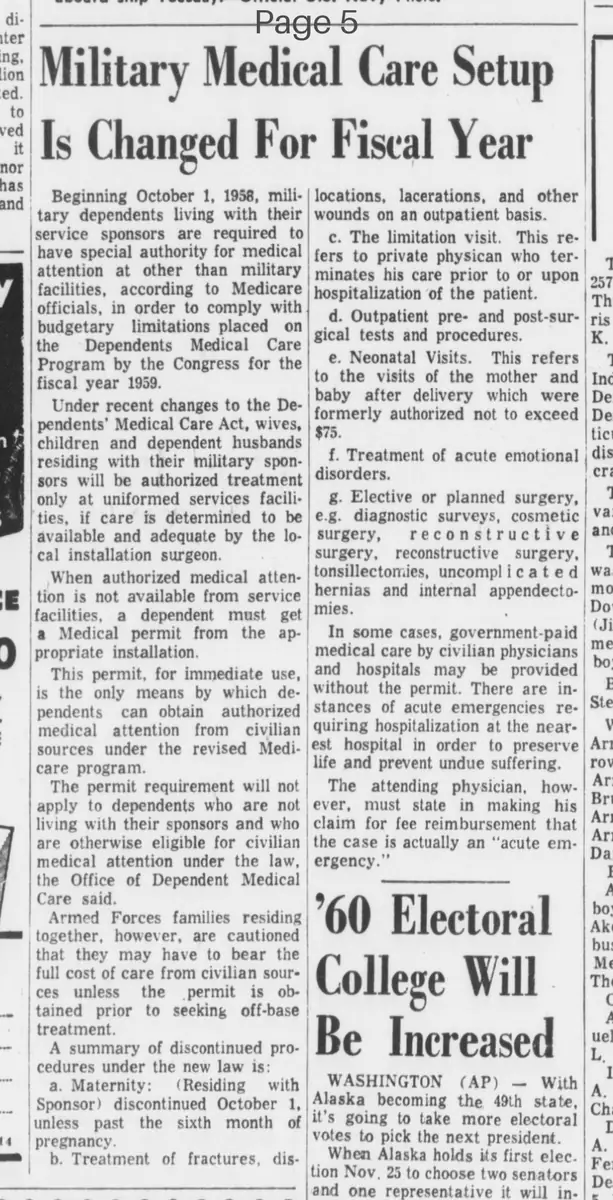
Beginning October 1, 1958, military dependents living with their service sponsors are required to have special authority for medical attention at other than military facilities, according to Medicare officials. In order to comply with budgetary limitations placed on the Dependents Medical Care Program by the Congress for the fiscal year 1959.
Under recent changes to the Dependents' Medical Care Act, wives, children and dependent husbands residing with their military sponsors will be authorized treatment only at uniformed services facilities, if care is determined to be available and adequate by the local installation surgeon.
When authorized medical attention is not available from service facilities, a dependent must get a Medical permit from the appropriate installation. This permit, for immediate use, is the only means by which dependents can obtain authorized medical attention from civilian sources under the revised Medicare program.
The permit requirement will not apply to dependents who are not living with their sponsors and who are otherwise eligible for civilian medical attention under the law, the Office of Dependent Medical Care said.
Armed Forces families residing together, however, are cautioned that they may have to bear the full cost of care from civilian sources unless the permit is obtained prior to seeking off-base treatment.
a. Maternity (Residing with Sponsor) discontinued October 1 unless past the sixth month of pregnancy.
b. Treatment of fractures, dislocations, lacerations, and other wounds on an outpatient basis.
c. The limitation visit. This refers to private physician who terminates his care prior to or upon hospitalization of the patient.
d. Outpatient pre- and post-surgical tests and procedures.
e. Neonatal Visits. This refers to the visits of the mother and baby after delivery which were formerly authorized not to exceed $75.
f. Treatment of acute emotional disorders.
g. Elective or planned surgery, e.g. diagnostic surveys, cosmetic surgery, reconstructive surgery, tonsillectomies, uncomplicated hernias and internal appendectomies.
In some cases, government-paid medical care by civilian physicians and hospitals may be provided without the permit. There are instances of acute emergencies requiring hospitalization at the nearest hospital in order to preserve life and prevent undue suffering. The attending physician, however, must state in making his claim for fee reimbursement that the case is actually an "acute emergency."
What sub-type of article is it?
What keywords are associated?
Where did it happen?
Story Details
Location
Military Facilities
Event Date
October 1, 1958
Story Details
Changes to the Dependents Medical Care Act require military dependents residing with sponsors to obtain medical permits for civilian care due to budget limits; prioritizes uniformed services facilities; lists restricted services like maternity and elective surgery; exceptions for emergencies.