Thank you for visiting SNEWPapers!
Sign up free
Story
December 26, 1886
Savannah Morning News
Savannah, Chatham County, Georgia
What is this article about?
A prospector discovers what is believed to be the lost Jesuit mine in Ventura County, California, hidden since the early 19th century. The site features an old tunnel, smelting remains, and rich ore including gold and silver, potentially a major find.
Clipping
OCR Quality
95%
Excellent
Full Text
DISCOVERY OF LOST MINE.
Rich Finds That Were Operated by the Jesuit Fathers.
From the Ventura (Col.) Free Press
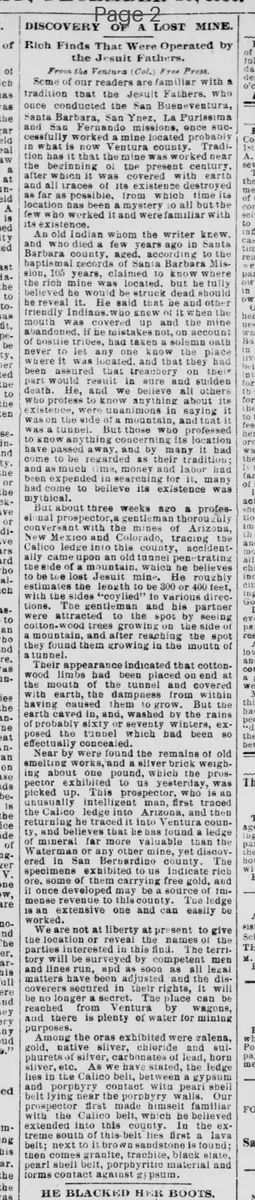
Some of our readers are familiar with a tradition that the Jesuit Fathers, who once conducted the San Buenaventura, Santa Barbara, San Ynez, La Purissima and San Fernando missions, once successfully worked a mine located probably in what is now Ventura county. Tradition has it that the mine was worked near the beginning of the present century, after which it was covered with earth and all traces of its existence destroyed as far as possible, from which time its location has been a mystery to all but the few who worked it and were familiar with its existence.
An old Indian whom the writer knew and who died a few years ago in Santa Barbara county, aged, according to the baptismal records of Santa Barbara Mission, 105 years, claimed to know where the rich mine was located, but he fully believed he would be struck dead should he reveal it. He said that he and other friendly Indians, who knew of it when the mouth was covered up and the mine abandoned, if he mistakes not, on account of hostile tribes, had taken a solemn oath never to let any one know the place where it was located, and that they had been assured that treachery on their part would result in sure and sudden death. He, and we believe all others who profess to know anything about its existence, were unanimous in saying it was on the side of a mountain, and that it was a tunnel. But those who professed to know anything concerning its location have passed away, and by many it had come to be regarded as their tradition; and as much time, money and labor had been expended in searching for it, many had come to believe its existence was mythical.
But about three weeks ago a professional prospector, a gentleman thoroughly conversant with the mines of Arizona, New Mexico and Colorado, tracing the Calico ledge into this county, accidentally came upon an old tunnel penetrating the side of a mountain, which he believes to be the lost Jesuit mine. He roughly estimates the length to be 300 or 400 feet, with the sides "caved" in various directions. The gentleman and his partner were attracted to the spot by seeing cotton-wood trees growing on the side of a mountain, and after reaching the spot they found them growing in the mouth of a tunnel.
Their appearance indicated that cottonwood limbs had been placed on end at the mouth of the tunnel and covered with earth, the dampness from within having caused them to grow. But the earth caved in, and, washed by the rains of probably sixty or seventy winters, exposed the tunnel which had been so effectually concealed. Near by were found the remains of old smelting works, and a silver brick weighing about one pound, which the prospector exhibited to us yesterday, was picked up. This prospector, who is an unusually intelligent man, first traced the Calico ledge into Arizona, and then returning he traced it into Ventura county, and believes that he has found a ledge of mineral far more valuable than the Waterman or any other mine yet discovered in San Bernardino county. The specimens exhibited to us indicate rich ore, some of them carrying free gold, and it once developed may be a source of immense revenue to this county. The ledge is an extensive one and can easily be worked.
We are not at liberty at present to give the location or reveal the names of the parties interested in this find. The territory will be surveyed by competent men and lines run, and as soon as all legal matters have been adjusted and the discoverers secured in their rights, it will be no longer a secret. The place can be reached from Ventura by wagons, and there is plenty of water for mining purposes.
Among the ores exhibited were galena, gold, native silver, chloride and sulphurets of silver, carbonates of lead, horn silver, etc. As we have stated, the ledge lies in the Calico belt, between a gypsum and porphyry contact with pearl shell belt lying near the porphyry walls. Our prospector first made himself familiar with the Calico belt, which he believed extended into this county. In the extreme south of this belt lies first a lava belt; next to it brown sandstone is found; then comes granite, trachite, black slate, pearl shell belt, porphyritic material and forms contact against gypsum.
Rich Finds That Were Operated by the Jesuit Fathers.
From the Ventura (Col.) Free Press
Some of our readers are familiar with a tradition that the Jesuit Fathers, who once conducted the San Buenaventura, Santa Barbara, San Ynez, La Purissima and San Fernando missions, once successfully worked a mine located probably in what is now Ventura county. Tradition has it that the mine was worked near the beginning of the present century, after which it was covered with earth and all traces of its existence destroyed as far as possible, from which time its location has been a mystery to all but the few who worked it and were familiar with its existence.
An old Indian whom the writer knew and who died a few years ago in Santa Barbara county, aged, according to the baptismal records of Santa Barbara Mission, 105 years, claimed to know where the rich mine was located, but he fully believed he would be struck dead should he reveal it. He said that he and other friendly Indians, who knew of it when the mouth was covered up and the mine abandoned, if he mistakes not, on account of hostile tribes, had taken a solemn oath never to let any one know the place where it was located, and that they had been assured that treachery on their part would result in sure and sudden death. He, and we believe all others who profess to know anything about its existence, were unanimous in saying it was on the side of a mountain, and that it was a tunnel. But those who professed to know anything concerning its location have passed away, and by many it had come to be regarded as their tradition; and as much time, money and labor had been expended in searching for it, many had come to believe its existence was mythical.
But about three weeks ago a professional prospector, a gentleman thoroughly conversant with the mines of Arizona, New Mexico and Colorado, tracing the Calico ledge into this county, accidentally came upon an old tunnel penetrating the side of a mountain, which he believes to be the lost Jesuit mine. He roughly estimates the length to be 300 or 400 feet, with the sides "caved" in various directions. The gentleman and his partner were attracted to the spot by seeing cotton-wood trees growing on the side of a mountain, and after reaching the spot they found them growing in the mouth of a tunnel.
Their appearance indicated that cottonwood limbs had been placed on end at the mouth of the tunnel and covered with earth, the dampness from within having caused them to grow. But the earth caved in, and, washed by the rains of probably sixty or seventy winters, exposed the tunnel which had been so effectually concealed. Near by were found the remains of old smelting works, and a silver brick weighing about one pound, which the prospector exhibited to us yesterday, was picked up. This prospector, who is an unusually intelligent man, first traced the Calico ledge into Arizona, and then returning he traced it into Ventura county, and believes that he has found a ledge of mineral far more valuable than the Waterman or any other mine yet discovered in San Bernardino county. The specimens exhibited to us indicate rich ore, some of them carrying free gold, and it once developed may be a source of immense revenue to this county. The ledge is an extensive one and can easily be worked.
We are not at liberty at present to give the location or reveal the names of the parties interested in this find. The territory will be surveyed by competent men and lines run, and as soon as all legal matters have been adjusted and the discoverers secured in their rights, it will be no longer a secret. The place can be reached from Ventura by wagons, and there is plenty of water for mining purposes.
Among the ores exhibited were galena, gold, native silver, chloride and sulphurets of silver, carbonates of lead, horn silver, etc. As we have stated, the ledge lies in the Calico belt, between a gypsum and porphyry contact with pearl shell belt lying near the porphyry walls. Our prospector first made himself familiar with the Calico belt, which he believed extended into this county. In the extreme south of this belt lies first a lava belt; next to it brown sandstone is found; then comes granite, trachite, black slate, pearl shell belt, porphyritic material and forms contact against gypsum.
What sub-type of article is it?
Historical Event
Curiosity
Extraordinary Event
What themes does it cover?
Exploration
Triumph
Fortune Reversal
What keywords are associated?
Lost Mine
Jesuit Fathers
Ventura County
Calico Ledge
Prospector Discovery
Rich Ore
Silver Brick
What entities or persons were involved?
Jesuit Fathers
Old Indian
Professional Prospector
Where did it happen?
Ventura County
Story Details
Key Persons
Jesuit Fathers
Old Indian
Professional Prospector
Location
Ventura County
Event Date
About Three Weeks Ago
Story Details
Tradition holds that Jesuit Fathers worked a rich mine in Ventura County around the early 19th century before concealing it. An old Indian knew its location but swore secrecy. A prospector tracing the Calico ledge discovers the hidden tunnel, smelting works, and valuable ores including gold and silver.