Thank you for visiting SNEWPapers!
Sign up free
The New Hampshire Gazette
Portsmouth, Rockingham County, New Hampshire
What is this article about?
James Madison's letter to George H. Rose on March 5, 1808, defends the US proclamation of July 2, 1807, against British naval aggressions, including the Chesapeake-Leopard incident, and demands satisfaction before negotiations, citing prior unaddressed violations in US waters.
Merged-components note: This is a single continuous diplomatic document (Madison's letter to Rose) spanning pages 1 and 2, with sequential reading order.
Clippings
1 of 2
OCR Quality
Full Text
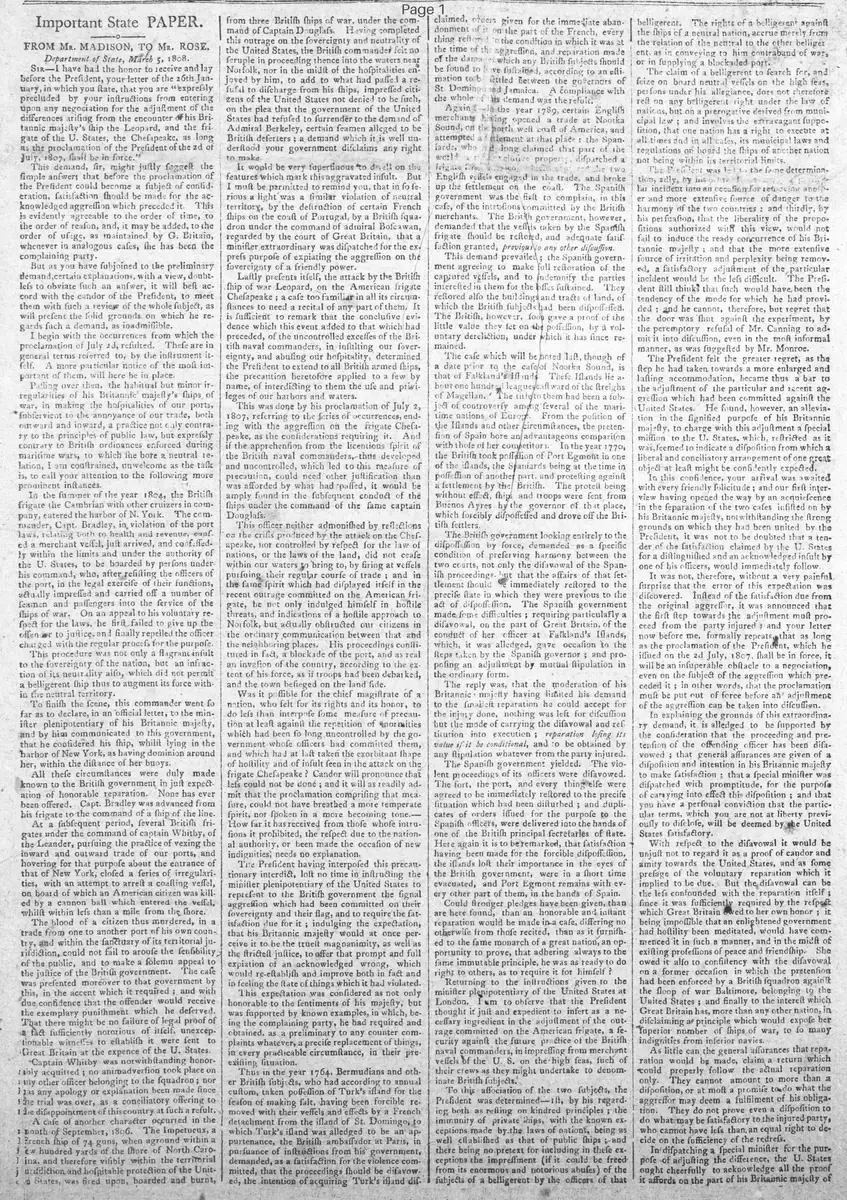
FROM Mr. MADISON. TO MR. ROSE.
Department of State, March 5, 1808.
Sir--I have had the honor to receive and lay before the President, your letter of the 26th January, in which you state, that you are "expressly precluded by your instructions from entering upon any negotiation for the adjustment of the differences arising from the encounter of his Britannic majesty's ship the Leopard, and the frigate of the U. States, the Chesapeake, as long as the proclamation of the President of the 2d of July, 1807, shall be in force."
This demand, sir, might justly object the simple answer; that before the proclamation of the President could become a subject of consideration, satisfaction should be made for the acknowledged aggression which preceded it. This is evidently agreeable to the order of time, to the order of reason, and, it may be added, to the order of usage, as maintained by G. Britain, whenever in analogous cases, she has been the complaining party.
But as you have subjoined to the preliminary demand, certain explanations, with a view, doubtless to obviate such an answer. it will be accord with the candor of the President, to meet them with such a review of the whole subject, as will present the solid grounds on which he regards such a demand, as inadmissible.
I begin with the occurrences from which the proclamation of July 2d, resulted. These are in general terms referred to, by the instrument itself. A more particular notice of the most important of them, will here be in place.
Passing over then, the habitual but minor irregularities of his Britannic majesty's ships of war. in making the hospitalities of our ports, subservient to the annoyance of our trade, both outward and inward, a practice not only contrary to the principles of public law, but expressly contrary to British ordinances enforced during maritime wars, to which she bore a neutral relation, I am constrained, unwelcome as the task is, to call your attention to the following more prominent instances.
In the summer of the year 1804, the British frigate the Cambrian with other cruisers in company, entered the harbor of N. York. The commander, Capt. Bradley, in violation of the port laws, relating both to health and revenue, caused a merchant vessel, just arrived, and consequently within the limits and under the authority of the U. States, to be boarded by persons under his command, who, after resisting the officers of the port, in the legal exercise of their functions, actually impressed and carried off a number of seamen and passengers into the service of the ships of war. On an appeal to his voluntary respect for the laws, he first failed to give up the offender to justice, and finally repelled the officer charged with the regular process for the purpose.
This procedure was not only a flagrant insult to the sovereignty of the nation, but an infraction of its neutrality also, which did not permit a belligerent ship thus to augment its force within the neutral territory.
To finish the scene, this commander went so far as to declare, in an official letter, to the minister plenipotentiary of his Britannic majesty, and by him communicated to this government, that he considered his ship, whilst lying in the harbor of New York, as having dominion around her, within the distance of her buoys.
All these circumstances were duly made known to the British government in just expectation of honorable reparation. None has ever been offered. Capt. Bradley was advanced from his frigate to the command of a ship of the line.
At a subsequent period, several British frigates under the command of captain Whitby, of the Leander, pursuing the practice of vexing the inward and outward trade of our ports, and hovering for that purpose about the entrance of that of New York, closed a series of irregularities, with an attempt to arrest a coasting vessel, on board of which an American citizen was killed by a cannon ball which entered the vessel, whilst within less than a mile from the shore.
The blood of a citizen thus murdered, in a trade from one to another port of his own country, and within the sanctuary of its territorial jurisdiction, could not fail to arouse the sensibility of the public, and to make a solemn appeal to the justice of the British government. The case was presented moreover to that government by this, in the accent which it required ; and with due confidence that the offender would receive the exemplary punishment which he deserved.
That there might be no failure of legal proof of a fact sufficiently notorious of itself, unexceptionable witnesses to establish it were sent to Great Britain at the expense of the U. States.
Captain Whitby was notwithstanding honorably acquitted ; no animadversion took place on any other officer belonging to the squadron; nor has any apology or explanation been made since the trial was over, as a conciliatory offering to the disappointment of this country at such a result.
A case of another character occurred in the month of September, 1806. The Impetueux, a French ship of 74 guns, when aground within a few hundred yards of the Shore of North Carolina, and therefore visibly within the territorial jurisdiction and hospitable protection of the United States, was fired upon, boarded and burnt, from three British ships of war. under the command of Captain Douglas. Having completed this outrage on the sovereignty and neutrality of the United States, the British commander felt no scruple in proceeding thence into the waters near Norfolk, nor in the midst of the hospitalities enjoyed by him. to add to what had passed a refusal to discharge from his ships, impressed citizens of the United States not denied to be such. on the plea that the government of the United States had refused to surrender to the demand of Admiral Berkeley, certain seamen alleged to be British deserters : a demand which it is well understood your government disclaims any right to make.
It would be very superfluous to dwell on the features which mark this aggravated insult. But I must be permitted to remind you, that in so serious a light was a similar violation of neutral territory, by the destruction of certain French ships on the coast of Portugal, by a British squadron under the command of admiral Boscawen, regarded by the court of Great Britain, that a minister extraordinary was dispatched for the express purpose of expiating the aggression on the sovereignty of a friendly power.
Lastly presents itself. the attack by the British ship of war Leopard, on the American frigate Chesapeake ; a case too familiar in all its circumstances to need a recital of any part of them, It is sufficient to remark that the conclusive evidence which this event added to that which had preceded, of the uncontrolled excesses of the British naval commanders, in insulting our sovereignty, and abusing our hospitality, determined the President to extend to all British armed ships, the precaution heretofore applied to a few by name, of interdicting to them the use and privileges of our harbors and waters.
This was done by his proclamation of July 2, 1807, referring to the series of occurrences, ending with the aggression on the frigate Chesapeake, as the considerations requiring it. And if the apprehension from the licentious spirit of the British naval commanders,-thus developed and uncontrolled, which led to this measure of precaution, could need other justification than was afforded by what had passed, it would be amply found in the subsequent conduct of the ships under the command of the same captain Douglas.
This officer neither admonished by reflections on the crisis produced by the attack on the Chesapeake, nor controlled by respect for the law of nations, or the laws of the land, did not cease within our waters to bring to, by firing at vessels pursuing their regular course of trade ; and in the same spirit which had displayed itself in the recent outrage committed on the American frigate, he not only indulged himself in hostile threats, and indications of a hostile approach to Norfolk, but actually obstructed our citizens in the ordinary communication between that and the neighboring places. His proceedings constituted in fact, a blockade of the port, and as real an invasion of the country, according to the extent of his force, as if troops had been debarked, and the town besieged on the land side.
Was it possible for the chief magistrate of a nation, who felt for its rights and its honor, to do less than interpose some measure of precaution at least against the repetition of enormities which had been so long uncontrouled by the government whose officers had committed them, and which had at last taken the exorbitant shape of hostility and of insult even in-the attack on the frigate Chesapeake ? Candor will pronounce that less could not be done ; and it will as readily admit that the proclamation comprising that measure, could not have breathed a more temperate spirit, nor spoken in a more becoming tone.
How far it has received from those whose intrusions it prohibited, the respect due to the national authority, or been made the occasion of new indignities, needs no explanation.
The President having interposed this precautionary interdict, lost no time in instructing the minister plenipotentiary of the United States to represent to the British government the signal aggression which had been committed on their sovereignty and their flag, and to require the satisfaction due for it ; indulging the expectation. that his Britannic majesty would at once perceive it to.be the truest magnanimity, as well as the strictest justice, to offer that prompt and full expiation of an acknowledged wrong, which would re-establish and improve both in fact and in feeling the state of things which it had violated.
This expectation was considered as not only honorable to the sentiments of his majesty, but was supported by known examples, in which, being the complaining party, he had required and obtained. as a preliminary to any counter complaints whatever, a precise replacement of things, in every practicable circumstance, in their pre-existing Situation.
Thus in the year 1764, Bermudians and other British subjects, who had according to annual custom, taken possession of Turk's island for the season of making salt, having been forcibly removed with their vessels and effects by a French detachment from the island of St. Domingo, to which Turk's island was alledged to be an appendage, the British ambassador at Paris, in pursuance of instructions from his government, demanded, as a satisfaction for the violence committed, that the proceedings should be disavowed. the intention of acquiring Turk's island disclaimed, orders given for the immediate abandonment of it on the part of the French, every thing restored to the condition in which it was at the time of the aggression, and reparation made of the damage , which any British subjects should be found to have sustained, according to an estimation to be settled between the governors of St. Domingo and Jamaica. A Compliance with the whole of his demand was the result.
Again -in the year 1789, certain English merchants having opened a trade at Nootka Sound, on the north west coast of America, and attempted a settlement at that place : the Spaniards, who had long claimed that part of the world as their exclusive property, dispatched a frigate lion xigo, &c. to- seize two English vessels engaged in the trade, and broke up the settlement on the coast. The Spanish government was the first to complain, in this case, of the intrusions committed by the British merchants. The British government, however, demanded that the vessels taken by the Spanish frigate should be restored, and adequate satisfaction granted, previous to any other discussion. This demand prevailed: the Spanish government agreeing to make full restoration of the captured vessels, and to indemnify the parties interested in them for the losses sustained. They restored also the buildings and tracts of land, of which the British subjects had been dispossessed. The British, however, soon gave a proof of the little value they set on the possession, by a voluntary dereliction, under which it has since remained.
The case which will be noticed last, though of a date prior to the case of Nootka Sound, is that of Falkland's Islands These Islands lie about one hundred leagues east ward of the straights of Magellan. ' The title to them had been a subject of controversy among several of the maritime nations of Europe. From the position of the Islands and other Circumstances, the pretension of Spain bore an advantageous comparison with those of her competitors. In the year 1770, the British took possession of Port Egmont in one of the islands, the Spaniards being at the time in possession of another part, and protesting against a settlement by the British. The protest being without effect, ship and troops were sent from Buenos Ayres by the governor of that place, which forcibly dispossessed and drove off the British settlers.
The British government looking entirely to the dispossession by force, demanded as a specific condition of preserving harmony between the two courts. not only the disavowal of the Spanish proceedings. but that the affairs of that settlement should be immediately restored to the precise state in which they were previous to the act of dispossession. The Spanish government made some difficulties ; requiring particularly a disavowal, on the part of Great Britain, of the conduct of her officer at Falkland's Islands. which, it was alledged, gave occasion to the steps taken by the Spanish governor ; and proposing an adjustment by mutual stipulation in the ordinary form.
The reply was, that the moderation of his Britannic- majesty having limited his demand to the simplest reparation he could accept for the injury done, nothing was left for discussion but the mode of carrying the disavowal and restitution into execution ; reparation losing its value if it be conditional, and to be obtained by any stipulation whatever from the party injured. The Spanish government yielded. The violent proceedings of its officers were disavowed The fort, the port, and every thing else were agreed to be immediately restored to the precise situation which had been disturbed ; and duplicates of orders issued for the purpose to the Spanish officers, were delivered into the hands of one of the British principal secretaries of state.
Here again it is to be remarked, that satisfaction having been made for the forcible dispossession, the islands lost their importance in the eyes of the British government, were in a short time evacuated, and Port Egmont remains with every other part of them, in the hands of Spain.
Could stronger pledges have been given, than are here found, than an honorable and instant reparation would be made in a case, differing no otherwise from those recited, than as it furnished to the same monarch of a great nation, an opportunity to prove, that adhering always to the same immutable principle, he was as ready to do right to others, as to require it for himself ?
Returning to the instructions given to the minister plenipotentiary of the United States at London, I am to observe that the President thought it just and expedient to insert as a necessary ingredient in the adjustment of the outrage committed on the American frigate, a security against the future practice of the British naval commanders, in impressing from merchant vessels of the U. S. on the high seas, such of their crews as they might undertake to denominate British subjects.'
To this association of the two subjects, the President was determined-it, by his regarding both as resting on kindred principles ; the immunity of private ships, with the known exceptions made by the laws of nations, being as well established as that of public ships ;-and there being no pretext for including in these exceptions the impressment (if it could be freed from its enormous and notorious abuses) of the subjects of a belligerent by the officers of that belligerent. The rights of a belligerent against the ships of a neutral nation.accrue merely from the relation of the neutral to the other belligerent, as in conveying to him contraband of war. or in supplying a blockaded port. *
The claim of a belligerent to search for, and seize on board neutral vessels on the high seas, persons under his allegiance, does not therefore rest on any belligerent right under the law of nations, but on a prerogative derived from municipal law ; and involves the extravagant supposition, that one nation has a right to execute at all times and in all cases. its municipal laws and regulations on board the ships of another nation not being within its territorial limits.
The President was led to the same determination, additionally, by his using the particular incident into an occasion for removing another and more extensive source of danger to the harmony of the two countries : and thirdly, by his persuasion, that the liberality of the propositions authorized with this view, would not fail to induce the ready concurrence of his Britannic majesty : and that the more extensive source of irritation and perplexity being removed. a satisfactory adjustment of the particular incident would be the less difficult. The President still thinks that such would have, been the tendency of the mode for which he had provided ; and he cannot, therefore, but regret that the door was shut against the experiment, by the peremptory refusal of Mr. Canning to admit it into discussion, even in the most informal manner, as was suggested by Mr. Monroe.
The President felt the greater regret, as the step he had taken towards a more enlarged and lasting accommodation, became thus a bar to the adjustment of the particular and recent aggression which had been committed against the United States. He found, however, an alleviation in the signified purpose of his Britannic majesty, to charge with this adjustment a special mission to the U. States. which, restricted as it was, seemed to indicate a disposition from which a liberal and conciliatory arrangement of one great object at least might be confidently expected.
In this confidence, your arrival was awaited with every friendly solicitude; and our first interview having opened the way by an acquiescence in the separation of the two cases insisted on by his Britannic majesty, notwithstanding the strong grounds on which they had been united by the President. it was not to be doubted that a tender of the satisfaction claimed by the U. States for a distinguished and an acknowledged insult by one of his officers, would immediately follow
It was not, therefore, without a very painful surprise that the error of this expectation was discovered. Instead of the satisfaction due from the original aggressor, it was announced that the first step towards the adjustment must proceed from the party injured ; and your letter now before me, formally repeats, that as long as the proclamation of the President, which he issued on the 2d July, 1807. shall be in force, it will be an insuperable obstacle to a negotiation, even on the subject of the aggression which preceded it ; in other words, that the proclamation must be put out of force before an adjustment of the aggression can be taken into discussion.
In explaining the grounds of this extraordinary demand, it is alledged to be supported by the consideration that the proceeding and pretension of the offending officer has been disavowed ; that general assurances are given of a disposition and intention in his Britannic majesty to make satisfaction ; that a special minister was dispatched with promptitude, for the purpose of carrying into effect this disposition : and that you have a personal conviction that the particular terms, which you are not at liberty previously to disclose, will be deemed by the United States satisfactory.
With respect to the disavowal it would be unjust not to regard it as a proof of candor and amity towards the United States, and as some presage of the voluntary' reparation which it implied to be due. But the disavowal can be the less confounded with the reparation itself : since it was sufficiently required by the respect which Great Britain owed to her own honor ; it being impossible that an enlightened government had hostility been meditated, would have commenced it in such a manner, and in the midst of existing professions of peace and friendship. She owed it also to consistency with the disavowal on a former occasion in which the pretension had been enforced by a British squadron against the sloop of war Baltimore, belonging to the United States : and finally to the interest which Great Britain has, more than any other nation, in disclaiming a principle which would expose her superior number of ships of war, to so many indignities from inferior navies.
As little can the general assurances that reparation would be made, claim a return which could properly follow the actual reparation only. They cannot amount to more than a disposition, or at most a promise to do what the aggressor may deem a fulfilment of his obligation. They do not prove even a disposition to do what may be satisfactory to the injured party, who cannot have less than, an equal right to decide on the sufficiency of the redress.
In dispatching a special minister for the purpose of adjusting the difference, the U. States ought cheerfully to acknowledge all the proof it affords on the part of his Britannic majesty of
his pacific views towards them, and of his respect for their friendship. But whilst they could not, under any circumstances, allow to the measure more than a certain participation in an honorable reparation, it is to be recollected that the avowed and primary object of the mission was to substitute for the more extended adjustment proposed by the U. S. at London, a reparation of the subjects as preferred by his Britannic majesty, and you well know, sir, how fully this object was accomplished.
With respect to the personal conviction which you have expressed, that the terms which you decline to disclose would be satisfactory to the U. States, it is incumbent on me to observe that with the highest respect for your judgment and the most perfect confidence in your sincerity, an insuperable objection manifestly lies, to the acceptance of a personal and unexplained opinion, in place of a disclosure which would enable this government to exercise its own judgment in a case affecting so essentially its honor and its rights. Such a course of proceeding would be without example; and there can be no hazard in saying that one will never be afforded by a government which respects itself as much as yours justly does; and therefore can never be reasonably expected from one which respects itself as much as this has a right to do.
I forbear, sir, to enlarge on the intrinsic incongruity of the expedient proposed. But I must be allowed to remark, as an additional admonition of the singular and mortifying perplexity in which a compliance might involve the President, that there are in the letter of Mr. Canning, communicating to Mr. Monroe the special mission to the U. S. pregnant indications that other questions and conditions may have been contemplated which would be found utterly reconcilable with the sentiments of this nation.
If neither any nor all of these considerations can sustain the preliminary demand made in your communication, it remains to be seen whether such a demand rests with greater advantage on the more precise ground on which you finally seem to place it.
The proclamation is considered as a hostile measure, and a discontinuance of it as due to the discontinuance of the aggression which led to it. It has been sufficiently shown that the proclamation, as appears on the face of it, was produced by a train of occurrences terminating in the attack on the American frigate, and not by this last alone. To a demand therefore that the proclamation be revoked, it would be perfectly fair to oppose a demand that redress be first given for the numerous irregularities which preceded the aggression on the American frigate, as well as for this particular aggression, and that effectual control be interposed against repetitions of them. And as no such redress has been given for the past, notwithstanding the lapse of time which has taken place, nor any such security for the future, notwithstanding the undiminished reasonableness of it, it follows, that a continuance of the proclamation would be consistent with an entire discontinuance of one only of the occurrences from which it proceeded.
But it is not necessary to avail the argument of this view of the case, although of itself entirely conclusive. Had the proclamation been founded on the single aggression committed on the Chesapeake, and were it admitted that the discontinuance of that aggression merely, gave a claim to the discontinuance of the proclamation, the claim would be defeated by the incontestable fact, that that aggression has not been discontinued. It has never ceased to exist; and is in existence at this moment. Need I remind you, sir, that the seizure and transportation of the seamen belonging to the crew of the Chesapeake, entered into the very essence of that aggression, that with an exception of the victim to a trial forbidden by the most solemn considerations, and greatly aggravating the guilt of its author, the seamen in question are still retained, and consequently that the aggression, if in no other respect, is by that act alone continued and in force?
If the views which have been taken of the subject have the justice which they claim, they will have shown that on no ground whatever can an annulment of the proclamation of July 2d, be reasonably required, as a preliminary to the negotiation with which you are charged. On the contrary, it clearly results, from a recurrence to the causes and object of the proclamation, that, as was at first intimated, the strongest sanctions of G. Britain herself, would support the demand that previous to a discussion of the proclamation, due satisfaction should be made to the U. States; that this satisfaction ought to extend to all the wrongs which preceded and produced that act: and that even limiting the merits of the question to the single relation of the proclamation to the wrong committed in the attack on the American frigate, and deciding the question on the principle that a discontinuance of the latter required of right a discontinuance of the former, nothing appears that does not leave such a preliminary destitute of every foundation which could be assumed for it.
With a right to draw this conclusion, the President might have instructed me to close this communication, with the reply stated in the beginning of it; and perhaps in taking this course, he would only have consulted a sensibility, to which most governments would, in such a case, have yielded. But adhering to the moderation by which he has been invariably guided, and anxious to rescue the two nations from the circumstances, under which an abortive issue to your mission, necessarily places them, he has authorized me, in the event of your disclosing the terms of reparation, which you believe will be satisfactory, and on its appearing that they are so, to consider this evidence of the justice of his Britannic majesty as a pledge for an effectual interposition with respect to all the abuses against a recurrence of which the proclamation was meant to provide, and to proceed to concert with you, a revocation of that act, bearing the same date with the act of reparation to which the U. States are entitled.
I am not unaware, sir, that according to the view which you appear to have taken of your instructions, such a course of proceeding has not been contemplated by them. It is possible nevertheless, that a re-examination, in the spirit in which I am well persuaded it will be made, may discover them to be not inflexible to a proposition, in so high a degree, liberal and conciliatory. In every event the President will have manifested his willingness to meet your government on a ground of accommodation, which pares to its feelings, however misapplied he may deem them, every concession not essentially due to those which must be equally respected: and consequently will have demonstrated that the very ineligible posture given to so important a subject in the relations of the two countries, by the unsuccessful termination, of your mission, can be referred to no other source, than the rigorous restrictions under which it was to be executed.
I make no apology, sir, for the long interval between the date of your letter and that under which I write. It is rendered unnecessary by your knowledge of the circumstances to which the delay is to be ascribed.
With high consideration and respect,
I have the honor to be, Sir,
Your most obedient servant,
(Signed) JAMES MADISON.
George H. Rose, Esq.
His Britannic majesty's minister, &c.
What sub-type of article is it?
What keywords are associated?
What entities or persons were involved?
Where did it happen?
Foreign News Details
Primary Location
United States
Event Date
March 5, 1808
Key Persons
Outcome
no reparation offered for prior incidents; british officers advanced or acquitted; chesapeake seamen still retained; proposal for concurrent revocation of proclamation and reparation.
Event Details
Madison's letter reviews British naval violations in US waters from 1804-1807, including impressments in New York, killing of a citizen, destruction of French ship off North Carolina, and Leopard's attack on Chesapeake, justifying the July 1807 proclamation barring British ships; demands satisfaction before negotiations, citing British precedents; proposes conditional revocation upon satisfactory terms.