Thank you for visiting SNEWPapers!
Sign up free
The Key West Citizen
Key West, Monroe County, Florida
What is this article about?
Article details U.S. Coast Guard's Search and Rescue operations along Atlantic and Gulf coasts, highlighting the rescue of 17 survivors from a Belgian plane crash in Newfoundland's forest using helicopters and planes. Covers July 1946 stats: 1,178 rescued, and organizational structure under Rear Adm. Ed H. 'Iceberg' Smith.
Merged-components note: Merging story segments with embedded image and caption for complete Coast Guard rescue article; resulting label story as dominant content.
Clipping
OCR Quality
Full Text
KEY
WEST
CITIZEN
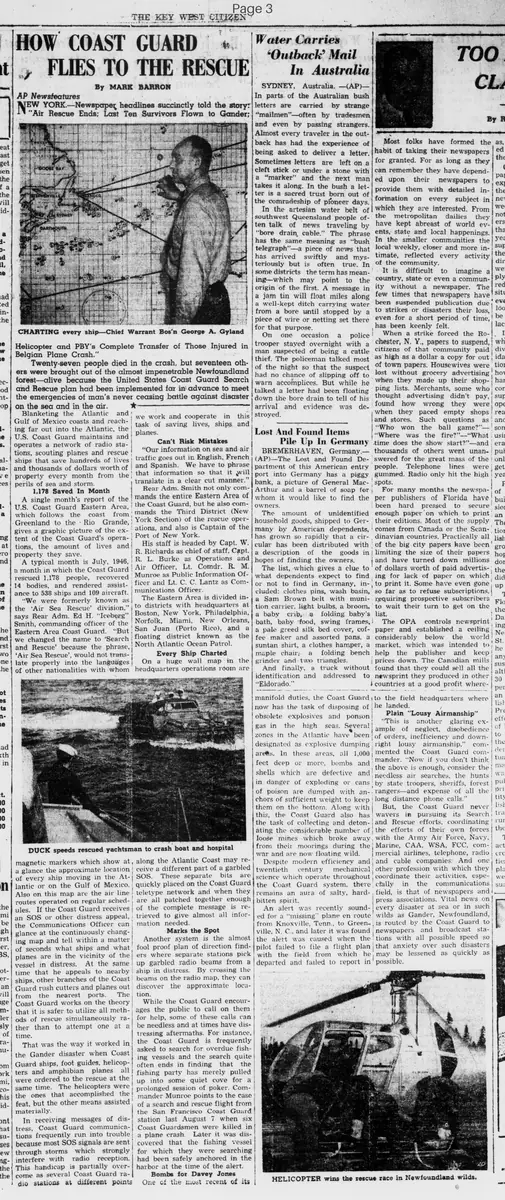
HOW COAST GUARD
FLIES TO THE RESCUE
By MARK BARRON
AP Newsfeatures
NEW YORK.--Newspaper headlines succinctly told the story:
"Air Rescue Ends; Last Ten Survivors Flown to Gander;
Helicopter and PBY's Complete Transfer of Those Injured in
Belgian Plane Crash."
Twenty-seven people died in the crash, but seventeen others
were brought out of the almost impenetrable Newfoundland
forest--alive because the United States Coast Guard Search
and Rescue plan had been implemented far in advance to meet
the emergencies of man's never ceasing battle against disaster
on the sea and in the air.
Blanketing
the
Atlantic
and
Gulf of Mexico coasts and reaching
far out into the Atlantic, the
U.S. Coast Guard maintains and
operates a network of radio stations,
scouting planes and rescue
ships that save hundreds of lives
and thousands of dollars worth of
property every month from the
perils of sea and storm.
1,178 Saved In Month
A single month's report of the
U.S. Coast Guard Eastern Area,
which follows the coast from
Greenland to the Rio Grande,
gives a graphic picture of the extent
of the Coast Guard's operations, the
amount of lives and
property they save.
A typical month is July, 1946,
a month in which the Coast Guard
rescued 1,178 people, recovered
14 bodies, and rendered assistance
to 538 ships and 109 aircraft.
"We were formerly known as
the Air Sea Rescue' division,
says Rear Adm. Ed H. "Iceberg
Smith, commanding officer of the
Eastern Area Coast Guard. "But
we changed the name to Search
and Rescue' because the phrase,
'Air Sea Rescue', would not translate
properly into the languages
of other nationalities with whom
we work and cooperate
in this
task of saving lives, ships, and
planes.
Can't Risk Mistakes
"Our information on sea and air
traffic goes out in English, French
and Spanish. We have to phrase
that information so that it will
translate in a clear cut manner."
Rear Adm. Smith not only commands
the entire Eastern Area of
the Coast Guard, but he also commands
the Third District (New
York Section of the rescue operations,
and also is Captain of the
Port of New York.
His staff is headed by Capt. W.
R. Richards as chief of staff, Capt.
R. L. Burke as Operations and
Air Officer, Lt. Comdr. R. M.
Munroe as Public Information Officer
and Lt. C. C. Lantz as Communications
Officer.
The Eastern Area is divided into
districts with headquarters at
Boston, New York, Philadelphia,
Norfolk, Miami, New
Orleans,
San Juan (Porto Rico), and
a
floating district known as the
North Atlantic Ocean Patrol.
Every Ship Charted
On a huge wall map in the
headquarters operations room are
magnetic markers which show at
a glance the approximate location
of every ship moving in the Atlantic
or on the Gulf of Mexico.
Also on this map are the air line
routes operated on regular schedules.
If the Coast Guard receives
an SOS or other distress appeal,
the Communications Officer can
glance at the continuously changing
map and tell within a matter
of seconds what ships and what
planes are in the vicinity of the
vessel in distress. At the same
time that he appeals to nearby
ships, other branches of the Coast
Guard rush cutters and planes out
from the nearest ports.
The
Coast Guard works on the theory
that it is safer to utilize all methods
of rescue simultaneously rather
than to attempt one at a
time.
That was the way it worked in
the Gander disaster when Coast
Guard ships, foot guides, helicopters
and amphibian planes all
were ordered to the rescue at the
same time. The helicopters were
the ones that accomplished the
feat, but the other means assisted
materially.
In receiving messages of distress,
Coast Guard communications
frequently run into trouble
because most SOS signals are sent
through storms which strongly
interfere with radio reception.
This handicap is partially overcome
as several Coast Guard radio
stations at different points
along the Atlantic Coast may receive
a different part of a garbled
SOS. These separate bits
are
quickly placed on the Coast Guard
teletype network and when they
are all patched together enough
of the complete message is retrieved
to give almost all information
needed.
Marks the Spot
Another system is the almost
fool proof plan of direction finders
where separate stations pick
up garbled radio beams from a
ship in distress.
By crossing the
beams on the radio map, they can
discover the approximate location.
While the Coast Guard encourages
the public to call on them
for help, some of these calls can
be needless and at times have distressing
aftermaths. For instance,
the Coast Guard is frequently
asked to search for overdue fishing
vessels and the search quite
often ends in finding that the
fishing party has merely pulled
up into some quiet cove for a
prolonged session of poker. Commander
Munroe points to the case
of a search and rescue flight from
the San Francisco Coast Guard
station last August 7 when six
Coast Guardsmen were killed in
a plane crash. Later it was discovered
that the fishing vessel
for which they were searching
had been safely anchored in the
harbor at the time of the alert.
Bombs for Davey Jones
One of the most recent of its
HELICOPTER wins the rescue race in Newfoundland wilds.
manifold duties, the Coast Guard
now has the task of disposing of
obsolete explosives and poison
gas in the high seas. Several
zones in the Atlantic have been
designated as explosive dumping
areas. In these areas, all 1,000
feet deep or more, bombs and
shells which are defective and
in danger of exploding or cans
of poison are dumped with anchors
of sufficient weight to keep
them on the bottom. Along with
this, the Coast Guard also has
the task of collecting and detonating
the considerable number of
loose mines which broke away
from their moorings during the
war and are now floating wild
Despite modern efficiency and
twentieth century mechanical
science which operate throughout
the Coast Guard system, there
remains an aura of salty, hard-bitten
spirit.
An alert was recently sounded
for a "missing" plane en route
from Knoxville, Tenn., to Greenville,
N. C., and later it was found
the alert was caused when the
pilot failed to file a flight plan
with the field from which he
departed and failed to report in
to the field headquarters where
he landed.
Plain "Lousy
Airmanship"
"This is another glaring example
of neglect, disobedience
of orders, inefficiency and down-right
lousy airmanship,"
commented
the Coast Guard commander.
"Now if you don't think
the above is enough, consider the
needless air searches, the hunts
by state troopers, sheriffs, forest
rangers--and expense of all the
long distance phone calls."
But, the Coast Guard never
wavers in pursuing its Search
and Rescue efforts, coordinating
the efforts of their own forces
with the Army Air Force, Navy,
Marine, CAA, WSA, FCC, commercial
airlines, telephone, radio
and cable companies: And one
other profession with which they
coordinate their activities, especially
in the communications
field, is that of newspapers and
press associations. Vital news on
every disaster at sea or in such
wilds as Gander, Newfoundland,
is routed by the Coast Guard to
newspapers and broadcast stations
with all possible speed
so
that anxiety over such disasters
may be lessened as
quickly as
possible.
What sub-type of article is it?
What themes does it cover?
What keywords are associated?
What entities or persons were involved?
Where did it happen?
Story Details
Key Persons
Location
Newfoundland Forest, Gander, Atlantic, Gulf Of Mexico, New York
Event Date
July 1946
Story Details
U.S. Coast Guard's Search and Rescue operations rescue 17 survivors from Belgian plane crash in Newfoundland using helicopters and planes, despite 27 deaths. Details Eastern Area stats for July 1946: 1,178 rescued, assistance to ships and aircraft. Describes organizational structure, communication methods, and coordination with other entities.