Thank you for visiting SNEWPapers!
Sign up free
The New Hampshire Gazette And General Advertiser
Portsmouth, Rockingham County, New Hampshire
What is this article about?
Transcript of debates in the Massachusetts Ratifying Convention on Article 1, Section 8 of the U.S. Constitution, focusing on Congress's powers to levy taxes, raise armies, and other authorities. Speakers argue for and against adoption, citing historical examples and risks of abuse.
Merged-components note: This is a continuation of the 'Proceedings of the Massachusetts Convention' story across pages 1 and 2, indicated by '(Continued from our last.)' and the sequential reading order.
Clippings
1 of 2
OCR Quality
Full Text
(Continued from our last.)
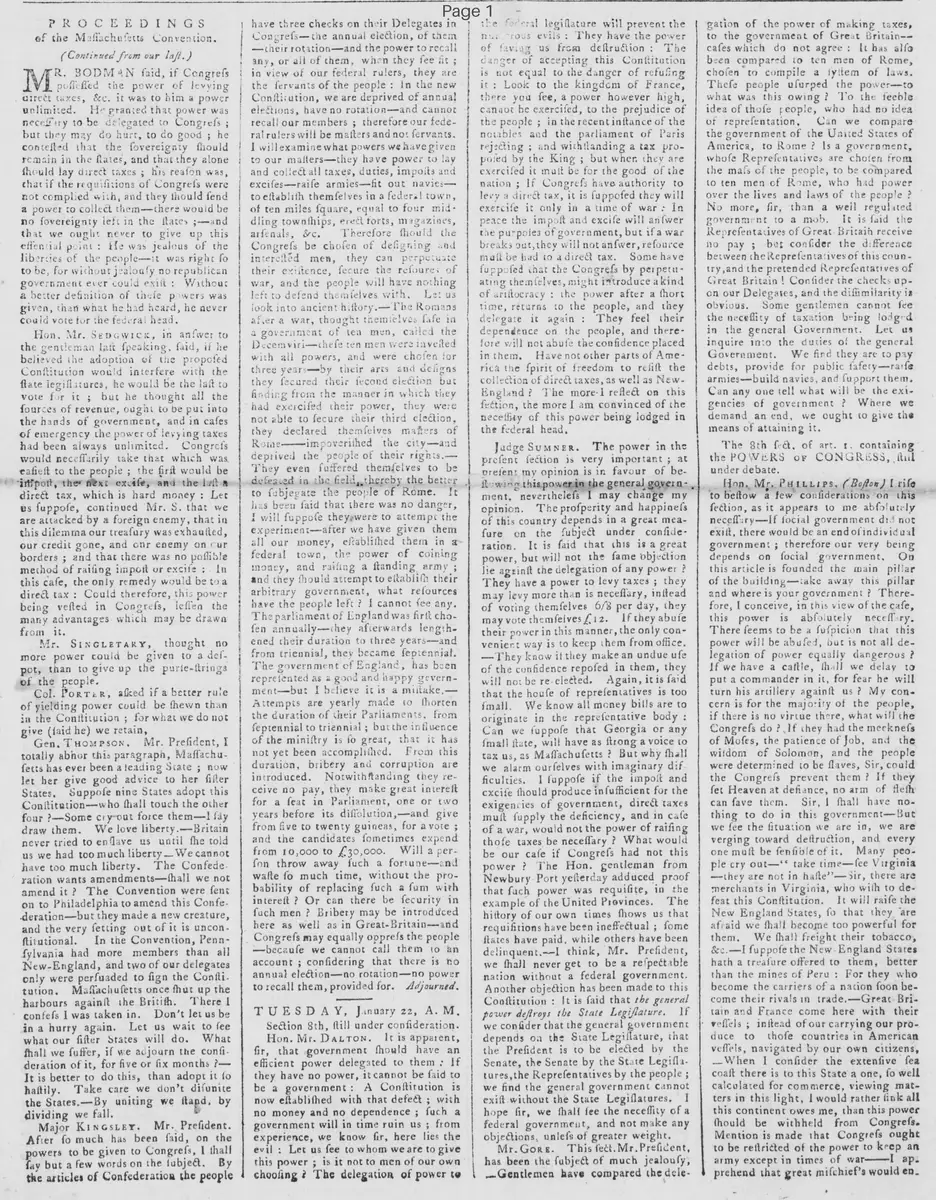
Mr. Bodman said, if Congress possessed the power of levying direct taxes, &c. it was to him a power unlimited. He granted that power was necessary to be delegated to Congress; but they may do hurt, to do good; he contended that the sovereignty should remain in the states, and that they alone should lay direct taxes; his reason was, that if the requisitions of Congress were not complied with, and they should send a power to collect them—there would be no sovereignty left in the states;—and that we ought never to give up this essential point: he was jealous of the liberties of the people—it was right so to be, for without jealousy no republican government ever could exist: Without a better definition of these powers was given, than what he had heard, he never could vote for the federal head.
Hon. Mr. Sedgwick, in answer to the gentleman last speaking, said, if he believed the adoption of the proposed Constitution would interfere with the state legislatures, he would be the last to vote for it: but he thought all the sources of revenue, ought to be put into the hands of government, and in cases of emergency the power of levying taxes had been always unlimited. Congress would necessarily take that which was easiest to the people; the first would be impost, the next excise, and the last a direct tax, which is hard money: Let us suppose, continued Mr. S. that we are attacked by a foreign enemy, that in this dilemma our treasury was exhausted, our credit gone, and our enemy on our borders; and that there was no possible method of raising impost or excise: In this case, the only remedy would be to a direct tax: Could therefore, this power being vested in Congress, lessen the many advantages which may be drawn from it.
Mr. Singletary, thought no more power could be given to a despot, than to give up the purse-strings of the people.
Col. Porter, asked if a better rule of yielding power could be shewn than in the Constitution; for what we do not give (said he) we retain.
Gen. Thompson. Mr. President, I totally abhor this paragraph, Massachusetts has ever been a leading State: now let her give good advice to her sister States. Suppose nine States adopt this Constitution—who shall touch the other four?—Some cry out force them—I say draw them. We love liberty.—Britain never tried to enslave us until she told us we had too much liberty We cannot have too much liberty. The Confederation wants amendments—shall we not amend it? The Convention were sent to Philadelphia to amend this Confederation—but they made a new creature, and the very setting out of it is unconstitutional. In the Convention, Pennsylvania had more members than all New-England, and two of our delegates only were persuaded to sign the Constitution. Massachusetts once shut up the harbours against the British. There I confess I was taken in. Don't let us be in a hurry again. Let us wait to see what our sister States will do. What shall we suffer, if we adjourn the consideration of it, for five or six months?—It is better to do this, than adopt it so hastily. Take care we don't disunite the States.—By uniting we stand, by dividing we fall.
Major Kingsley. Mr. President. After so much has been said, on the powers to be given to Congress, I shall say but a few words on the subject. By the articles of Confederation the people have three checks on their Delegates in Congress—the annual election, of them—their rotation—and the power to recall any, or all of them, when they see fit; in view of our federal rulers, they are the servants of the people: In the new Constitution, we are deprived of annual elections, have no rotation—and cannot recall our members: therefore our federal rulers will be masters and not servants. I will examine what powers we have given to our masters—they have power to lay and collect all taxes, duties, imposts and excises—raise armies—fit out navies—to establish themselves in a federal town, of ten miles square, equal to four middling townships, erect forts, magazines, arsenals, &c. Therefore should the Congress be chosen of designing and interested men, they can perpetuate their existence, secure the resources, of war, and the people will have nothing left to defend themselves with, Let us look into ancient history.—The Romans after a war, thought themselves safe in a government of ten men, called the Decemviri—these ten men were invested with all powers, and were chosen for three years—by their arts and designs they secured their second election but finding from the manner in which they had exercised their power, they were not able to secure their third election. they declared themselves masters of Rome—impoverished the city—and deprived the people of their rights.—They even suffered themselves to be defeated in the field, thereby the better to subjugate the people of Rome. It has been said that there was no danger. I will suppose they were to attempt the experiment—after we have given them all our money, established them in a federal town, the power of coining money, and raising a standing army; and they should attempt to establish their arbitrary government, what resources have the people left? I cannot see any. The parliament of England was first chosen annually—they afterwards lengthened their duration to three years—and from triennial, they became septennial. The government of England, has been represented as a good and happy government—but I believe it is a mistake,—Attempts are yearly made to shorten the duration of their Parliaments. from septennial to triennial; but the influence of the ministry is so great, that it has not yet been accomplished. From this duration, bribery and corruption are introduced. Notwithstanding they receive no pay, they make great interest for a seat in Parliament, one or two years before its dissolution,—and give from five to twenty guineas, for a vote; and the candidates sometimes expend from 10,000 to £30,000. Will a person throw away such a fortune—and waste so much time, without the probability of replacing such a sum with interest? Or can there be security in such men? Bribery may be introduced here as well as in Great-Britain—and Congress may equally oppress the people—because we cannot call them to an account; considering that there is no annual election—no rotation—no power to recall them, provided for. Adjourned.
TUESDAY, January 22, A. M.
Section 8th. still under consideration.
Hon. Mr. Dalton. It is apparent, sir, that government should have an efficient power delegated to them: If they have no power, it cannot be said to be a government: A Constitution is now established with that defect: with no money and no dependence: such a government will in time ruin us: from experience, we know sir, here lies the evil: Let us see to whom we are to give this power; is it not to men of our own choosing? The delegation of power to the federal legislature will prevent the numerous evils: They have the power of saving us from destruction: The danger of accepting this Constitution is not equal to the danger of refusing it: Look to the kingdom of France, there you see, a power however high, cannot be exercised, to the prejudice of the people: in the recent instance of the notables and the parliament of Paris rejecting; and notwithstanding a tax proposed by the King; but when they are exercised it must be for the good of the nation: If Congress have authority to levy a direct tax, it is supposed they will exercise it only in a time of war: In peace the impost and excise will answer the purposes of government, but if a war breaks out, they will not answer, resource must be had to a direct tax. Some have supposed that the Congress by perpetuating themselves, might introduce a kind of aristocracy: the power after a short time, returns to the people, and they delegate it again: They feel their dependence on the people, and therefore will not abuse the confidence placed in them. Have not other parts of America the spirit of freedom to resist the collection of direct taxes, as well as New-England? The more I reflect on this section, the more I am convinced of the necessity of this power being lodged in the federal head.
Judge Sumner. The power in the present section is very important; at present my opinion is in favour of bestowing this power in the general government, nevertheless I may change my opinion. The prosperity and happiness of this country depends in a great measure on the subject under consideration. It is said that this is a great power, but will not the same objection lie against the delegation of any power? They have a power to levy taxes; they may levy more than is necessary, instead of voting themselves 6/8 per day, they may vote themselves £12. If they abuse their power in this manner, the only convenient way is to keep them from office.—They know if they make an undue use of the confidence reposed in them, they will not be re-elected. Again, it is said that the house of representatives is too small. We know all money bills are to originate in the representative body: Can we suppose that Georgia or any small state, will have as strong a voice to tax us, as Massachusetts? But why shall we alarm ourselves with imaginary difficulties. I suppose if the impost and excise should produce insufficient for the exigencies of government, direct taxes must supply the deficiency, and in case of a war, would not the power of raising those taxes be necessary? What would be our case if Congress had not this power The Hon. gentleman from Newbury Port yesterday adduced proof that such power was requisite, in the example of the United Provinces. The history of our own times shows us that requisitions have been ineffectual: some states have paid, while others have been delinquent,—I think, Mr. President, we shall never get to be a respectable nation without a federal government. Another objection has been made to this Constitution: It is said that the general power destroys the State Legislature. If we consider that the general government depends on the State Legislature, that the President is to be elected by the Senate, the Senate by the State Legislatures, the Representatives by the people; we find the general government cannot exist without the State Legislatures. I hope sir, we shall see the necessity of a federal government, and not make any objections, unless of greater weight.
Mr. Gore. This sect. Mr. President. has been the subject of much jealousy, Gentlemen have compared the delegation of the power of making taxes, to the government of Great Britain—cases which do not agree: It has also been compared to ten men of Rome, chosen to compile a system of laws. These people usurped the power to what was this owing? To the feeble idea of those people, who had no idea of representation. Can we compare the government of the United States of America, to Rome? Is a government, whose Representatives are chosen from the mass of the people, to be compared to ten men of Rome, who had power over the lives and laws of the people? No more, sir, than a well regulated government to a mob. It is said the Representatives of Great Britain receive no pay; but consider the difference between the Representatives of this country, and the pretended Representatives of Great Britain! Consider the checks upon our Delegates, and the dissimularity is obvious. Some gentlemen cannot see the necessity of taxation being lodged in the general Government. Let us inquire into the duties of the general Government. We find they are to pay debts, provide for public safety—raise armies—build navies, and support them. Can any one tell what will be the exigencies of government? Where we demand an end, we ought to give the means of attaining it.
The 8th rat. of art. 1. containing the POWERS OF CONGRESS. still under debate.
Hon. Mr. Phillips. (Boston) rise to bestow a few considerations on this section, as it appears to me absolutely necessary—If social government did not exist, there would be an end of individual government; therefore our very being depends on social government, On this article is founded the main pillar of the building—take away this pillar and where is your government? Therefore, I conceive, in this view of the case, this power is absolutely necessary. There seems to be a suspicion that this power will be abused, but is not all delegation of power equally dangerous? If we have a castle, shall we delay to put a commander in it, for fear he will turn his artillery against us? My concern is for the majority of the people, if there is no virtue there, what will the Congress do? If they had the meekness of Moses. the patience of Job, and the wisdom of Solomon, and the people were determined to be slaves, Sir, could the Congress prevent them? If they set Heaven at defiance, no arm of flesh can save them. Sir. I shall have nothing to do in this government—But we see the situation we are in, we are verging toward destruction, and every one must be sensible of it. Many people cry out—" take time—see Virginia—they are not in haste"—sir, there are merchants in Virginia, who wish to defeat this Constitution. It will raise the New England States, so that they are afraid we shall become too powerful for them. We shall freight their tobacco, &c.—I suppose the New England States hath a treasure offered to them. better than the mines of Peru: For they who become the carriers of a nation soon become their rivals in trade.—Great-Britain and France come here with their vessels: instead of our carrying our produce to those countries in American vessels, navigated by our own citizens, _When I consider the extensive sea coast there is to this State as one, so well calculated for commerce. viewing matters in this light, I would rather sink all this continent owes me. than this power should be withheld from Congress. Mention is made that Congress ought to be restricted of the power to keep an army except in times of war—I apprehend that great mischief's would en.
sue from such a restriction. Let us
take means to prevent war, by granting
to Congress the power of raising an
army. if a declaration of war is made
against us, before Congress could col-
lect the means to withstand this enemy,
they would penetrate into the bowels
of our country, and every thing dear to
us, would be gone in a moment.--The
Hon. Gentleman from Topsham has
made use of the expression ' O my coun-
try'' from an apprehension that the Con-
stitution should be adopted ; I will cry
out " O my country"if it is notadopted.
I see nothing but destruction and ine-
vitable ruin, if it is not.-The more I
peruse and study this article, the more
convinced am I of the necessity of such
a power being vested in Congress-the
more I hear laid against it, the more I
am confirmed in my sentiments of its
expediency--for it is like the pure
metal, the more you rubit, the brighter
it shines. It is with concern I hear the
Hon. Gentleman from Topsham make
use of language against the gentlemen
of the law..Sir, I look on this order
of men to be essential to the liberties and
rights of the people : and whoever
speaks against them is speaking against
anordinanceof Heaven.-Mr.President,
I hope every gentleman will offer his
sentiments candidly on this momentous
affair-that he will examine for himself
-and consider that he has not only the
good of this Commonwealth under his
consideration, but the welfare of the
United States.
Dr. WILLARD entered largely into
the field of ancient historyand deduced
therefrom arguments to prove that
where power had been trusted to men,
whether in great or small bodies, they
had always abused it-and that thus re-
publics soon degenerated to aristocracies,
Heinstanced Sparta, Athens, and Rome.
The Amphictionick league, he said
resembled the Confederation of the
United states--while thus united, they
defeated Xerxes-but were subdued by
the gold of Phillip--who bought the
Council to betray the interest of the
country.
Hon. Mr. GORHAM, (in reply to
the gentleman from Uxbridge) exposed
the absurdity of conclusions and hy-
pothesis drawn from ancient govern-
ments-which bore no relation to the
confederacy proposed : for those govern-
ments had no idea of representations as
we have.. He however warned us a.
gainst the evils which had ruined those
States-which he thought was the want
of an efficient federal government. As
much as the Athenians rejoiced in the
extirpation of a Lacedemonian, will, if
we are disunited, a citizen of Massachu-
setts, at the death of a Connecticut man.
or a Yorker. With respect to the pro-
posed government degenerating into an
aristocracy, the Hon. Gentleman ob-
served, that the nature and situation of
our country rendered such a circum-
stance impossible : As from the great
preponderance of the agricultural in-
terest in the United Statesthat interest
would always have it in its power the
electing of such men, as would, he ob-
served, effectually prevent the intro-
duction of any other than a perfectly
democratical form of government.
Hon. Mr. CABOT, went fully into a
continuation of the arguments of the
Hon. Gentleman last up. In a clear
and elegant manner he analyzed the
ancient governments, mentioned by
Dr. Willard, and by comparing them
with the proposed system, fully demon-
strated the superiority of ths latter, and in
a particular manner the S. under debate.
Mr. RANDAL said, the quoting of
ancient history was no more to the pur-
pose, than to tell how our fore-fathers
dug clams at Plymouth : He feared a
consolidation ofthe thirteen States.--Our
manners, he said, were widely different
from the southern State - their elections
were not so free and unbiased ; therefore,
if the States were consolidated, he
thought it would introduce manners a-
mong us, which would set us at contin-
ual variance.
Mr. BOWDOIN, pointed cutotherin-
stances of dissimilarity between the sys-
tems of the ancient republics, and the
proposed Constitution, than those men-
tioned by the Hon. gentleman from
Charlestown and Beverly-in the want
of the important checks in the former,
which were to be found in the latter--
to the want of which, in the first. was
owing, he said, the usurpation that took
placeHe instanced the decemviri, who
though chosen for a short period, yet
unchecked, soon subverted the liberties
of the Romans : and concluded, with a
decided opinion infavour of the Consti-
tution under debate. (To be continued.)
What sub-type of article is it?
What themes does it cover?
What keywords are associated?
What entities or persons were involved?
Where did it happen?
Story Details
Key Persons
Location
Massachusetts
Event Date
Tuesday, January 22, A. M.
Story Details
Debate on Article 1, Section 8 of the proposed U.S. Constitution, with speakers expressing concerns over Congress's unlimited taxation powers, potential for abuse, historical parallels to Rome and England, and arguments for necessity in emergencies like war, emphasizing checks, representation, and federal efficiency.