Thank you for visiting SNEWPapers!
Sign up free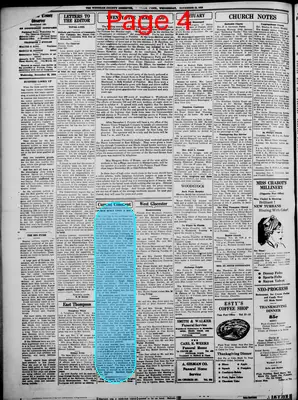
Editorial
November 22, 1939
Windham County Observer
Putnam, Windham County, Connecticut
What is this article about?
The editorial praises the decision by members of the First Congregational Church of Woodstock, CT, to repair hurricane damage and restore the interior to colonial simplicity under architect Ralph Adams Cram, celebrating its 250-year history of serving the New England community since John Eliot's time.
Clipping
OCR Quality
98%
Excellent
Full Text
Current Comment
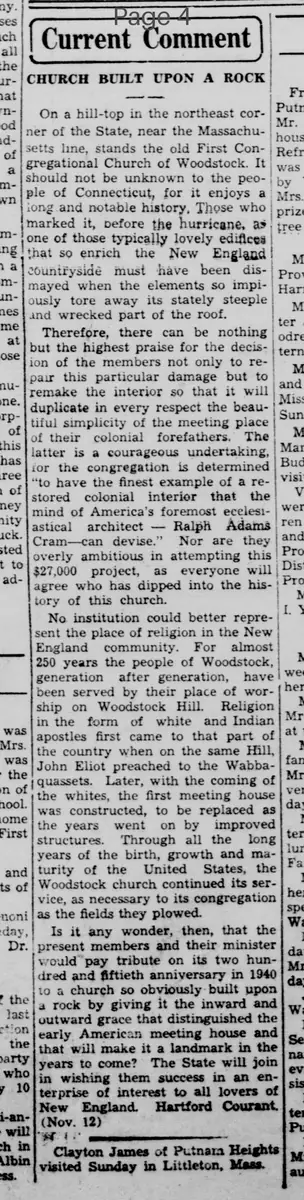
CHURCH BUILT UPON A ROCK
On a hill-top in the northeast corner of the State, near the Massachusetts line, stands the old First Congregational Church of Woodstock. It should not be unknown to the people of Connecticut, for it enjoys a long and notable history. Those who marked it, before the hurricane, as one of those typically lovely edifices that so enrich the New England countryside must have been dismayed when the elements so impiously tore away its stately steeple and wrecked part of the roof.
Therefore, there can be nothing but the highest praise for the decision of the members not only to repair this particular damage but to remake the interior so that it will duplicate in every respect the beautiful simplicity of the meeting place of their colonial forefathers. The latter is a courageous undertaking, for the congregation is determined "to have the finest example of a restored colonial interior that the mind of America's foremost ecclesiastical architect - Ralph Adams Cram - can devise."
Nor are they overly ambitious in attempting this $27,000 project, as everyone will agree who has dipped into the history of this church.
No institution could better represent the place of religion in the New England community. For almost 250 years the people of Woodstock, generation after generation, have been served by their place of worship on Woodstock Hill. Religion in the form of white and Indian apostles first came to that part of the country when on the same Hill, John Eliot preached to the Wabbiquassets. Later, with the coming of the whites, the first meeting house was constructed, to be replaced as the years went on by improved structures.
Through all the long years of the birth, growth and maturity of the United States, the Woodstock church continued its service, as necessary to its congregation as the fields they plowed.
Is it any wonder, then, that the present members and their minister would pay tribute on its two hundred and fiftieth anniversary in 1940 to a church so obviously built upon a rock by giving it the inward and outward grace that distinguished the early American meeting house and that will make it a landmark in the years to come? The State will join in wishing them success in an enterprise of interest to all lovers of New England. Hartford Courant. (Nov. 12)
Clayton James of Putnam Heights visited Sunday in Littleton, Mass.
CHURCH BUILT UPON A ROCK
On a hill-top in the northeast corner of the State, near the Massachusetts line, stands the old First Congregational Church of Woodstock. It should not be unknown to the people of Connecticut, for it enjoys a long and notable history. Those who marked it, before the hurricane, as one of those typically lovely edifices that so enrich the New England countryside must have been dismayed when the elements so impiously tore away its stately steeple and wrecked part of the roof.
Therefore, there can be nothing but the highest praise for the decision of the members not only to repair this particular damage but to remake the interior so that it will duplicate in every respect the beautiful simplicity of the meeting place of their colonial forefathers. The latter is a courageous undertaking, for the congregation is determined "to have the finest example of a restored colonial interior that the mind of America's foremost ecclesiastical architect - Ralph Adams Cram - can devise."
Nor are they overly ambitious in attempting this $27,000 project, as everyone will agree who has dipped into the history of this church.
No institution could better represent the place of religion in the New England community. For almost 250 years the people of Woodstock, generation after generation, have been served by their place of worship on Woodstock Hill. Religion in the form of white and Indian apostles first came to that part of the country when on the same Hill, John Eliot preached to the Wabbiquassets. Later, with the coming of the whites, the first meeting house was constructed, to be replaced as the years went on by improved structures.
Through all the long years of the birth, growth and maturity of the United States, the Woodstock church continued its service, as necessary to its congregation as the fields they plowed.
Is it any wonder, then, that the present members and their minister would pay tribute on its two hundred and fiftieth anniversary in 1940 to a church so obviously built upon a rock by giving it the inward and outward grace that distinguished the early American meeting house and that will make it a landmark in the years to come? The State will join in wishing them success in an enterprise of interest to all lovers of New England. Hartford Courant. (Nov. 12)
Clayton James of Putnam Heights visited Sunday in Littleton, Mass.
What sub-type of article is it?
Moral Or Religious
What keywords are associated?
Church Restoration
Colonial Architecture
New England Religion
Woodstock History
Hurricane Damage
What entities or persons were involved?
First Congregational Church Of Woodstock
Ralph Adams Cram
John Eliot
Wabbiquassets
Hartford Courant
Editorial Details
Primary Topic
Restoration Of The First Congregational Church Of Woodstock
Stance / Tone
Praiseworthy And Supportive
Key Figures
First Congregational Church Of Woodstock
Ralph Adams Cram
John Eliot
Wabbiquassets
Hartford Courant
Key Arguments
Praise For Repairing Hurricane Damage And Restoring Colonial Interior
Historical Significance Spanning 250 Years
Representation Of Religion In New England Community
Tribute On 250th Anniversary In 1940
Project To Create Finest Restored Colonial Interior By Renowned Architect