Thank you for visiting SNEWPapers!
Sign up free
Macon Intelligencer
Macon, Noxubee County, Mississippi
What is this article about?
Daniel Webster's speech defends the credit system and banks, highlighting their role in Southern agriculture and Massachusetts industry. He critiques calls for a hard money system, praises economic equality and progress, and argues against excessive regulation of currency.
Merged-components note: Continuation of Mr. Webster's speech across pages 1 and 2, indicated by '(Continued.)' and '[To be continued.]'.
Clippings
1 of 2
OCR Quality
Full Text
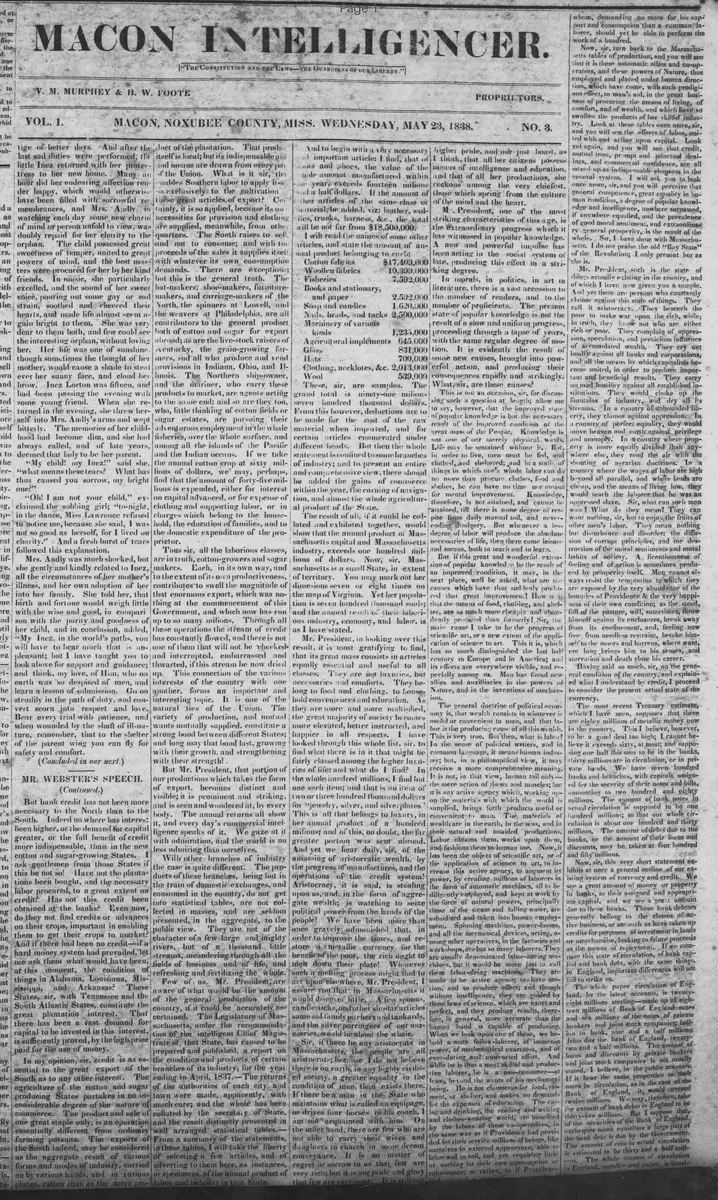
(Continued.)
But bank credit has not been more necessary to the North than to the South. Indeed nowhere has interest been higher, or the demand for capital greater, or the full benefit of credit more indispensable, than in the new cotton and sugar-growing States. I ask gentlemen from those States if this be not so! Have not the plantations been bought, and the necessary labor procured, to a great extent on credit? Has not this credit been obtained at the banks? Even now, do they not find credits or advances on their crops, important in enabling them to get their crops to market! And if there had been no credit—if a hard money system had prevailed, let me ask them what would have been, at this moment, the condition of things in Alabama, Louisiana, Mississippi, and Arkansas? These States, sir, with Tennessee and the South Atlantic States, constitute the great plantation interest. That there has been a vast demand for capital to be invested in this interest, is sufficiently proved, by the high price paid for the use of money.
In my opinion, sir, credit is as essential to the great export of the South as to any other interest. The agriculture of the cotton and sugar producing States partakes in no inconsiderable degree of the nature of commerce. The product and sale of one great staple only, is an operation essentially different from ordinary farming pursuits. The exports of the South indeed, may be considered as the aggregate result of various forms and modes of industry, carried on by various hands, and in various places, rather than as the mere product of the plantation. That product itself is local; but its indispensable aid and means are drawn from every part of the Union. What is it sir, that enables Southern labor to apply itself so exclusively to the cultivation of these great articles of export? Certainly, it is so applied, because its own necessities for provision and clothing are supplied, meanwhile, from other quarters. The South raises to sell, and not to consume; and with the proceeds of the sales it supplies itself with whatever its own consumption demands. There are exceptions: but this is the general truth. The hat-makers, shoe-makers, furniture makers, and carriage-makers of the North, the spinners at Lowell, and the weavers at Philadelphia, are all contributors to the general product both of cotton and sugar for export abroad; as are the live-stock raisers of Kentucky, the grain-growing farmers, and all who produce and vend provisions in Indiana, Ohio, and Illinois. The Northern ship-owner, and the mariner, who carry these products to market, are agents acting to the same end; and so are they too, who, little thinking of cotton fields or sugar estates, are pursuing their adventurous employment in the whale fisheries, over the whole surface, and among all the islands of the Pacific and the Indian oceans. If we take the annual cotton crop at sixty millions of dollars, we may, perhaps, find that the amount of forty-five millions is expended, either for interest on capital advanced, or for expense of clothing and supporting labor, or in charges which belong to the household, the education of families, and to the domestic expenditure of the proprietor.
Thus sir, all the laborious classes, are in truth, cotton-growers and sugar makers. Each, in its own way, and to the extent of its own productiveness, contributes to swell the magnitude of that enormous export, which was nothing at the commencement of this Government, and which now has run up to so many millions. Through all these operations the stream of credit has constantly flowed, and there is not one of them that will not be checked and interrupted, embarrassed and thwarted, if this stream be now dried up. This connection of the various interests of the country with one another, forms an important and interesting topic. It is one of the natural ties of the Union. The variety of production, and mutual wants mutually supplied, constitute a strong bond between different States: and long may that bond last, growing with their growth, and strengthening with their strength!
But Mr. President, that portion of our productions which takes the form of export, becomes distinct and visible; it is prominent and striking, and is seen and wondered at, by everybody. The annual returns all show it, and every day's commercial intelligence speaks of it. We gaze at it with admiration, and the world is no less admiring than ourselves.
With other branches of industry the case is quite different. The products of these branches, being but in the train of domestic exchanges, and consumed in the country, do not get into statistical tables, are not collected in masses, and are seldom presented, in the aggregate, to the public view. They are not of the character of a few large and mighty rivers, but of a thousand little streams, meandering through all the fields of business and of life, and refreshing and fertilizing the whole.
Few of us, Mr. President, are aware of what would be the amount of the general production of the country, if it could be accurately ascertained. The Legislature of Massachusetts, under the recommendation of the intelligent Chief Magistrate of that State, has caused to be prepared and published, a report on the condition and products of certain branches of its industry, for the year ending in April, 1837. The returns of the authorities of each city and town were made, apparently, with much care; and the whole has been collated by the secretary of State, and the result distinctly presented in well arranged statistical tables.
From a summary of the statements, in these tables, I will take the liberty of selecting a few articles, and of adverting to them here, as instances, or specimens, of the annual product of labor and industry in that State.
And to begin with a very necessary important article: I find, that of boots and shoes, the value of the whole amount manufactured within the year, exceeds fourteen millions and a half dollars. If the amount of other articles of the same class or material, be added, viz: leather, saddles, trunks, harness, &c., the total will be not far from $18,500,000.
I will read the names of some other articles, and state the amount of annual product belonging to each:
Cotton fabrics $17,409,000
Woollen fabrics 10,399,000
Fisheries 7,592,000
Books and stationary, and paper 2,592,000
Soap and candles 1,620,000
Nails, brads, and tacks 2,500,000
Machinery of various kinds 1,235,000
Agricultural implements 645,000
Glass 831,000
Hats 700,000
Clothing, necklaces, &c. 2,013,000
Wool 539,000
These, sir, are samples. The grand total is ninety-one millions seven hundred thousand dollars.
From this however, deductions are to be made for the cost of the raw material when imported, and for certain articles enumerated under different heads. But then the whole statement is confined to some branches of industry; and to present an entire and comprehensive view, there should be added the gains of commerce within the year, the earning of navigation, and almost the whole agricultural product of the State.
The result of all, if it could be collated and exhibited together, would show that the annual product of Massachusetts capital and Massachusetts industry, exceeds one hundred millions of dollars. Now, sir, Massachusetts is a small State, in extent of territory. You may mark out her dimensions seven or eight times on the map of Virginia. Yet her population is seven hundred thousand souls; and the annual result of their laborious industry, economy, and labor, is as I have stated.
Mr. President, in looking over this result, it is most gratifying to find, that its great mass consists in articles equally essential and useful to all classes. They are not luxuries, but necessaries and comforts. They belong to food and clothing, to household conveniences and education. As they are more and more multiplied, the great majority of society becomes more elevated, better instructed, and happier in all respects. I have looked through this whole list, sir, to find what there is in it that might be fairly classed among the higher luxuries of life: and what do I find? In the whole hundred millions, I find but one such item; and that is an item of two or three hundred thousand dollars for "jewelry, silver, and silverplates." This is all that belongs to luxury, in her annual product of a hundred millions: and of this, no doubt, the far greater portion was sent abroad.
And yet we hear daily, sir, of the amassing of aristocratic wealth, by the progress of manufactures, and the operations of the credit system! Aristocracy, it is said, is stealing upon us, and, in the form of aggregate wealth, is watching to seize political power from the hands of the people! We have been more than once gravely admonished that, in order to improve the times, and restore a metallic currency, for the benefit of the poor, the rich ought to melt down their plate! Whatever such a melting process might find to act upon elsewhere, Mr. President, I assure you that in Massachusetts it would discover little. A few spoons, candlesticks, and other similar articles some old family pitchers and tankards, and the silver porringers of our nurseries, would be about the whole.
Sir, if there be any aristocrats in Massachusetts, the people are all aristocrats; because I do not believe there is on earth, in any highly civilized society, a greater equality in the condition of men, than exists there. If there be a man in the State who maintains what is called an equipage, or drives four horses in his coach, I am not acquainted with him. On the other hand, there are few who are not able to carry their wives and daughters to church in some decent conveyance. It is no matter of regret or sorrow to us that few are very rich; but it is our pride and glory that few are very poor. It is still our
higher pride, and our just boast, as I think, that all her citizens possess means of intelligence and education, and that of all her productions, she reckons among the very chiefest, those which spring from the culture of the mind and the heart.
Mr. President, one of the most striking characteristics of this age, is the extraordinary progress which it has witnessed in popular knowledge. A new and powerful impulse has been acting in the social system of late, producing this effect in a striking degree.
In morals, in politics, in art in literature, there is a vast accession to the number of readers, and to the number of proficients. The present state of popular knowledge is not the result of a slow and uniform progress, proceeding through a lapse of years, with the same regular degree of motion. It is evidently the result of some new causes, brought into powerful action, and producing their consequences rapidly and strikingly.
What, sir, are these causes?
This is not an occasion, sir, for discussing such a question at length; allow me however, to say, that the improved state of popular knowledge is not the necessary result of the improved condition of the great mass of the People. Knowledge is not one of our merely physical wants. Life may be sustained without it. But, in order to live, men must be fed, and clothed and sheltered; and in a state of things in which one's whole labor can do no more than procure clothes, food and shelter, he can have no time nor means for mental improvement. Knowledge, therefore, is not attained, and cannot be attained, till there is some degree of respite from daily manual toil, and never-ending drudgery. But whenever a less degree of labor will produce the absolute necessaries of life, then there come leisure and means, both to teach and to learn.
But if this great and wonderful extension of popular knowledge be the result of an improved condition, it may, in the next place, well be asked, what are the causes which have thus suddenly produced that great improvement? How is it that the means of food, clothing, and shelter, are so much more cheaply and abundantly procured than formerly? Sir, the main cause I take to be the progress of scientific art, or a new extent of the application of science to art. This it is, which has so much distinguished the last half century in Europe and in America; and its effects are everywhere visible, and especially among us. Man has found new allies and auxiliaries in the powers of Nature, and in the inventions of mechanism.
The general doctrine of political economy is, that wealth consists in whatever is useful or convenient to man, and that labor is the producing cause of all this wealth. This is very true. But then, what is labor? In the sense of political writers, and in common language, it means human industry; but, in a philosophical view, it may receive a more comprehensive meaning.
It is not, in that view, human toil only—the mere action of thews and muscles; but it is any active agency which, working upon the materials with which the world is supplied, brings forth products useful or convenient to man. The materials of wealth are in the earth, in the seas, and in their natural and unaided productions. Labor obtains them, works upon them, and fashions them to human use. Now, it has been the object of scientific art, or of the application of science to art, to increase this active agency, to augment its power, by creating millions of laborers in the form of automatic machines, all to be diligently employed, and kept at work by the force of natural powers, principally those of the steam and falling water, are subsidized and taken into human employment. Spinning machines, power-looms, and all the mechanical devices, acting, among other operatives, in the factories and workshops, are but so many laborers. They are usually denominated labor-saving machines, but it would be more just to call them labor-doing machines. They are made to be active agents; to have motion, and to produce effect; and though without intelligence, they are guided by those laws of science, which are exact and perfect, and they produce results, therefore, in general, more accurate than the human hand is capable of producing.
When we look upon one of these, we behold a mute fellow-laborer, of immense power, of mathematical exactness, and of ever-during and unwearied effort. And while he is thus a most skilful and productive laborer, he is a non-consumer—at least, beyond the wants of his mechanical being. He is not clamorous for food, raiment, or shelter, and makes no demands for the expenses of education. The eating and drinking, the reading and writing and clothes-wearing world, are benefited by the labors of these co-operatives, in the same way as if Providence had provided for their service millions of beings, like ourselves in external appearance, able to labor and to toil, and yet requiring little or nothing for their own consumption or subsistence; or rather, as if Providence
whom, demanding no more for his support and consumption than a common laborer, should yet be able to perform the work of a hundred.
Now, sir, turn back to the Massachusetts tables of production, and you will see that it is these automatic allies and co-operators, and these powers of Nature, thus employed and placed under human direction, which have come, with such prodigious effect, to man's aid, in the great business of procuring the means of living, of comfort, and of wealth, and which have so swollen the products of her skilful industry. Look at these tables once more, sir, and you will see the effects of labor, united with and acting upon capital. Look yet again, and you will see that credit, mutual trust, prompt and punctual dealings, and commercial confidence, are all mixed up as indispensable elements in the general system. I will ask you to look once more, sir, and you will perceive that general competence, great equality in human condition, a degree of popular knowledge and intelligence, nowhere surpassed, if anywhere equalled, and the prevalence of good moral sentiment, and extraordinary general prosperity, is the result of the whole. Sir, I have done with Massachusetts. I do not praise the old "Bay State" of the Revolution; I only present her as she is.
Mr. President, such is the state of things actually existing in the country, and of which I have now given you a sample. And yet there are persons who constantly clamor against this state of things. They call it aristocracy. They beseech the poor to make war upon the rich, while; in truth, they know not who are either rich or poor. They complain of oppression, speculation, and pernicious influence of accumulated wealth. They cry out loudly against all banks and corporations, and all the means by which capitalists become united, in order to produce important and beneficial results. They carry on mad hostility against all established institutions. They would choke up the fountains of industry, and dry all its streams. In a country of unbounded liberty, they clamor against oppression. In a country of perfect equality, they would move heaven and earth against privilege and monopoly. In a country where property is more equally divided than anywhere else, they rend the air with the shouting of agrarian doctrines. In a country where the wages of labor are high beyond all parallel, and where lands are cheap, and the means of living low, they would teach the laborer that he was an oppressed slave. Sir, what can such men want? What do they mean? They can want nothing, sir, but to enjoy the fruits of other men's labor. They mean nothing but disturbance and disorder: the diffusion of corrupt principles, and the destruction of the moral sentiments and moral habits of society. A licentiousness of feeling and of action is sometimes produced by prosperity itself. Men cannot always resist the temptation to which they are exposed by the very abundance of the bounties of Providence & the very happiness of their own condition; as the steed, fat of the pasture, will, sometimes, throw himself against its enclosures, break away from its confinement, and, feeling now free from needless restraint, betake himself to the moors and barrens, where want; ere long brings him to his senses, and starvation and death close his career.
Having said so much, sir, on the general condition of the country, and explained what I understand by credit, I proceed to consider the present actual state of the currency.
The most recent Treasury estimate, which I have seen, supposes that there are eighty millions of metallic money now in the country. This I believe, however, to be a good deal too high; I cannot believe it exceeds sixty, at most; and supposing one half this sum to be in the banks, thirty millions are in circulation, or in private hands. We have seven hundred banks and branches, with capitals assigned for the security of their notes and bills, amounting to two hundred and eighty millions. The amount of bank notes in actual circulation is supposed to be one hundred millions; so that our whole circulation is about one hundred and thirty millions. The amount of debts due to the banks, or the amount of their loans and discounts, may be taken at four hundred and fifty millions.
Now, sir, this very short statement exhibits at once a general outline of our existing system of currency and credit. We see a great amount of money or property in banks, as their assigned and appropriate capital, and we see a great amount due to these banks. These bank debtors generally belong to the classes of active business, or are such as have taken up credits for purposes of investment in lands or merchandise, looking to ulterior proceeds as the means of repayment. If we compare this state of circulation, of bank capital and bank debt, with the same things, in England, important differences will not fail to strike us.
The whole paper circulation of England, by the latest accounts, is twenty-eight millions sterling made up of eighteen millions of Bank of England notes and ten millions of the notes of private bankers and joint stock companies; bullion in bank, nine and a half millions; loans and discounts by private bankers and joint stock companies two and a half millions. The amount of debts due the bank of England, twenty-five millions. The amount of debts due to private bankers and joint stock companies is not usually stated, I believe, in the public accounts. If it bear the same proportion to their notes in circulation, as in the case of the Bank of England, it would exceed twelve millions. We may, therefore, take the amount of bank debts in England to be thirty-five millions. But I suppose that, of the securities of the Bank of England, the bank debt is due by the Government. exchequer notes constitute a large part of it is estimated to be thirty and a half millions. The amount of coin in actual circulation The whole amount of circulation in England, metallic and paper, is usually
millions; which rating the pound sterling at $4 80, is equal to two hundred and eighty-eight millions of dollars.
It will be seen, sir, that our paper circulation is one half less than that of England, but our bank debt is, nevertheless, much greater; since thirty-five millions sterling amount to only one hundred and sixty-eight millions of dollars; and this sum, too, includes the amount of exchequer bills, or Government debt in the form of such bills, which the bank holds. These facts are very material to any just comparison of the state of things, in the two countries. The whole, or nearly the whole capital of the Bank of England, is lent to Government, not by means of exchequer notes, but on a permanent loan. And as to the private banks and joint-stock companies, though they issue bills for circulation, they have no assigned or appropriated capital whatever. The bills circulate on the private credit of the individual banker, or of those who compose the joint stock companies. In the United States, an amount of capital, supposed to be sufficient to sustain the credit of the paper and secure the public against loss, is provided by law, in the act of incorporation of each bank, and is assigned as a trust fund for the payment of the liabilities of the bank. And if this capital be fairly and substantially advanced, it is a proper security; and in most cases no doubt it is substantially advanced. The directors are trustees of this fund, and they are liable, both civilly and criminally, for mismanagement, embezzlement, or breach of trust.
This amount of capital, thus secured, is the basis of loans and discounts; and this is the reason why permanent, or at least long loans, are not considered so inappropriate to banking operations, with us, as they are in England. With us, it is evident that the directors are agents, holding a fund intended to be loaned, and acting between lender and borrower; and this form of loan has been found exceedingly convenient and useful in the country. In some States, it is generally preferred to mortgages, though there are others which mortgages are usual. Whether exactly conformable to the true notion of banking, or not, the truth is, that the object and operation of our banks is to loan money; and this is mostly on personal security. The system, no doubt, is liable to abuse, in particular instances. There may be directors who will loan too freely to themselves and their friends. Gross cases of this kind have recently been detected and exposed, and, I hope, will be suitably treated; but, considering the great number of banks, these instances, I think, are remarkably few. In general, the banks have been well conducted, and are believed to be solvent and safe.
We have heard much, sir, in the course of this debate, of excess in the issue of bank notes for circulation. I have no doubt, sir, that there was a very improper expansion some years ago. When President Jackson, in 1832, had negatived the bill for continuing the Bank of the United States, (which act I esteem the true original source of all the disorders of the currency,) a vast addition was immediately made to the number of State banks. In 1833, the public deposits were actually removed from the Bank of the United States, and placed in selected State banks. And, for the purpose of showing how much better the Public would be accommodated without, than with, a Bank of the United States, these banks were not only encouraged, but admonished, to be free and liberal in loans and discounts, made on strength of the public moneys, to merchants and other individuals. The circular letter from the Treasury Department, addressed to the new deposit banks, under date of September 26, 1833, has this significant clause, which could not have been misunderstood:
"The deposits of public money will enable you to afford increased facilities to commerce, and to extend your accommodation to individuals; and as the duties which are payable to the Government arise from the business and enterprise of the merchants engaged in foreign trade, it is but reasonable that they should be preferred in the additional accommodation which the public deposits will enable your institution to give, whenever it can be done without injustice to the claims of other classes of the community."
Having read this letter, sir, I ask leave to refer the Senate to the 20th section of the bill now before us. There we find that, "any officer, charged with the safe-keeping of the public money, shall loan the same, or any portion thereof, with or without interest, such act shall be deemed an embezzlement and a high misdemeanor, and the party convicted thereof shall be sentenced to imprisonment."
Sir, what a pretty piece of consistency is here! In 1833 the depositories of the public money were not even left to their own desire or gain, or their wishes to accommodate others, as being sufficient incentives to lend it out: they were admonished and directed to give increased facilities to commerce, and to extend their accommodation to individuals, since the public moneys in their vaults would enable them to give such additional accommodation! Now, sir, under this bill, any officer who shall do any one of the same things, instead of being praised, is to be punished: he is to be adjudged guilty of embezzlement, and of a high misdemeanor, and is to be confined, for aught I know, in cells as dark and dismal as the vaults and safes which are to contain our metallic currency. But, although I think, sir, that the acts of government created this expansion, yet I am certainly of opinion that there was a very undue expansion created. A contraction, however, had begun; and I am of opinion, that had it not been for the specie order of July 1836, and for the manner in which the deposit law was executed, the banks would have gone through the crisis without suspension. This is my full and firm belief. I cannot, however, discuss these points here. They were treated with very great ability, last year, by a gentleman who then occupied one of the seats of Georgia on this floor. Whomsoever he did not satisfy, I cannot convince. Still, sir, the question is, whether there was an excess in the general amount of our circulation, in May last, whether there be now such excess.
By what standard is this to be judged? If the question be, whether there be too much paper in circulation, it may be answered by reference to the amount of coin in the banks from which the paper issues; because I am unquestionably of opinion—an opinion which I believe nothing can ever shake—that the true criterion by which to decide the question of excess, in a convertible paper currency, is the amount of that paper, compared with the gold and silver in the banks. Such excess would not be proved, absolutely and certainly, in every case by the mere fact of the suspension of specie payments; because such an event might be produced by panic, or other sudden cause, having power to disturb the best regulated system of paper circulation. But the immediate question now is, whether, taking the whole circulation together, both metallic and paper, there was an excess existing in May, or is an excess now existing? Is one hundred and thirty millions an excessive or undue amount of circulation for the United States? Seeing that one part of the circulation is coin, and the other part paper, resting upon coin, and intended to be convertible, is the whole mass more than may be fairly judged necessary to represent the property, the transactions, and the business of the country? Or, in order to sustain such an amount of circulation, and to keep that part of it which is composed of paper in a safe state, should we be obliged to attempt to draw to ourselves more than our just proportion of that metallic money, which is in the use of all the commercial nations? These questions appear to me to be but different modes of stating the same inquiry.
Upon this subject we may, perhaps, form some general idea, by comparing ourselves with others. Various things, no doubt, exist, in different places and countries, to modify, either by enlarging or diminishing, the demand for money or currency in the transactions of business; still the amount of trade and commerce may furnish a general element of comparison between different States or nations. The aggregate of American imports or exports in 1836 was three hundred and eighteen millions; that of England, reckoning the pound sterling at $4 80, again, was four hundred and eighty millions, as near as I can ascertain; the currency of England being, as already stated, sixty millions sterling, or two hundred and eighty-eight million of dollars. If we work out a result from these proportions, the currency of the United States, it will be found, should be one hundred and ninety millions, in order to be equal to that of England; but, according to the estimates of the Treasury, it did not, even in that year, exceed one hundred and eighty millions.
Our population is about equal to that of England and Wales. The amount of our mercantile tonnage, perhaps one-fifth less. But then we are to consider that our country is vastly wider; and our facilities of internal exchange, by means of bills of exchange, greatly less. Indeed, there are branches of our intercourse in which remittances cannot be well made, except in currency. Take one example: The agricultural products of Kentucky are sold to the South; her purchases of commodities made at the North. There can be, therefore, very little of direct exchange between her and the places of purchase and sale. The trade goes round in a circle. Therefore, while the Bank of the United States existed, payments were made to by citizens of Kentucky, and of the States similarly situated, not in bills of exchange, but in the notes of the Bank.
These considerations augment the demand for currency. More than all, the country is new, sir; almost the entire amount of our capital active; and the whole amount of property, in the aggregate, rapidly increasing. In the last three years thirty-seven millions of acres of land have been separated from the wilderness, purchased, paid for, and become subject to private individual ownership, to transfer and sale, and all other dispositions to which other real estate is subject. It has thus become property to be bought and sold for money; whereas, while in the hands of Government, it called for no expenditure, formed the basis of no transactions, and created no demand for currency. Within that short period our people have bought from Government a territory as large as the whole of England and Wales, and, taken together, far more fertile by nature. This seems incredible, yet the returns show it. Suppose all this to have been bought at the minimum price of a dollar and a quarter per acre; and suppose the value to be increased in the common ratio in which we know the value of land is increased, by such purchase, and by the preliminary steps and beginnings of cultivation; an immense augmentation, it will readily be perceived, is made, even in so short a time, of the aggregate property, in nominal price, and, to a great extent, in real value also.
On the whole, sir, I confess I know no standard by which to decide that our circulation is at present in excess. I do not believe it is so. Nor was there, as I think, any depreciation in the value of money, up to the moment of the suspension of specie payments by the banks, comparing our currency with the currency of other nations. An American paper dollar would buy a silver dollar in England, deducting only the charge of transporting a dollar across the ocean, because it commanded a silver dollar here. There may be excess, however, I admit, where there is no present depreciation, in the sense in which I now use the term.
It is hardly necessary to dwell, Mr. President, on the evils of a suddenly depreciated circulation. It arrests business, puts an end to it, and overwhelms all debtors, by depression and downfall of prices. And even if we reduce circulation—not suddenly, but still reduce it farther than is necessary to keep within just and reasonable limits—we produce many mischiefs; we augment the necessity of foreign loans; we contract business, discourage enterprise, slacken the activity of capital, and restrain the commercial spirit of the country. It is very important to be remembered, sir, that, in our intercourse with other nations, we were acting on a principle of equality; that is to say, we do not protect our own shipping interest by peculiar privileges; we ask a clear field, and seek no favor. Yet, the materials for ship-building are high with us, and the wages of ship-builders and seamen are high also. We have to contend against these unfavorable circumstances; and if, in addition to these, we are to suffer further by unnecessary restraints on currency, and by a cramped credit, who can tell what may be the effect? Money is abundant in England, very abundant; the rate of interest, therefore, is low, and capital will seek its investment wherever it can hope to find it. If we derange our own currency, compulsively curtail circulation, and break up credit; how are the commerce and navigation of the United States to maintain themselves against foreign competition?
Before leaving, altogether, this subject of an excessive circulation, Mr. President, I will say a few words upon a topic which, if time would permit, I should be glad to consider at more length; I mean, sir, the proper guards and securities for a paper circulation. I have occasionally addressed the Senate on this subject before, especially in the debate on the specie circular, in December 1836; but I wish to recur to it again, because I hold it to be of the utmost importance to prove, if it can be proved, to the satisfaction of the country, that a convertible paper currency may be so guarded as to be secure against probable dangers. I say, sir, a convertible paper currency: or I lay it down as an unquestionable truth, that no paper can be made equal, and kept equal to gold and silver, on demand. But, I have gone farther, and still go farther than this; and I contend that even convertibility, though itself indispensable, is not a certain and unfailing ground of reliance. There is a liability to excessive issues of paper, even while paper is convertible at will. Of this, there can be no doubt. Where, then, shall a regulator be found? What principle of prevention may we rely on?
Now I think, sir, it is too common with banks, in judging of their condition, to set all their liabilities against all their resources. They look to the quantity of specie in their vaults, and to the notes and bills becoming payable, as means of assets; and, with these, they expect to be able to meet their returning notes, and to answer the claims of depositors. So far as the bank is to be regarded as a mere bank of discount, all this is very well. But banks of circulation exercise another function. By the very act of issuing their own paper, they affect the amount of currency. In England, the Bank of England, and in the United States, all the banks expand or contract the amount of circulation, of course, as they increase or curtail the general amount of their own paper. And this renders it necessary that they should be regulated and controlled. The question is, by what rule? To this I answer, by subjecting all banks to the rule which the most discreet of them always follow—by compelling them to maintain a certain fixed proportion between specie and circulation; without regarding deposits on one hand, or notes payable on the other. There will always occur occasional fluctuations in trade, and a demand for specie, by one country on another, will arise. It is too much the practice, when such occurrences take place, and specie is leaving the country, for banks to issue more paper, in order to prevent a scarcity of money. But exactly the opposite course should be adopted. A demand for specie to go abroad should be regarded as conclusive evidence of the necessity of contracting circulation. If, indeed, in such cases, it could be certainly known that the demand would be of short duration, the temporary pressure might be relieved by an issue of paper to fill the place of departing specie. But this never can be known. There is no safety, therefore, but in meeting the case at the moment, and in conforming to the infallible index of the exchanges. Circulating paper is thus kept always nearer to the character, and to the circumstances of that, of which it is designed to be the representative—the metallic money. This subject might be pursued, I think and clearly illustrated; but, for the present, I only express my belief that, with experience before us, and with the lights which recent discussions, both in Europe and America, hold out, a national bank might be established, with regard to its function of regulating currency, than to its function of discount, on principles, and subject to regulations, such as should render its operations extremely useful; and I should hope that, with an example before them of plain and eminent advantage, State institutions would conform to the same rules and principles; and that, in this way, all the advantages of convertible paper might be enjoyed, with just security against its dangers.
I have detained the Senate too long, sir, with these observations upon the state of the country, and its pecuniary system and condition. And now when the banks have suspended payments universally; when the internal exchanges are all deranged, and the business of the country most seriously interrupted, the questions are—Whether the measure before us is suitable to our condition? and Whether it is a just and proper exercise and fulfilment of the powers and duties of Congress?
What, then, sir, will be the practical operation and effect of this measure, if it should become a law? Like its predecessor of the last session, the bill proposes nothing for the general currency of the country; nothing to restore exchanges: nothing to bring about a speedy resumption of specie payments by the banks. Its whole professed object is the collection and disbursement of the public revenue. Some of its friends, indeed, say that when it shall go into operation, it will, incidentally, produce a favorable effect on the currency, by restraining the issue of bank paper. But others press it as if its effect was to be the final overthrow of all banks, and the introduction of an exclusive metallic currency for all the uses of the country.
Are we to understand, then, that it is intended, by means of which this is the first, to rid the country of all banks, as being but so many nuisances, and to abolish all paper currency whatever? Or is it expected, on the contrary, that after this system shall be adopted for the use of Government, there will still be a paper currency in the country for the use of the People? And if there shall still be a paper currency, will that currency consist of irredeemable Government paper or of convertible bank notes, such as have circulated heretofore? These questions must be answered, before we can judge, accurately of the operation of this bill.
As to an exclusive metallic currency, sir, the Administration on this point is regularly Janus-faced. Out doors, and among the People, it shows itself "all clinquant, all in gold." There, every thing is to be hard money—no paper rags—no delusive credits—no bank monopolies—no trust in paper of any kind. But in the Treasury Department, and in the Houses of Congress, we see another aspect—a mixed appearance, partly gold and partly paper; gold for Government, and paper for the People. The small voice which is heard here, allows the absolute necessity of paper of some sort, and to some extent. But the shouts in the community demand the destruction of all banks, and the final extermination of all paper circulation.
To the People, the lion roars against paper money in all the loudness and terror of his natural voice; but to Members of Congress, he is more discreet; lest he should frighten them out of their wits, he here restrains and modulates, and roars "as gently as any sucking dove, or, as it were, any nightingale." The impracticability of an exclusive metallic currency, the absurdity of attempting any such thing in a country like this, are so manifest that nobody here undertakes to support it by any reasoning or argument. All that is said in its favor, is general denunciation of paper, general outcry against the banks, and declamation against existing institutions, full of sound and fury, signifying nothing.
The moment any one considers it, he sees how ridiculous any such supposition would be. An exclusive metallic circulation for the second commercial country on earth, in the nineteenth century! Sir, you might as well propose to abolish commerce altogether.
The currency of England is estimated at sixty millions sterling; and it is Mr. McCulloch's calculation, that if this currency were all gold, allowing only one quarter of one per cent. for wear of metals, the annual expense, attending such a currency, would be three millions and a quarter a year, or nearly five per cent, upon the whole. With us, this charge would be much greater. The loss of capital would be more, owing to the higher rates of interest; and besides all this, is the cost of transportation, which, in a country so extensive as ours, would be vast, and not easily calculated. We should also require, proportionally, more specie than is requisite in England, because our system of exchange, by means of bills of exchange, is at present, and would be, under such a system as is proposed, much less perfect & convenient than that of England. Besides, the English metallic circulation is mostly gold, being in England the standard metal. With us, silver and gold both are made standards, at a fixed relation; and if we should succeed to keep this relation so true as to preserve both the precious metals among us, (which, indeed, is not very probable,) our circulation would be still more extensive and cumbrous, from the quantity of silver which it would contain. The silver in the world is estimated to be fifty times that of gold, and consequently something more than three times in value. If both should circulate, therefore, equally, in proportion to value, the currency would be three parts silver and one gold.
Now, sir, the annual expense of such a circulation, upon the basis of Mr. McCulloch's estimate would exceed the whole annual expenditure made for our army and our navy. Consider, sir, the actual daily payments made in our country. It is difficult to estimate it, and quite impossible to ascertain it with any degree of accuracy. But we can form some notion of it by the daily amount of payments in the banks in some of the cities. In times of prosperous business and commerce, the daily amount of payments in the banks of New York alone has been equal to eight millions. Whether we call this a tenth, a twentieth, or a fiftieth part of all payments and receipts made daily in the country, we see to what an aggregate result the whole would rise. And how is it possible that such amount of receipt and payment could be performed by an actual passing of gold and silver from hand to hand?
Such notions, sir, hardly require refutation.
Mr. President, an entire metallic currency would necessarily create banks immediately. Where would the money be kept, or how could it be remitted? Banks of deposit must and would be instantly provided for it. Would the merchants of the cities be seen, in their daily walks of business, with servants behind them, with bags of gold and silver on their wheelbarrows? What folly is great enough to imagine this? If there were not now a bank note in the country, and if there should be an exclusive metallic currency to-morrow morning at nine o'clock, there would be fifty banks before sunset. From necessity there would be created at once, places of deposit; and persons having money in such depositories would draw checks for it, and pass the checks for money, and from one hand they would pass to another; or the depositary himself would issue certificates of deposit, and these would pass as currency. And all this would do no more than carry us back two or three hundred years, to the infancy of banks. We should then have done nothing but reject the experience of the most civilized nations, for some centuries, as well as our own experience, and have returned to the rude conception of former times.
These certificates of deposit will soon be found to be often issued without any solid capital, or actual deposit. Abuses arising from this source would call for legislative interference, and the Legislature would find it necessary to restrain the paper intended for circulation by enacting that such issues which should be made on the strength of competent capital, actually provided and assigned, placed under proper legislation, and managed by persons responsible to the laws. And this would bring us back exactly to the state of things which we now are; that is to say, to the use, of the paper of banks, established, regulated, and controlled by law. In the mean time, before this process could be carried through, half the community would be made bankrupt by the ruin of their business and by the violent revolutionary changes of property which the process would create. The whole class of debtors, all that live on borrowed capital, would be overwhelmed by undistinguished destruction.
There will then, sir, be no such thing as an exclusive specie currency. The country will not be guilty of the folly of attempting it. I should have felt that I have occupied too much time with such a senseless and preposterous suggestion, in aid of notions upon it were partizans of the war against the banks. We shall then, sir, have paper of some sort forming a part of our currency. What will that paper be?
The honorable gentleman from South Carolina, admitting that paper is necessary as a part of the currency, or circulation, has contended that the paper ought to be Government paper not convertible nor redeemable, only so far as being receivable for debts or dues to government. My colleague has endeavored to satisfy the Senate, that the aim of the whole system; of which he regards this bill as but part, is to establish a circulation of Government paper and a Government Bank. Other gentlemen have taken the same view of it. But as the bill itself does not profess any such purpose, I am willing to discuss it in the character in which it presents itself. I take it for what its friends say it is—a bill making further provision for collecting the revenues.
[To be continued.]
What sub-type of article is it?
What themes does it cover?
What keywords are associated?
What entities or persons were involved?
Where did it happen?
Story Details
Key Persons
Location
United States, Massachusetts, Southern States
Event Date
1837
Story Details
Webster argues for the necessity of bank credit in Southern agriculture and Northern industry, critiques anti-bank sentiments, praises Massachusetts' economic equality and progress through science and machinery, analyzes currency and banks compared to England, and opposes exclusive metallic currency.