Thank you for visiting SNEWPapers!
Sign up free
Norfolk Day Book
Norfolk, Portsmouth, Virginia
What is this article about?
Commodore Maury's 1869 letter to Lynchburg society urges support for Dutch direct steamship trade line from Flushing to Norfolk, highlighting benefits for Virginia commerce and warning of New York's growing favor due to local apathy. (187 chars)
Clipping
OCR Quality
Full Text
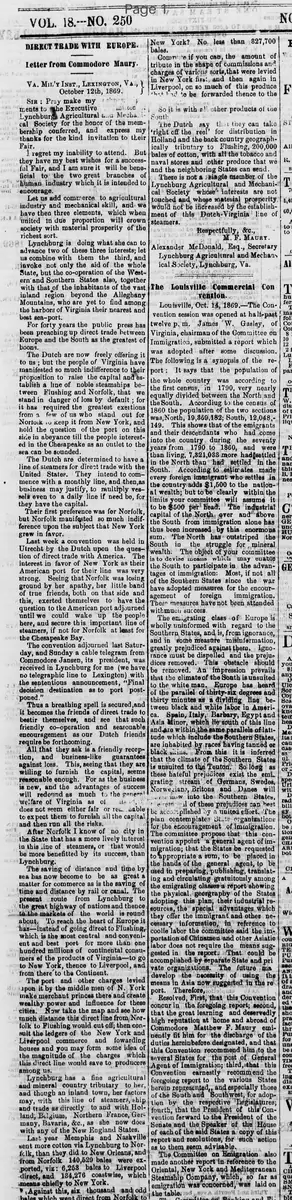
DIRECT TRADE WITH EUROPE.
Letter from Commodore Maury.
V. A. MIL'Y INST., Lexington, Va.,
October 12th, 1869.
SIR: Pray make my compliments to the Executive Committee of the Lynchburg Agricultural and Mechanical Society for the honor of the membership conferred, and express my thanks for the kind invitation to their Fair.
I regret my inability to attend. But they have my best wishes for a successful Fair, and I am sure it will be beneficial to the two great branches of human industry which it is intended to encourage.
Let us add commerce to agricultural industry and mechanical skill, and we have those three elements, which when united in due proportion will crown society with material prosperity of the richest sort.
Lynchburg is doing what she can to advance two of these three interests; let us combine with them the third, and invoke not only the aid of the whole State, but the co-operation of the Western and Southern States also, together with that of the inhabitants of the vast inland region beyond the Alleghany Mountains, who are yet to find among the harbors of Virginia their nearest and best sea-port.
For forty years the public press has been preaching up direct trade between Europe and the South as the greatest of boons.
The Dutch are now freely offering it to us; but the people of Virginia have manifested so much indifference to their proposition to raise the capital and establish a line of noble steamships between Flushing and Norfolk, that we stand in danger of loss by default; for it has required the greatest exertions from a few of us who stand out for Norfolk to keep it from New York, and hold the question of the port on this side in abeyance till the people interested in the Chesapeake as an outlet to the sea can be sounded.
The Dutch are determined to have a line of steamers for direct trade with the United States. They intend to commence with a monthly line, and then, as business may justify, to multiply vessels even to a daily line if need be, for they have the capital.
Their first preference was for Norfolk, but Norfolk manifested so much indifference upon the subject that New York grew in favor.
Last week a convention was held in Utrecht by the Dutch upon the question of direct trade with America. The interest in favor of New York as their American port for their line was very strong. Seeing that Norfolk was losing ground by her apathy, her little band of true friends, both on that side and this, exerted themselves to have the question to the American port adjourned until we could wake up the people here, and secure this important line of steamers, if not for Norfolk at least for the Chesapeake Bay.
The convention adjourned last Saturday, and Sunday a cable telegram from Commodore Jansen, its president, was received in Lynchburg for me (we have no telegraphic line to Lexington) with the sententious announcement, "Final decision destination as to port postponed."
Thus a breathing spell is secured, and it becomes the friends of direct trade to bestir themselves, and see that such friendly co-operation and seasonable encouragement as our Dutch friends require be forthcoming.
All that they ask is a friendly reception and business-like guarantees against loss. This, seeing that they are willing to furnish the capital, seems reasonable enough. For as the business is new, and the advantages of success will redound as much to the general welfare of Virginia as of Holland, does not seem either fair or reasonable to expect them to furnish all the capital and then run all the risks.
After Norfolk I know of no city in the State that has a more lively interest in this line of steamers, or that would be more benefitted by its success, than Lynchburg.
The saving of distance and time by sea has now become to be as great a matter for commerce as is the saving of time and distance by rail or canal. The present route from Lynchburg to the great highway of nations and thence to the markets of the world is round about. To reach the heart of Europe it has—instead of going direct to Flushing, which is the most central and convenient and best port for more than one hundred millions of continental consumers of the products of Virginia—to go to New York, thence to Liverpool, and from there to the Continent.
The port and other charges levied upon it by the middle men of N. York make merchant princes there and create wealthy power and influence for these cities. Now take the map and see how much distance this direct line from Norfolk to Flushing would cut off; then consult the ledgers of the New York and Liverpool commerce and forwarding houses and you may form some idea of the magnitude of the charges which this direct line would save to producers among us.
Lynchburg has a fine agricultural and mineral country tributary to her, and though an inland town, her factors may, with this line of steamers, ship and trade as directly to and with Holland, Belgium, Northern France, Germany, Bavaria, &c., as she now does with any of the New England States.
Last year Memphis and Nashville sent more cotton via Lynchburg to Norfolk, than they did to New Orleans, and from Norfolk 140,529 bales were exported, viz: 6,253 bales to Liverpool direct, and 134,276 coastwise, which means chiefly to New York? No, less than 827,700 bales.
Count, if you can, the amount of tribute in the shape of commissions and charges of various sorts, that were levied in New York first, and then again in Liverpool, on so much of this produce that had to be forwarded thence to the continent, how many went from Liverpool, to be sent thence perhaps, to the continent.
So it is with all other products of the South. The Dutch say that they can take 'right off the reel' for distribution in Holland and the back country geographically tributary to Flushing, 200,000 bales of cotton, with all the tobacco and naval stores and other produce that we and the neighboring States can send.
There is not a single member of the Lynchburg Agricultural and Mechanical Society whose interests are not touched and whose material prosperity would not be increased by the establishment of this Dutch-Virginia line of steamers.
Respectfully, &c.,
M. F. MAURY.
Alexander McDonald, Esq., Secretary Lynchburg Agricultural and Mechanical Society, Lynchburg, Va.
What sub-type of article is it?
What themes does it cover?
What keywords are associated?
What entities or persons were involved?
Where did it happen?
Story Details
Key Persons
Location
Lexington, Va.; Lynchburg, Va.; Norfolk, Va.; Flushing; Utrecht; Chesapeake Bay
Event Date
October 12th, 1869
Story Details
Commodore Maury declines invitation to Lynchburg Fair but urges support for Dutch steamship line from Flushing to Norfolk for direct trade, detailing recent Utrecht convention where decision was postponed due to Norfolk's apathy, emphasizing economic benefits and risks of losing to New York.