Thank you for visiting SNEWPapers!
Sign up free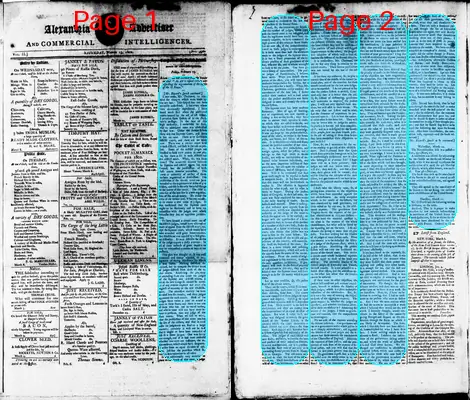
Alexandria Advertiser And Commercial Intelligencer
Alexandria, Virginia
What is this article about?
House debate on repealing the 1801 Judiciary Act features Mr. Bayard's defense of the reorganization, emphasizing no new courts, improved efficiency, and political motivations behind repeal efforts. Other actions include passing Naturalization bill and agreeing to Senate amendments on tax and military establishments. (248 characters)
Merged-components note: These components form a continuous report of the congressional debate on the judiciary bill repeal, including Mr. Bayard's speech and related proceedings, spanning from page 1 to page 2. Relabeled to domestic_news as it pertains to U.S. national politics.
Clippings

1 of 2
OCR Quality
Full Text
Mr. Bayard's [speech continued.]
I now come, Mr. Chairman, to examine the changes which were made by the late law. This subject has not been correctly understood. It has every where been erroneously represented. I have heard much said about the additional courts created by the act of last session. I perceive them spoken of in the President's message. In the face of this high authority, I undertake to state that no additional court was established by that law. Under the former system there was one Supreme Court, and there is but one now. There were seventeen district courts, and there are no more now. There was a circuit court held in each district, and such is the case at present. Some of the district judges are directed to hold their courts at new places, but there is still in each district but one district court. What, sir, has been done? The unnatural alliance between the supreme and district courts has been severed; but the jurisdiction of both these courts remains untouched. The power or authority of neither of them has been augmented or diminished. The jurisdiction of the circuit court has been extended to the cognizance of debts of 400 dollars, and this is the only material change in the power of that court. The chief operation of the late law is a new organization of the circuit courts. To avoid the evils of the former plan, it became necessary to create a new corps of judges. It was considered that the supreme court ought to be stationary and to have no connection with the judges over whose sentences they have an appellate jurisdiction.
To have formed a circuit court out of the district judges, would have allowed no court of appeal from the district court, except the supreme court, which would have been attended with great inconvenience. But this scheme was opposed by a still greater difficulty. In many districts the duties of the judge require a daily attention. In all of them business of great importance may on unexpected occurrences require his presence.
This plan was thought of: it was well examined and finally rejected in consequence of strong objections to which it was liable. Nothing therefore remained, but to compose the circuit court of judges distinct from those of the other courts. Admitting the propriety of excluding from this court the judges of the supreme and district courts, I think the late Congress cannot be accused of any wanton expense nor even of a neglect of economy in the new establishment. The extensive country has been divided into six circuits, and three judges appointed for each circuit. Most of the judges have twice a year to attend a court in three states, and there is not one of them who has not to travel farther, and who in time will not have more labour to perform, than any judge of the state courts. When we call to mind, that the jurisdiction of this court reaches the life of the citizen, and that in civil cases its judgments are final to a large amount; certainly it will not be said that it ought to have been composed of less than three judges. One was surely not enough, and if it had been doubtful whether two were not sufficient, the inconvenience, which would have frequently arisen from an equal division of opinion, justifies the provision which secures a determination in all cases.
It was additionally very material to place on the bench of this court, a judge from each state, as the court was in general bound to conform to the law and the practice of the several states. I trust, sir, the committee are satisfied that the number of judges, which compose the circuit court is not too great and that the legislature would have been extremely culpable, to have committed the high powers of this court to fewer hands. Let me now ask; if the compensation allowed to these judges is extravagant. It is little more than half the allowance made to the judges of the supreme court. It is but a small proportion of the ordinary practice of those gentlemen of the bar, who are fit, and to whom we ought to look to fill the places. You have given a salary of 2000 dollars: The puisne judges of Pennsylvania, I believe, have more. When you deduct the expenses of the office, you will leave but a moderate compensation for service, but a scanty provision for a family. When, Mr. Chairman, gentlemen coolly consider the amendments of the late law, I flatter myself their candour will at least admit that the present modification was fairly designed to meet and remedy the evils of the old system. The supreme court has been rendered stationary. Men of age, of learning, and of experience, are now capable of holding a seat on the bench; they have time to mature their opinions in causes on which they are called to decide, and they have leisure to devote to their books, and to augment their store of knowledge. It was our hope by the present establishment of the court, to render it the future pride, and honor, and safety of the nation. It is this tribunal which must stamp abroad the judicial character of our country. It is here, that ambassadors, and foreign agents, resort for justice, and it belongs to this high court to decide finally, not only on controversies of unlimited value between individuals, and on the more important collision of state pretensions, but also upon the validity of the laws of the states, and of this government. Will it be contended that such great trusts ought to be reposed in feeble or incapable hands. It has been asserted that this court will not have business to employ it. The assertion is unsupported neither by what is past, nor by what is likely to happen. During the present session of Congress, at their last term, the court was fully employed for two weeks in the daily hearing of causes. But its business must increase. There is no longer that restraint upon appeals from the circuit court, which was imposed by the authority of the judge of the court to which the appeal was to be carried: no longer will the apprehension of a secret unavoidable bias in favour of the decision of a member of their own body, shake the confidence of a suitor in resorting to this court, who thinks that justice was not done to him in the court below. The progressive increase of the wealth and population of the country, will unavoidably swell the business of the court. But there is a more certain and unfailing source of employment, which will arise in the appeals from the courts of the national territory. From the courts of original cognizance in this territory, it affords the only appellate jurisdiction. If gentlemen will look to the state of property of vast amount in this city, they must be satisfied that the supreme court will have enough to do for the money which is paid them. Let us next consider, sir, the present state of the circuit courts. There are six courts, which sit in twenty two districts, each court visits at least three districts, some four. The courts are now composed of three judges of equal power and dignity. Standing on equal ground their opinions will be independent and firm. Their number is the best for consultation, and they are exempt from the inconvenience of an equal division of opinion. But what I value most, and what was designed to remedy the great defect of the former system, is the identity which the court maintains. Each district has now always the same court. Each district will hereafter have a system of practice and uniformity of decision. The judges of each circuit will now study, and learn, and retain the laws and practice of their respective districts. It never was intended, nor is it practicable that the same rule of property or of proceeding should prevail from N. Hampshire to Georgia. The old courts were enjoined to obey, the laws of the respective states. Those laws fluctuate with the will of the state legislatures, and no other uniformity could ever be expected, but in the construction of the constitution and statutes of the United States. This uniformity is still preserved by the control of the supreme court over the courts of the circuits. Under the present establishment, a national system of jurisprudence will arise. The practice and local laws of the different districts may vary, but in the same district they will be uniform. The practice of each district will suggest improvements to the others, the progressive adoption of which will in time assimilate the systems of the several districts. It is unnecessary, Mr. Chairman, for me to say any thing in relation to the district courts. Their former jurisdiction was not varied by the law of the last session. It has been my endeavor, sir, to give a correct idea of the defects of the former judicial plan, and of the remedies for those defects introduced by the law now designed to be repealed. I do not pretend to say that the present system is perfect, I contend only that it is better than the old. If, sir, instead of destroying, gentlemen will undertake to improve the present plan, I will not only applaud their motives, but will assist in their labour. We ask only that our system may be tried. Let the sentence of experience be pronounced upon it. Let us hear the national voice after it has been felt. They will then be better able to judge its merits. In practice it has not yet been complained of; and as it is designed for the benefit of the people, how can their friends justify the act of taking it from them before they have manifested their disposition to part with it? How, sir, am I to account for the extreme anxiety to get rid of this establishment. Does it proceed from that spirit which since power has been given to it, has so unrelentingly persecuted men in office who belonged to a certain sect? I hope there will be a little patience; these judges are old and infirm men; they will die; they must die; wait but a short time, their places will be vacant; they will be filled by the disciples of the new school, and gentlemen will not have to answer for the political murder which is now meditated. I shall take the liberty now, sir, of paying some attention to the objections which have been expressed against the late establishment. An early exception which, in the course of the debate, has been abandoned by most gentlemen, and little relied on by any one, is the additional expense. The gentleman from Virginia stated the expense of the present establishment at 137,000 dollars. On this head the material question is, not what is the expense of the whole establishment, but what will be saved by the repealing law on the table. I do not estimate the saving at more than 28,500 dolls. You save nothing but the salaries of 16 judges of 2000 dollars each. From this amount is to be deducted the salary of a judge of the supreme court, which is 3,500 dollars. Abolishing the present system will not vary the incidental expenses of the circuit court. You revive a circuit court whose incidental expenses will be equal to those of the court you destroy. The increased salaries of the district judges of Kentucky and Tennessee must remain. It is not proposed to abolish their offices, and the admissions on the other side allow that the salaries cannot be reduced. If there were no other objection, the present bill could not pass without amendment, because it reduces the salaries of those judges, which is a plain undeniable infraction of the constitution. But; sir, it is not a fair way of treating the subject to speak of the aggregate expense. The great enquiry is, whether the judges are necessary, and whether the salaries allowed to them are reasonable? Admitting the utility of the judges, I think no gentleman will contend, that the compensation is extravagant. We are told of the expense attending the federal judiciary. Can gentlemen tell me of a government under which justice is more cheaply administered; add together the salaries of all your judges and the amount but little exceeds the emoluments of the Chancellor of England. Ascertain the expenses of state justice, and the proportion of each state of the expense of federal justice, and you will find that the former is five times greater than the latter. Do gentlemen expect that a system expanded over the whole union is to cost no more than the establishment of a single state? Let it be remembered, sir. that the judiciary is an integral and coordinate part with the highest branches of the government. No government can long exist without an efficient judiciary. It is the judiciary which applies the law and enables the executive to carry it into effect. Leave your laws to the judiciaries of the states to execute and my word for it in ten years you have neither law nor constitution. Is your judiciary so costly that you will not support it? Why then lay out so much money upon the other branches of your government? I beg that it will be recollected that if your judiciary costs you thousands of dollars, your legislature costs you hundreds of thousands. and your executive millions. An objection has been derived from the paucity of causes in the federal courts and the objection has been magnified by the allegation, that the number had been annually decreasing. The facts admitted, I draw a very different inference from my opponents. In my opinion they furnish the strongest proof of the defects of the former establishment, and of the necessity of a reform. I have no doubt, nay, I know it to be a fact, that many suitors were diverted from those tribunals by the fluctuations to which they were subject. Allow me, however, to take some notice of the facts. They are founded upon the Presidential document, No. 8. Taking the facts as there stated, they allow upwards of 20 suits annually, for each court, when it is considered that these causes must each exceed the value of 500 dols. and that they were generally litigated cases, I do not conceive, that there is much ground to affirm, that the courts were without business. But, sir, I must be excused for saying, I pay little respect to this document. It has been shown by others in several points to be erroneous, and from my own knowledge, I know it to be incorrect. What right had the President to call upon the clerks to furnish him with a list of the suits which had been brought. or were depending in their respective courts? Had this been directed by Congress, or was there any money appropriated to pay the expense? Is there any law which made it the duty of the clerks to obey the order of the executive? Are the clerks responsible for refusing the lists, or for making false or defective returns? Do we know any thing about the authenticity of the certificates made by the clerks? And are we not now aiming a mortal blow at one branch of the government, upon the credit and the instigation of another and a rival department?. Yes, sir, I say at the instigation of the President, for I consider this business wholly as a Presidential measure. This document and his message, show that it originated with him; I consider it as now prosecuted by him, and I believe, that he has the power to arrest its progress, or to accomplish its completion. I repeat that it is his measure. I hold him responsible for it; and I trust in God that the time will come, when he will be called upon to answer for it as his act. And I trust the time will arrive, when he will hear us speaking upon the subject more effectually. It has been stated as the reproach, sir, of the bill of the last session, that it was made by a party at the moment when they were sensible that their power was expiring and passing into other hands. It is enough for me, that the full and legitimate power existed. The remnant was plenary and efficient. And it was our duty to employ it according to our judgments and consciences for the good of the country. We thought the bill a salutary measure, and there was no obligation upon us to leave it as a work for our successors. Nay, sir, I have no hesitation in avowing, that I had no confidence in the persons who were to follow us. And I was the more anxious while we had the means to accomplish a work which I believed they would not do, and which I sincerely thought, would contribute to the safety of the nation by giving strength and support. to the constitution through the storm to which it was likely to be exposed. The fears, which I then felt, have not been dispelled, but multiplied by what I have since seen. I know nothing which is to be allowed to stand. I observe the institutions of the government falling around me, and where the work of destruction is to end God alone knows. We discharged our consciences in establishing a judicial system, which now exists, and it will be for those who now hold the power of the government to answer for the abolition of it, which they at present meditate. We are told that our law was against the sense of the nation Let me tell those gentlemen, they are deceived, when they call themselves the nation. They are only a dominant party, and though the sun of federalism should never rise again, they will shortly find men better or worse than themselves thrusting them out of their places. I know it is the cant of those in power. however they have acquired it, to call themselves the nation. We have recently witnessed an example of it abroad. How rapidly did the nation change in France, at one time Brissot called himself the nation --then Robespierre, afterwards Tallien and Barras, and finally. Buonaparte. but their dreams were soon dissipated, and they awoke in succession upon the scaffold, or in banishment. Let not these gentlemen flatter themselves, that heaven has reserved for them a peculiar destiny. What has happened to others in this country, they must be liable to. Let them not exult too highly in the enjoyment of a little brief and fleeting authority. It was ours yesterday, it is theirs to day, but tomorrow it may belong to others. [Mr. Bayard here stated, that he had gone through the remarks he had to make connected with the first point of the debate : that he observed, that the common hour of adjournment had gone by, and that he should sit down in order to allow the committee to rise, if they thought proper : and that he should beg leave to be heard the following day upon the second point. After some conversation, the committee rose, reported--and the house adjourned.] [Mr. Bayard's Speech to be continued.] Wednesday, March 10. The Naturalization bill was passed- Yeas, 59-Nays, 27. A resolution was offered for adjourning the two houses on the second Monday in April, when it was moved to postpone the consideration of it until the 4th Monday of March, which, after debate, was carried. Yeas 46-Nays 42. The house then took up the amendment of the Senate to the act to amend an act to lay and collect a direct tax, and agreed thereto. They also agreed to the amendment of the Senate to the act fixing the military peace establishment of the United States. Thursday. March 11. Mr. Griswold laid the following motion in substance, on the table. Resolved, That it is proper to make provision by law towards indemnifying the merchants of the United States for French spoliations, so far as claims for the same have been abandoned by the convention with France. Ordered to lie on the table.
What sub-type of article is it?
What keywords are associated?
What entities or persons were involved?
Domestic News Details
Event Date
March 1802
Key Persons
Outcome
debate on judiciary repeal bill continues; naturalization bill passed (yeas 59, nays 27); adjournment resolution postponed (yeas 46, nays 42); senate amendments to direct tax act and military peace establishment act agreed to; motion on indemnifying merchants for french spoliations laid on table.
Event Details
In the House, Mr. Bayard defends the recent judicial reorganization law against repeal, clarifying no new courts were created, jurisdiction unchanged except for circuit courts extending to $400 debts, and new circuit judges appointed for efficiency. He argues the system improves appellate processes, ensures uniformity, and is economically justified. He criticizes the push for repeal as politically motivated. Speech continued next day. On March 10, Naturalization bill passed, adjournment resolution postponed, Senate amendments to tax and military acts agreed. On March 11, Mr. Griswold's resolution for indemnifying merchants for French spoliations ordered to lie on table.