Thank you for visiting SNEWPapers!
Sign up free
Independent Journal, Or, The General Advertiser
New York, New York County, New York
What is this article about?
Criticism of a French naval commander's inhumane treatment of captured British officers and sailors from an English frigate seized by his squadron in India on January 10, 1783, leading to forced enlistments and deaths at sea.
Clipping
OCR Quality
Full Text
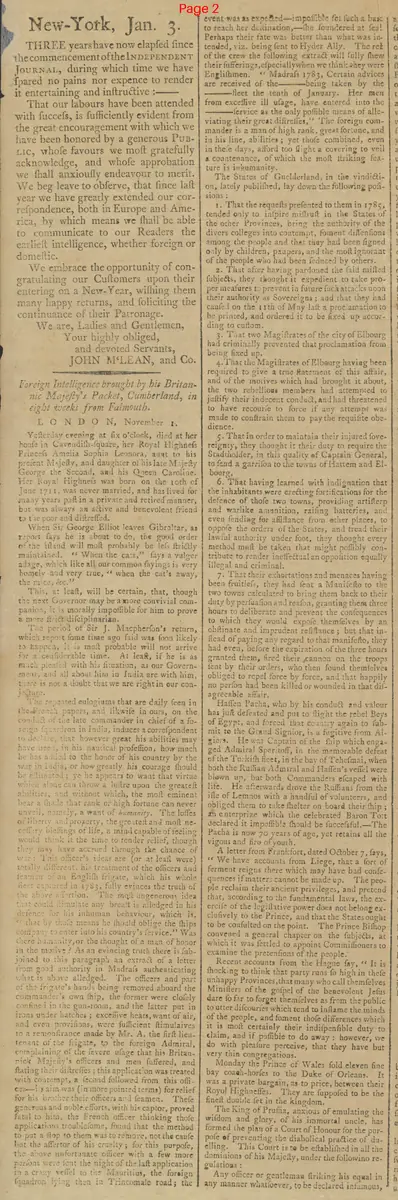
The loss of liberty and property, the greatest and most necessary blessings of life, a mind capable of feeling would think it the time to tender relief, though they may have accrued through the chance of war. This officer's ideas are (or at least were) totally different. His treatment of the officers and seamen of an English frigate, which his whole squadron captured in 1783, fully evinces the truth of the above assertion.
The most ungenerous idea that could stimulate any breast is alleged in his defence: For his inhuman behaviour, which is, that by those means he should oblige the ship's company to enter into his country's service. Was there humanity, or the thought of a man of honor in the motive?
As an evincing truth there is subjoined to this paragraph an extract of a letter from good authority in Madras authenticating what is above alleged. The officers and part of the frigate's hands being removed aboard the commander's own ship, the former were closely confined in the gun-room, and the latter put in irons under hatches; excessive heats, want of air, and even provisions, were sufficient stimulatives to a remonstrance made by Mr. A. the first lieutenant of the frigate, to the foreign Admiral, complaining of the severe usage that his Britannic Majesty's officers and men suffered, and stating their distress; this application was treated with contempt, a second followed from this officer, whose aim was (in more pointed terms) for relief for his brother officers and seamen.
These generous and noble efforts, with his captor, proved fatal to him, the French officer thinking those applications troublesome, found that the method to put a stop to them was to remove, not the cause but the asserter of his cruelty; for this purpose, the above unfortunate officer with a few more persons were sent the night of the last application in a crazy vessel to the Mauritius, the foreign squadron lying then in Trincomalee road; the event was as expected--impossible for such a boat to reach her destination,--she foundered at sea! Perhaps their fate was better than what was intended, viz, being sent to Hyder Ally.
The rest of the crew the following extract will fully show their sufferings, especially when we think they were Englishmen. "Madras 1783, Certain advices are received of the --- being taken by the --- fleet the tenth of January. Her men from excessive ill usage, have entered into the service as the only possible means of alleviating their great distress."
The foreign commander is a man of high rank, great fortune, and in his line abilities: yet those combined, even in these days, afford too slight a covering to veil a countenance, of which the most striking feature is inhumanity.
What sub-type of article is it?
What keywords are associated?
What entities or persons were involved?
Where did it happen?
Foreign News Details
Primary Location
India
Event Date
1783 01 10
Key Persons
Outcome
english frigate captured; officers and men suffered severe confinement, lack of provisions, and heat; many crew entered french service to escape distress; mr. a. and others sent to mauritius in unseaworthy vessel that foundered at sea, presumed lost.
Event Details
A French squadron under a high-ranking commander captured an English frigate in India in January 1783. Captured British officers were confined in the gun-room, and seamen ironsed under hatches with insufficient air and provisions. First Lieutenant Mr. A. protested twice to the French Admiral, but was ignored and then sent with others in a leaky boat to Mauritius from Trincomalee, where the vessel sank at sea. The remaining crew endured such mistreatment that they joined French service for relief. The commander aimed to force enlistments through cruelty.