Thank you for visiting SNEWPapers!
Sign up free
Editorial
November 22, 1808
The Enquirer
Richmond, Henrico County, Virginia
What is this article about?
Editorial critiques various congressional propositions on US foreign relations amid tensions with Britain and France, rejecting war, submission, or partial embargo relaxations. Advocates continuing and enforcing the embargo, adopting non-intercourse laws, and protective duties to support domestic manufactures.
Clipping
OCR Quality
95%
Excellent
Full Text
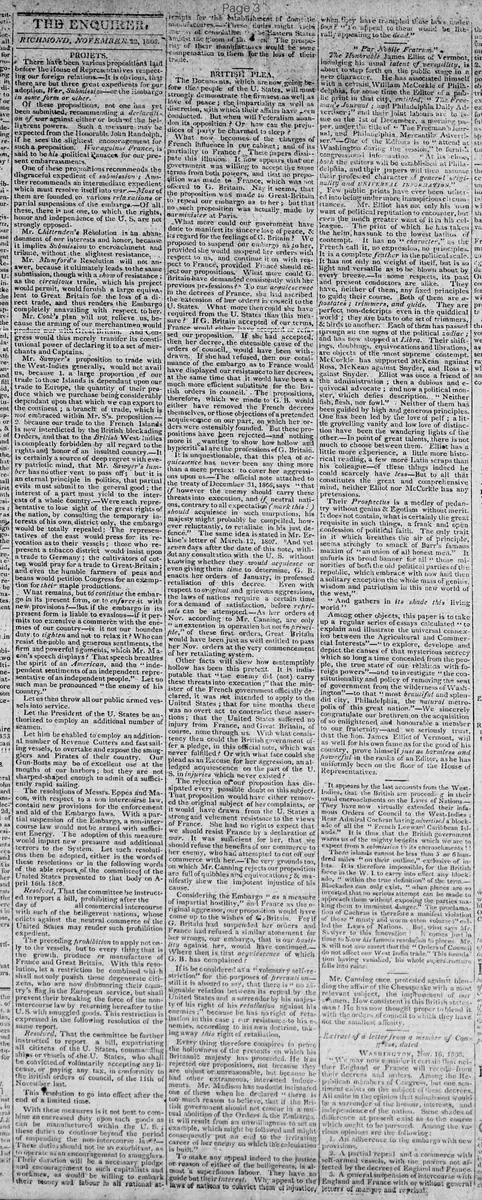
THE ENQUIRER.
RICHMOND. NOVEMBER 22, 1808.
PROJETS.
There have been various propositions laid before the House of Representatives respecting our foreign relations.—It is obvious, that there are but three great expedients for our adoption, War, Submission—or the Embargo in some form or other.
Of these propositions, not one has yet been submitted, recommending a declaration of war against either or both of the belligerent powers. Such a measure may be expected from the Honourable John Randolph, if he sees the slightest encouragement for such a proposition. War against France, is said to be his political Panacea for our present embarrassments.
One of these propositions recommends the disgraceful expedient of submission; Another recommends an intermediate expedient which must resolve itself into war.—Most of them are founded on various relaxations or partial suspensions of the embargo.—Of all these, there is not one, to which the rights, honor and independence of the U. S. are not strongly opposed—
Mr. Chittenden's Resolution is an abandonment of our interests and honor, because it implies Submission to encroachment and tribute, without the slightest resistance...
Mr. Mumford's Resolution will not answer, because it ultimately leads to the same submission, though with a show of resistance; as the circuitous trade, which his project would permit, would furnish a large equivalent to Great Britain for the loss of a direct trade, and thus renders the Embargo completely unavailing with respect to her.
Mr. Cook's plan will not relieve us, because the arming of our merchantmen would entail. And congress would thus merely transfer its constitutional power of declaring it to a set of merchants and Captains.
Mr. Sawyer's proposition to trade with the West-Indies generally, would not avail us, because 1. a large proportion of our trade to those Islands is dependant upon our trade to Europe, the quantity of their produce which we purchase being considerably dependant upon that which we can export to the continent; a branch of trade, which is not embraced within Mr. S's. proposition.—2. because our trade to the French Islands is now interdicted by the British blockading Orders, and that to the British West-indies is compleatly forbidden by all regard to the rights and honor of an insulted country.—It is certainly a source of deep regret with every patriotic mind, that Mr. Sawyer's lumber has no other vent to pass off; but it is an eternal principle in politics, that partial evils must submit to the general good; the interest of a part must yield to the interests of a whole country.—Were each representative to lose sight of the great rights of the nation, by consulting the temporary interests of his own, district only, the embargo would be totally repealed: The representatives of the east would press for its revocation as to their vessels; those who represent a tobacco district would insist upon a trade to Germany; the cultivators of cotton would pray for a trade to Great-Britain; and even the humble farmers of peas and beans would petition Congress for an exemption for their staple productions...
What remains, but to continue the embargo in its present form, or to enforce it with new provisions? But if the embargo in its present form is liable to evasions—if it permits too extensive a commerce with the enemies of our country—is it not our bounden duty to tighten and not to relax it? Who can resist the noble and generous sentiments, the firm and powerful arguments, which Mr. Mason's speech displays? That speech breathes the spirit of an American, and the "independent sentiments of an independent representative of an independent people." Let no such man be pronounced "the enemy of his country."
Let us then throw all our public armed vessels into service. Let the President of the U. States be authorized to employ an additional number of seamen. Let him be enabled to employ an additional number of Revenue Cutters and fast sailing vessels, to overtake and expose the smugglers and Pirates of their country. Our Gun-Boats may be of excellent use at the mouths of our harbors; but they are not sharp-shaped enough to admit of a sufficiently rapid sailing.
The resolutions of Messrs. Eppes and Mason, with respect to a non intercourse law, contain new provisions for the enforcement and aid of the Embargo laws. With a partial suspension of the Embargo, a non-intercourse law would not be armed with sufficient Energy. The adoption of this measure would impart new pressure and additional terrors to the System. Let such resolutions then be adopted, either in the words of these resolutions or in the following words of the able report of the committee of the United States presented to that body on April 16th 1808.
Resolved, That the committee be instructed to report a bill, prohibiting after the day of all commercial intercourse with such of the belligerent nations, whose edicts against the neutral commerce of the United States may render such prohibition expedient.
The preceding prohibition to apply not only to the vessels, but to every thing that is the growth, produce or manufacture of France and Great Britain. With this resolution, let a restriction be combined which shall not only punish those degenerate citizens, who are now dishonoring their country's flag in the European service, but shall prevent their breaking the force of the non-intercourse law by returning hereafter to the U.S. with smuggled goods. This restriction is expressed in the following resolution of the same report.
Resolved, That the committee be further instructed to report a bill, expatriating all citizens of the U. States, commanding ships or vessels of the U. States, who shall be convicted of voluntarily accepting any license, or paying any tax, in conformity to the British orders of council, of the 11th of November last.
This resolution to go into effect after the end of a limited time.
With these measures is it not best to combine an increased duty upon such goods as can be manufactured within the U. S.: these duties to continue beyond the period of suspending the non-intercourse law—These duties should not be so exorbitant, as to operate as an encouragement to smugglers. Their duration will be a necessary pledge and encouragement to such capitalists and workmen, as would be willing to embark their money and labour in all rational attempts for the establishment of domestic manufactures.—These duties might yield a source of consolation to the Eastern States amidst the gloom of their prospects. The prosperity of their manufactures would be some compensation to them for the loss of their trade.
RICHMOND. NOVEMBER 22, 1808.
PROJETS.
There have been various propositions laid before the House of Representatives respecting our foreign relations.—It is obvious, that there are but three great expedients for our adoption, War, Submission—or the Embargo in some form or other.
Of these propositions, not one has yet been submitted, recommending a declaration of war against either or both of the belligerent powers. Such a measure may be expected from the Honourable John Randolph, if he sees the slightest encouragement for such a proposition. War against France, is said to be his political Panacea for our present embarrassments.
One of these propositions recommends the disgraceful expedient of submission; Another recommends an intermediate expedient which must resolve itself into war.—Most of them are founded on various relaxations or partial suspensions of the embargo.—Of all these, there is not one, to which the rights, honor and independence of the U. S. are not strongly opposed—
Mr. Chittenden's Resolution is an abandonment of our interests and honor, because it implies Submission to encroachment and tribute, without the slightest resistance...
Mr. Mumford's Resolution will not answer, because it ultimately leads to the same submission, though with a show of resistance; as the circuitous trade, which his project would permit, would furnish a large equivalent to Great Britain for the loss of a direct trade, and thus renders the Embargo completely unavailing with respect to her.
Mr. Cook's plan will not relieve us, because the arming of our merchantmen would entail. And congress would thus merely transfer its constitutional power of declaring it to a set of merchants and Captains.
Mr. Sawyer's proposition to trade with the West-Indies generally, would not avail us, because 1. a large proportion of our trade to those Islands is dependant upon our trade to Europe, the quantity of their produce which we purchase being considerably dependant upon that which we can export to the continent; a branch of trade, which is not embraced within Mr. S's. proposition.—2. because our trade to the French Islands is now interdicted by the British blockading Orders, and that to the British West-indies is compleatly forbidden by all regard to the rights and honor of an insulted country.—It is certainly a source of deep regret with every patriotic mind, that Mr. Sawyer's lumber has no other vent to pass off; but it is an eternal principle in politics, that partial evils must submit to the general good; the interest of a part must yield to the interests of a whole country.—Were each representative to lose sight of the great rights of the nation, by consulting the temporary interests of his own, district only, the embargo would be totally repealed: The representatives of the east would press for its revocation as to their vessels; those who represent a tobacco district would insist upon a trade to Germany; the cultivators of cotton would pray for a trade to Great-Britain; and even the humble farmers of peas and beans would petition Congress for an exemption for their staple productions...
What remains, but to continue the embargo in its present form, or to enforce it with new provisions? But if the embargo in its present form is liable to evasions—if it permits too extensive a commerce with the enemies of our country—is it not our bounden duty to tighten and not to relax it? Who can resist the noble and generous sentiments, the firm and powerful arguments, which Mr. Mason's speech displays? That speech breathes the spirit of an American, and the "independent sentiments of an independent representative of an independent people." Let no such man be pronounced "the enemy of his country."
Let us then throw all our public armed vessels into service. Let the President of the U. States be authorized to employ an additional number of seamen. Let him be enabled to employ an additional number of Revenue Cutters and fast sailing vessels, to overtake and expose the smugglers and Pirates of their country. Our Gun-Boats may be of excellent use at the mouths of our harbors; but they are not sharp-shaped enough to admit of a sufficiently rapid sailing.
The resolutions of Messrs. Eppes and Mason, with respect to a non intercourse law, contain new provisions for the enforcement and aid of the Embargo laws. With a partial suspension of the Embargo, a non-intercourse law would not be armed with sufficient Energy. The adoption of this measure would impart new pressure and additional terrors to the System. Let such resolutions then be adopted, either in the words of these resolutions or in the following words of the able report of the committee of the United States presented to that body on April 16th 1808.
Resolved, That the committee be instructed to report a bill, prohibiting after the day of all commercial intercourse with such of the belligerent nations, whose edicts against the neutral commerce of the United States may render such prohibition expedient.
The preceding prohibition to apply not only to the vessels, but to every thing that is the growth, produce or manufacture of France and Great Britain. With this resolution, let a restriction be combined which shall not only punish those degenerate citizens, who are now dishonoring their country's flag in the European service, but shall prevent their breaking the force of the non-intercourse law by returning hereafter to the U.S. with smuggled goods. This restriction is expressed in the following resolution of the same report.
Resolved, That the committee be further instructed to report a bill, expatriating all citizens of the U. States, commanding ships or vessels of the U. States, who shall be convicted of voluntarily accepting any license, or paying any tax, in conformity to the British orders of council, of the 11th of November last.
This resolution to go into effect after the end of a limited time.
With these measures is it not best to combine an increased duty upon such goods as can be manufactured within the U. S.: these duties to continue beyond the period of suspending the non-intercourse law—These duties should not be so exorbitant, as to operate as an encouragement to smugglers. Their duration will be a necessary pledge and encouragement to such capitalists and workmen, as would be willing to embark their money and labour in all rational attempts for the establishment of domestic manufactures.—These duties might yield a source of consolation to the Eastern States amidst the gloom of their prospects. The prosperity of their manufactures would be some compensation to them for the loss of their trade.
What sub-type of article is it?
Foreign Affairs
Economic Policy
War Or Peace
What keywords are associated?
Embargo Enforcement
Non Intercourse Law
Foreign Relations
Belligerent Powers
War Propositions
Submission Critique
Domestic Manufactures
What entities or persons were involved?
John Randolph
Mr. Chittenden
Mr. Mumford
Mr. Cook
Mr. Sawyer
Mr. Mason
Messrs. Eppes And Mason
President Of The U. States
France
Great Britain
House Of Representatives
Editorial Details
Primary Topic
Propositions On Foreign Relations And Embargo Enforcement
Stance / Tone
Advocacy For Stricter Embargo And Non Intercourse Against Belligerents
Key Figures
John Randolph
Mr. Chittenden
Mr. Mumford
Mr. Cook
Mr. Sawyer
Mr. Mason
Messrs. Eppes And Mason
President Of The U. States
France
Great Britain
House Of Representatives
Key Arguments
No Proposition For War Yet, But Expected From John Randolph Against France
Chittenden's Resolution Implies Submission Without Resistance
Mumford's Allows Circuitous Trade Benefiting Britain
Cook's Arming Merchantmen Transfers War Power Unconstitutionally
Sawyer's West Indies Trade Ignores Dependencies On Europe And British Interdictions
Continue And Tighten Embargo To Prevent Evasions
Adopt Non Intercourse Prohibiting Trade With Belligerents
Expatriate Citizens Accepting British Licenses
Impose Duties On Importable Domestic Goods To Encourage Manufactures