Thank you for visiting SNEWPapers!
Sign up free
Editorial
October 17, 1792
National Gazette
Philadelphia, Philadelphia County, Pennsylvania
What is this article about?
An editorial defending the U.S. Secretary of the Treasury against misrepresentations in the National Gazette, clarifying his views on public debt as not endorsing it as a general blessing but useful in specific situations like the early U.S., and criticizing the accuser as an impostor. Dated Philadelphia, October 16.
Clipping
OCR Quality
95%
Excellent
Full Text
For the National Gazette.
GENUINE Truth never deviates into misrepresentation. That an impostor has assumed its name in the National Gazette of the 10th inst. is sufficiently evinced by the following circumstance.
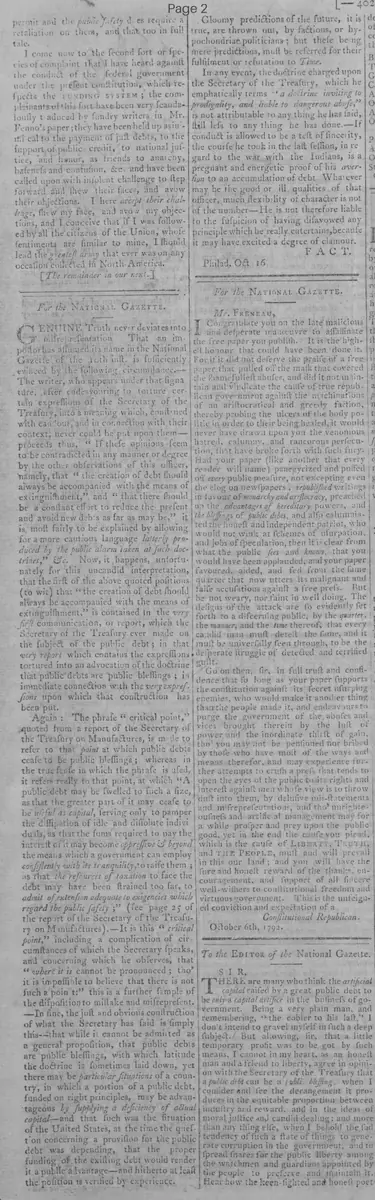
The writer, who appears under that signature, after endeavouring to torture certain expressions of the Secretary of the Treasury, into a meaning which, construed with candour, and in connection with their context, never could be put upon them— proceeds thus, "If these opinions seem to be contradicted in any manner or degree by the other observations of this officer, namely, that "the creation of debt should always be accompanied with the means of extinguishment," and "that there should be a constant effort to reduce the present and avoid new debts as far as may be," it is most fairly to be explained by allowing for a more cautious language latterly produced by the public alarm taken at such doctrines," &c. Now, it happens, unfortunately for this uncandid interpretation, that the first of the above quoted positions (to wit) that "the creation of debt should always be accompanied with the means of extinguishment," is contained in the very first communication, or report, which the Secretary of the Treasury ever made on the subject of the public debt; in that very report which contains the expressions tortured into an advocation of the doctrine that public debts are public blessings; in immediate connection with the very expressions upon which that construction has been put.
Again: The phrase "critical point," quoted from a report of the Secretary of the Treasury on Manufactures, is made to refer to that point at which public debts cease to be public blessings; whereas in the true sense in which the phrase is used, it refers really to that point, at which "A public debt may be swelled to such a size, as that the greater part of it may cease to be useful as capital, serving only to pamper the dissipation of idle and dissolute individuals, as that the sums required to pay the interest of it may become oppressive & beyond the means which a government can employ consistently with its tranquility, to raise them; as that the resources of taxation to face the debt may have been strained too far, to admit of extension adequate to exigencies which regard the public safety;" (see page 25 of the report of the Secretary of the Treasury on Manufactures).--It is this "critical point," including a complication of circumstances of which the Secretary speaks, and concerning which he observes, that "where it is cannot be pronounced; tho it is impossible to believe that there is not such a point:" this is a further sample of the disposition to mistake and misrepresent.
-In fine, the just and obvious construction of what the Secretary has said is simply this--that while it cannot be admitted as a general proposition, that public debts are public blessings, with which latitude the doctrine is sometimes laid down, yet there may be particular situations of a country, in which a portion of a public debt, funded on right principles, may be advantageously supplying a deficiency of actual capital--and that such was the situation of the United States, at the time the question concerning a provision for the public debt was depending, that the proper funding of the existing debt would render it a public advantage—and hitherto at least the position is verified by experience.
Gloomy predictions of the future, it is true, are thrown out, by factious, or hypochondriac politicians; but these being mere predictions, must be referred for their fulfilment or refutation to Time.
In any event, the doctrine charged upon the Secretary of the Treasury, which he emphatically terms a doctrine inviting to prodigality, and liable to dangerous abuse, is not attributable to any thing he has said, still less to any thing he has done.-If conduct is allowed to be a test of sincerity, the course he took in the last session, in regard to the war with the Indians, is a pregnant and energetic proof of his aversion to an accumulation of debt. Whatever may be the good or ill qualities of that officer, much flexibility of character is not of the number-He is not therefore liable to the suspicion of having disavowed any principle which he really entertains, because it may have excited a degree of clamour.
FACT.
Philad. Oct 16
GENUINE Truth never deviates into misrepresentation. That an impostor has assumed its name in the National Gazette of the 10th inst. is sufficiently evinced by the following circumstance.
The writer, who appears under that signature, after endeavouring to torture certain expressions of the Secretary of the Treasury, into a meaning which, construed with candour, and in connection with their context, never could be put upon them— proceeds thus, "If these opinions seem to be contradicted in any manner or degree by the other observations of this officer, namely, that "the creation of debt should always be accompanied with the means of extinguishment," and "that there should be a constant effort to reduce the present and avoid new debts as far as may be," it is most fairly to be explained by allowing for a more cautious language latterly produced by the public alarm taken at such doctrines," &c. Now, it happens, unfortunately for this uncandid interpretation, that the first of the above quoted positions (to wit) that "the creation of debt should always be accompanied with the means of extinguishment," is contained in the very first communication, or report, which the Secretary of the Treasury ever made on the subject of the public debt; in that very report which contains the expressions tortured into an advocation of the doctrine that public debts are public blessings; in immediate connection with the very expressions upon which that construction has been put.
Again: The phrase "critical point," quoted from a report of the Secretary of the Treasury on Manufactures, is made to refer to that point at which public debts cease to be public blessings; whereas in the true sense in which the phrase is used, it refers really to that point, at which "A public debt may be swelled to such a size, as that the greater part of it may cease to be useful as capital, serving only to pamper the dissipation of idle and dissolute individuals, as that the sums required to pay the interest of it may become oppressive & beyond the means which a government can employ consistently with its tranquility, to raise them; as that the resources of taxation to face the debt may have been strained too far, to admit of extension adequate to exigencies which regard the public safety;" (see page 25 of the report of the Secretary of the Treasury on Manufactures).--It is this "critical point," including a complication of circumstances of which the Secretary speaks, and concerning which he observes, that "where it is cannot be pronounced; tho it is impossible to believe that there is not such a point:" this is a further sample of the disposition to mistake and misrepresent.
-In fine, the just and obvious construction of what the Secretary has said is simply this--that while it cannot be admitted as a general proposition, that public debts are public blessings, with which latitude the doctrine is sometimes laid down, yet there may be particular situations of a country, in which a portion of a public debt, funded on right principles, may be advantageously supplying a deficiency of actual capital--and that such was the situation of the United States, at the time the question concerning a provision for the public debt was depending, that the proper funding of the existing debt would render it a public advantage—and hitherto at least the position is verified by experience.
Gloomy predictions of the future, it is true, are thrown out, by factious, or hypochondriac politicians; but these being mere predictions, must be referred for their fulfilment or refutation to Time.
In any event, the doctrine charged upon the Secretary of the Treasury, which he emphatically terms a doctrine inviting to prodigality, and liable to dangerous abuse, is not attributable to any thing he has said, still less to any thing he has done.-If conduct is allowed to be a test of sincerity, the course he took in the last session, in regard to the war with the Indians, is a pregnant and energetic proof of his aversion to an accumulation of debt. Whatever may be the good or ill qualities of that officer, much flexibility of character is not of the number-He is not therefore liable to the suspicion of having disavowed any principle which he really entertains, because it may have excited a degree of clamour.
FACT.
Philad. Oct 16
What sub-type of article is it?
Economic Policy
Partisan Politics
What keywords are associated?
Public Debt
Treasury Secretary
Misrepresentation
Funded Debt
Economic Policy
Partisan Criticism
Indian War
What entities or persons were involved?
Secretary Of The Treasury
Impostor Writer
Factious Politicians
Editorial Details
Primary Topic
Defense Of Secretary Of The Treasury's Public Debt Policies
Stance / Tone
Defensive Clarification Against Misrepresentations
Key Figures
Secretary Of The Treasury
Impostor Writer
Factious Politicians
Key Arguments
Genuine Truth Avoids Misrepresentation; Impostor Misinterprets Treasury Secretary's Words.
Secretary's Quote On Debt Extinguishment Is From His First Report, Connected To The Disputed Expressions.
Phrase 'Critical Point' Refers To Excessive Debt Dangers, Not Where Debts Cease To Be Blessings.
Public Debt Not Generally A Blessing, But Funded Debt Can Supply Capital In Specific U.S. Situations.
Predictions Of Doom By Factious Politicians To Be Tested By Time.
Secretary's Actions, Like Opposing Indian War Debt, Prove Sincerity Against Debt Accumulation.