Thank you for visiting SNEWPapers!
Sign up free
New York Tribune
New York, New York County, New York
What is this article about?
Detailed report of U.S. Senator Charles Sumner's funeral on March 16 in Boston, covering autopsy results, public mourning, procession, church services at King's Chapel, burial at Mount Auburn, and tributes from political groups praising his lifelong fight for emancipation and justice. (248 characters)
Clipping
OCR Quality
Full Text
THE LAST HOURS IN BOSTON.
PUBLIC MOURNING—RESULTS OF THE AUTOPSY—THE CHURCH DECORATIONS—THE SERVICES IN KING'S CHAPEL—APPROPRIATE TEXTS—THE PRAYER HYMNS AT THE GRAVE.
[BY TELEGRAPH TO THE TRIBUNE.]
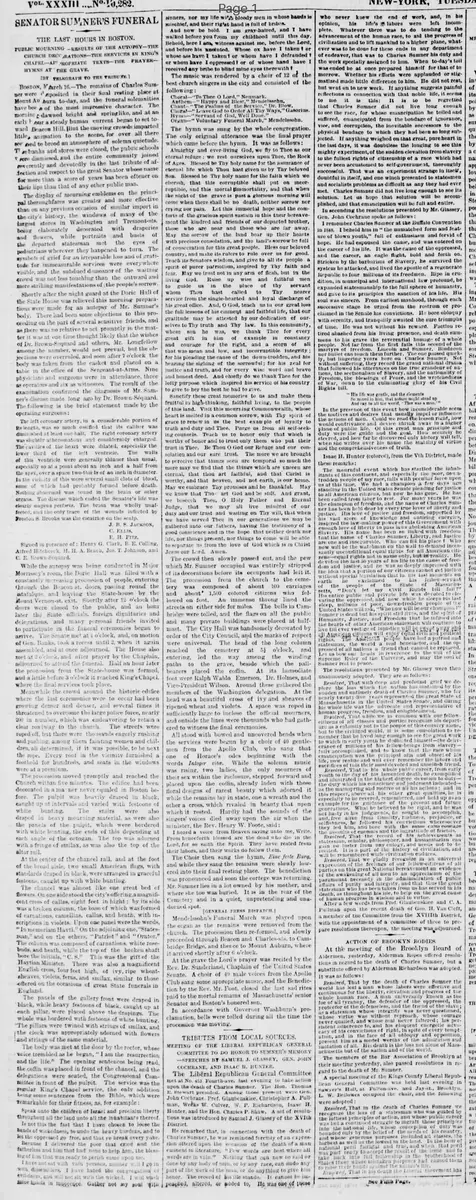
Boston, March 16.—The remains of Charles Sumner were deposited in their final resting place at Mount Auburn to-day, and the funeral solemnities have been of the most impressive character. The morning dawned bright and springlike, and at an early hour a steady human current began to set toward Beacon Hill. But the moving crowds imparted little animation to the scene, for over all there seemed to brood an atmosphere of solemn quietude. Banks and stores were closed, the public schools were dismissed, and the entire community joined reverently and devotedly in the last tribute of affection and respect to the great Senator whose name for more than a score of years has been oftener on their lips than that of any other public man.
The display of mourning emblems on the principal thoroughfares was greater and more effective than on any previous occasion of similar import in the city's history, the windows of many of the largest stores in Washington and Tremont-sts. being elaborately decorated with draperies and flowers, while portraits and busts of the departed statesman met the eyes of pedestrians wherever they happened to turn. The symbols of grief for an irreparable loss and of gratitude for immeasurable services were everywhere visible, and the subdued demeanor of the waiting crowd was not less touching than the outward and more striking manifestations of the people's sorrow.
Shortly after the night guard at the Doric Hall of the State House was relieved this morning preparations were made for an autopsy of Mr. Sumner's body. There had been some objections to this proceeding on the part of several sensitive friends, and as there was no relative to act promptly in the matter it was at one time thought likely that the wishes of Dr. Brown-Séquard and others, Mr. Longfellow among the number, would not prevail, but the objections were overruled, and soon after 7 o'clock the body was taken from the casket and placed on a table in the office of the Sergeant-at-Arms. Nine physicians and surgeons were in attendance, three as operators and six as witnesses. The result of the examination confirmed the diagnosis of Mr. Sumner's disease made long ago by Dr. Brown-Séquard.
The following is the brief statement made by the operating surgeons:
The left coronary artery, in a considerable portion of its length, was so much ossified that its caliber was diminished at least one-half. The right coronary artery was slightly atheromatous and considerably enlarged.
The cavities of the heart were dilated, especially the lower third of the left ventricle. The walls of this ventricle were generally thinner than usual, especially so at a point about an inch and a half from the apex, over a space two-thirds of an inch in diameter.
In the vicinity of this were several small clots of blood, some of which had probably formed before death.
Nothing abnormal was found in the brain or other organs. The disease which ended the Senator's life was clearly angina pectoris. The brain was wholly unaffected, and the only trace of the wounds inflicted by Preston S. Brooks was the cicatrice on the scalp.
J. B. S. JACKSON,
C. ELLIS,
E. H. FITZ.
Signed in presence of: Henry G. Clark, B. E. Cotting, Alfred Hitchcock, H. H. A. Beach, Jos. T. Johnson, and C. E. Brown-Séquard.
While the autopsy was being conducted in Major Morrissey's room, the Doric Hall was filled with a constantly increasing procession of people, entering through the Beacon-st. doors, passing round the catafalque, and leaving the State-house by the Mount Vernon-st. exit. Shortly after 12 o'clock the doors were closed to the public, and an hour later the State officials, foreign dignitaries and delegations, and many personal friends invited to participate in the funeral ceremonies began to arrive. The Senate met at 1 o'clock, and, on motion of Gen. Banks, took a recess until 2, when it again assembled, and at once adjourned. The House also met at 2 o'clock, and after prayer by the Chaplain, adjourned to attend the funeral. Half an hour later the procession from the State-house was formed, and a little before 3 o'clock it reached King's Chapel, where the final services took place.
Meanwhile the crowd around the historic edifice where the last ceremonies were to occur had been growing denser and denser, and several times it threatened to overcome the large police force, nearly 200 in number, which was endeavoring to retain a clear roadway to the church. The streets were roped off, but there were thousands eagerly rushing and pushing, among them fainting women and children, all determined, if it was possible, to be next the rope. Every roof in the vicinity furnished a foothold for hundreds, and seats in the windows were at a premium.
The procession moved promptly and reached the Church within five minutes. The edifice had been decorated in a manner never equaled in Boston before. The pulpit was heavily draped in black, caught up at intervals and varied with festoons of white bunting.
The stairs were also draped in heavy mourning material, as were also the panels of the pulpit, which were bordered with white bunting, the ends of this depending at each angle of the octagon. The top was adorned with a fringe of smilax, as was also the top of the altar rail.
At the center of the chancel rail, and at the foot of the broad aisle, two small American flags, with standards draped in black, were arranged in graceful festoons, caught up with white bunting.
The chancel was almost like one great bed of flowers. On one side stood the city's offering, a magnificent cross of callas, eight feet in height; by its side was a broken column, the base of which was formed of carnations, camellias, callas, and heath, with inscriptions in violets. Upon one panel were the words, "In memoriam Haiti." On the adjoining one, "Statesman," and on the others, "Patriot" and "Orator."
The column was composed of carnations, white rosebuds, and heath, while the top of the broken shaft bore the initials, "C. S." This was the gift of the Haytian Minister. There was also a magnificent English cross, four feet high, of ivy, ripe wheat-sheaves, violets, ferns, and smilax, similar to those offered on the occasions of great State funerals in England.
The panels of the gallery front were draped in black, while heavy festoons of black, caught up at each pillar, were placed above the drapings. The whole was bordered with festoons of white bunting. The pillars were twined with strings of smilax, and the clock was appropriately adorned with flowers and strings of the same material.
The body was met at the door by the rector, whose voice trembled as he began, "I am the resurrection and the life." The opening sentences being read, the coffin was placed in front of the chancel, and the delegations were seated, the Congressional Committee in front of the pulpit. The service was the regular King's Chapel service, the only addition being some sentences from the Bible, which were remarkable for their fitness, as, for example:
Speak unto the children of Israel and proclaim liberty throughout all the land unto all the inhabitants thereof.
Is not this the fast that I have chosen to loose the bands of wickedness, to undo the heavy burdens, and to let the oppressed go free, and that ye break every yoke.
Because I delivered the poor that cried and the fatherless and him that had none to help him, the blessing of him that was ready to perish came upon me.
I have not sat with vain persons, neither will I go in with dissemblers. I have hated the congregation of evil-doers, and will not sit with the wicked. I will wash mine hands in innocency. Gather not my soul with sinners, nor my life with bloody men in whose hands is mischief, and their right hand is full of bribes.
And now be bold. I am gray-haired, and I have walked before you from my childhood until this day.
Behold, here I am witness against me, before the Lord, and before his anointed. Whose ox have I taken? or whose ass have I taken? or whom have I defrauded? or of whose hand have I received any bribe to blind mine eyes therewith?
The music was rendered by a choir of 12 of the best church singers in the city and consisted of the following:
Choral—“To Thee O Lord,” Neumark.
Anthem—“Happy and Blest,” Mendelssohn.
Chant—“The Psalms of the Service,” Dr. Blow.
Choral—“Leave God to Order All Thy Ways,” Gasorius.
Hymn—“Servant of God, Well Done.”
Organ—“Voluntary Funeral March,” Mendelssohn.
The hymn was sung by the whole congregation.
The only original utterance was the final prayer which came before the hymn. It was as follows:
Almighty and ever-living God, we fly to Thee as our eternal refuge: we rest ourselves upon Thee, the Rock of Ages. Blessed be Thy holy name for the assurance of eternal life which Thou hast given us by Thy beloved Son. Blessed be Thy holy name for the faith which we cherish, that the corruptible shall put on incorruptible, and this mortal immortality, and that when the night of the grave is past a glorious morning will come when there shall be no death, neither sorrow nor crying nor pain. Let this immortal hope and the comforts of the gracious spirit sustain in this their bereavement the kindred and friends of our departed brother, those who are near and those who are far away.
May the sorrow of the land bear up their hearts with precious consolation, and the land's sorrow be full of consecration for this great people. Bless our beloved country, and make its rulers to rule over us for good. Teach its Senators wisdom, and give to all its people a spirit of purer patriotism, inspired by Thy faith and fear. May we trust not in any arm of flesh, but in the living God.
Raise up wise and faithful men to guide us in the place of thy servant whom Thou hast called to Thy nearer service from the single-hearted and loyal discharge of his great office. And, O God, teach us in our great loss the full lessons of his eminent and faithful life, that our gratitude may be attested by our dedication of ourselves to Thy truth and Thy law. In this community, whose son he was, we thank Thee for every great gift in him of example in constancy and courage for the right, and a scorn of all that was mean and low, and incorruptible integrity; for his pleading the cause of the down-trodden, and his hearing the sighing of the sorrowful; for his zeal for justice and truth, and for every wise word and brave and honest deed. And chiefly do we thank Thee for the lofty purpose which inspired his service of his country to give to her the best he had to give.
Sanctify these great memories to us and make them fruitful in high-thinking, faithful living, to the people of this land. Visit this mourning Commonwealth, whose heart is melted in a common sorrow, with Thy spirit of grace to renew in us the best example of loyalty to truth and duty and Thee. Purge us from all self-seeking counsels. Teach us to honor only that which is worthy of honor and to trust only them who put their trust in Thee. Be Thou O God our Refuge and our consolation and our sure trust. The more we are brought to perceive that things seen are temporal so much the more may we find that the things which are unseen are eternal, that thou art faithful, and that Christ is worthy, and that heaven, and not earth, is our home.
May we embrace Thy promises and be thankful. May we know that Thou art God and be still. And grant, we beseech Thee, O Holy Father and Eternal Judge, that we may all live mindful of our duty and our trust and waiting on Thy will, that when we have served Thee in our generations we may be gathered unto our fathers, having the testimony of a good conscience and in the hope that neither death nor life, nor things present, nor things to come will be able to separate us from the love of God which is in Christ Jesus our Lord. Amen.
The crowd then slowly passed out, and the pew which Mr. Sumner occupied was entirely stripped of its decorations before its occupants had left it.
The procession from the church to the cemetery was composed of about 100 carriages and about 1,500 colored citizens who followed on foot. An immense throng lined the streets on either side for miles. The bells in Cambridge were tolled, and the flags on all the public and many private buildings were placed at half-mast. The City Hall was handsomely decorated by order of the City Council, and the marks of respect were universal. The head of the long column reached the cemetery at 5 o'clock, and entering, led the way among the winding paths to the grave, beside which the pall-bearers placed the coffin. At its immediate foot were Ralph Waldo Emerson, Dr. Holmes, and Vice-President Wilson. Around these gathered the members of the Washington delegation. At the head was a beautiful cross of ivy and sheaves of ripened wheat and violets. A space was roped in sufficiently large to inclose the official mourners, and outside the lines were thousands who had gathered to witness the final ceremonies.
All stood with bowed and uncovered heads when the services were begun by a choir of 40 gentlemen from the Apollo Club, who sang that one of Horace's odes beginning with the words Integer vitae. While the solemn music was rising, two ladies, the only mourners of their sex within the inclosure, stepped forward and placed upon the coffin, already laden with those floral designs of rarest beauty which adorned it while the remains lay in state, one a wreath and the other a cross, which rivaled in beauty that upon which it rested. Hardly had the sounds of the singers' voices died away upon the air when the minister, the Rev. Henry W. Foote, said:
I heard a voice from Heaven saying unto me, Write. From henceforth blessed are the dead who die in the Lord, for so saith the Spirit. They have rested from their labors, and their works do follow them.
The Choir then sang the hymn, Eine feste Burg, and while they sang the remains were slowly lowered into their final resting place. The benediction was pronounced and soon the cortege was returning.
Mr. Sumner lies in a lot owned by his mother, and where she too was buried. It is in the rear of the Cemetery and in a quiet, unpretending and unadorned spot.
[GENERAL PRESS DISPATCH.]
Mendelssohn's Funeral March was played upon the organ as the remains were removed from the church. The procession then re-formed, and slowly proceeded through Beacon and Charles-sts. to Cambridge Bridge, and thence to Mount Auburn, where it arrived shortly after 6 o'clock.
At the grave the Lord's prayer was recited by the Rev. Dr. Sunderland, Chaplain of the United States Senate. A choir of 40 male voices from the Apollo Club sang some appropriate music, and the Benediction by the Rev. Mr. Foote, closed the last sad rites paid to the mortal remains of Massachusetts' senior Senator and Boston's honored son.
In accordance with Governor Washburn's proclamation, bells were tolled during all the time the procession was moving.
TRIBUES FROM LOCAL SOURCES.
MEETING OF THE LIBERAL REPUBLICAN GENERAL COMMITTEE TO DO HONOR TO SUMNER'S MEMORY
-SPEECHES BY SAMUEL J. GLASSEY, GEN. JOHN COCHRANE, AND ISAAC H. HUNTER.
The Liberal Republican General Committee met at No. 453 Fourth-ave. last evening to take action upon the death of Charles Sumner. The Hon. Thomas E. Stewart presided. Among those present were Gen. John Cochrane, Prof. Glaubensklee, Christopher A. Pullman, Weeks W. Culver, W. P. Richardson, Isaac H. Hunter, and the Hon. Charles P. Shaw. A set of resolutions was introduced by Samuel J. Glassey of the XVIth District.
He remarked that, in connection with the death of Charles Sumner, he was reminded forcibly of an expression uttered upon the occasion of the death of a man eminent in literature, "Few words are best where all words are in vain." Nothing that can now be said or done by any body of men, or by any race, can undo any part of the work of the man, or do anything to give him honor. The record of his life stands. It cannot be impeached, altered, or added to. He was one of those who never knew the end of work, and, in his opinion, his life's labors were left incomplete. Whatever there was to do tending to the advancement of the human race, to aid the progress of civilization and to lift mankind to a higher plane, whatever was to be done for these ends in any department of endeavor, that was to Charles Sumner his duty and the work specially assigned to him. When to-day's toil was ended he at once prepared himself for that of to-morrow. Whether his efforts were applauded or stigmatized made little difference to him. He did not rest, but went on to new work. If anything suggests painful reflections in connection with that noble life, it seems to me it is this: It is to be regretted that Charles Sumner did not live long enough to see the race, for whose emancipation he toiled and suffered, emancipated from the bondage of ignorance, vice, and corruption, the inevitable successors to the physical bondage to which they had been so long subjected. If anything weighed on that great, pure heart in the last days, it was doubtless the longing to see this mighty experiment, of the sudden elevation from slavery to the fullest rights of citizenship of a race which had never been accustomed to self-government, thoroughly successful. That was an experiment strange in itself, doubtful in itself, and one which presented to statesmen and socialists problems as difficult as any they had ever met. Charles Sumner did not live long enough to see its solution. Let us hope that solution will be accomplished, and that emancipation will be full and entire.
In seconding the resolutions presented by Mr. Glassey, Gen. John Cochrane spoke as follows:
I remember Charles Sumner at the Buffalo Convention in 1848. I beheld him in "the unmatched form and feature of blown youth," full of enthusiasm and fervid of hope. He had espoused the cause, and was entered on the career of his life. It was the cause of the oppressed, and the career, an eagle flight, bold and forth on. Stricken by the barbarism of Slavery, he survived the system he attacked, and lived the apostle of a regenerate Republic to four millions of its freedmen. Ripe in erudition, in municipal and international law profound, he expanded statesmanship to the full sphere of humanity, and gave to its principles the sanction of his life. His soul was sincere. From earliest manhood, through each successive stage he urged from the rostrum or proclaimed in the Senate his convictions. He bore obloquy with serenity, and tranquilly awaited the sure triumphs of time. He was not without his reward. Faction retired abashed from his living presence, and death summons to his grave the reverential homage of a whole people. Not far from the first falls this second of the martyrs of freedom. Lincoln and Sumner. Bludgeon nor bullet can touch them further. The one passed quickly, but lingering years bore on Charles Sumner. Not without suffering, they record the grand national drama that followed his utterances on the true grandeur of nations, the sectionalism of Slavery, and the nationality of Freedom, the blessings of Peace, and the wretchedness of War, down to the culminating glory of his Civil Rights bill.
"His life was gentle, and the elements So mixed in him, that nature might stand up And say to all the world, This was a man.'"
In the presence of this event how inconsiderable seem the motives and desires that usually impel or influence the actions of men. Could we read the lesson right, how would contrivance and device shrink away in a higher plane of public life. To this great man principle and duty were the guide and the goal. How securely he steered, and how far he discovered only history will tell, when she writes over his name the stability of virtue and the comprehensiveness of truth.
Isaac H. Hunter (colored), from the Vth District, made these remarks:
The mournful event which has startled the inhabitants of this continent, and especially the poor, down-trodden people of my race, falls with peculiar force upon us at this time. We had a champion a few days ago standing in the United States Senate pleading for justice to all American citizens, but now he has gone. He has been called from labor to rest. For many years he was the champion of freedom, and the name of Charles Sumner has been held dear by every true lover of liberty and justice. His love of justice and freedom, supported by his vast store of knowledge and untiring energies, inspired the law-making power of this Government with enough love of liberty to pass laws abolishing American Slavery. His name has been so linked with freedom that the name of Charles Sumner, Liberty, and Justice are one and inseparable. Who can fill his place? Who now will be the watchman on the wall to demand incessantly unconditional equal rights for all American citizens—equal rights not in name only, but in reality. He devoted the last 30 years of his life to the cause of freedom and justice, and he was so deeply impressed with the idea that a portion of our citizens cannot get justice without special legislation that in his last moments on earth he exclaimed to his fellow-servant of the people of the State of Massachusetts,
"Don't let my Civil Rights bill fail!"
His entire public and private life was devoted to elevating the oppressed, and now while he sleeps his last sleep, millions of poor, down-trodden people of the United States will ask, "Who now will be our champion?" Sumner is dead but his spirit still lives, and the spirit of Humanity, Justice, and Freedom that he infused into the hearts of other American statesmen will continue to live til every vestige of injustice will be swept away and all American citizens will enjoy equal civil and political rights. The American people have lost a patriot and statesman, the world a real benefactor, and the oppressed of all nations a friend that cannot be replaced.
Let us bow our heads in reverence to the will of the Supreme Ruler of the Universe, and may the soul of Sumner rest in peace.
The resolutions presented by Mr. Glassey were then unanimously adopted. They are as follows:
Resolved, That with deep and profound grief we deplore the loss which the nation has sustained by the sudden and untimely death of Charles Sumner, who for nearly twenty-five years represented the great State of Massachusetts in the United States Senate, and during his whole life was the advocate and representative of human progress, freedom, and enlightenment.
Resolved, That while we in common with our fellow-citizens of all classes and parties recognize his departure as a calamity not to the people of this country alone, but to the civilized world, it is some consolation to remember that he lived long enough to see the great work of the emancipation of millions of his fellow-beings from slavery—to which in early youth he dedicated himself—fully accomplished, and to know that the race whose emancipation was the principal aim and object of his life, now realize and will ever remember the labors and sacrifices of this their most devoted and unselfish friend.
Resolved, That in his whole public career, from early youth to the day of his lamented death, he exemplified and illustrated in the highest degree devotion to duty—the duty which his conscience and judgment indicated—this respect, above all his other great qualities, he is to be revered, remembered, and held up as an example for the guidance of the present and future generations. What he believed to be right, and he was not hasty in his judgments, he sought to accomplish, and, free alike from timidity, rashness, prejudice, or selfishness, he followed his convictions wheresoever they led him, and bore with the same calm courage the assaults of enemies and the ingratitude of friends.
Resolved, That the record of his achievements as statesman, scholar, philosopher, and humanitarian can gain no luster from any eulogy, and needs not to be recited. It is a part of the history of civilization, and will be remembered while civilization endures.
Resolved, That we gladly recognize in an universal expression of the feelings of our fellow-citizens of all parties on this great National bereavement an evidence of the awakening of all men to an appreciation of the paramount necessity in the administration of public affairs of purity and integrity, and that thus the great statesman who has been taken from us has served in his death, as throughout his life, to help on the great cause of human progress in wisdom and in virtue.
After a few words from Prof. Glaubensklee and C. A. Pullman upon the recent death of Geo. H. Van Cleef, a member of the Committee from the XVIIIth District, with the appointment of a committee of three to prepare resolutions thereupon, the meeting was adjourned.
ACTION OF BROOKLYN BODIES
At the meeting of the Brooklyn Board of Aldermen, yesterday, Alderman Ropes offered resolutions in regard to the death of Charles Sumner, but a substitute offered by Alderman Richardson was adopted. It was as follows:
Resolved, That by the death of Charles Sumner the world has lost a man whose labors were effective and continuous for the liberty, elevation and progress of the whole human race. A man universally known as the foe of all tyranny, the defender of the oppressed, the protector of the defenseless, and the friend of the slave; as a statesman whose integrity was never questioned, whose virtue was without reproach, whose courage never quailed, and whose zeal never faltered; his persistent adherence to, and his eloquent energetic advocacy of his convictions of right, in spite of every temptation, and in the face of all obloquy and opposition, present him as a model worthy of the admiration and imitation of all. His death is the loss not alone of Massachusetts but of the nation and of the world.
The members of the Bar Association of Brooklyn at their meeting yesterday, also passed resolutions in regard to the death of Mr. Sumner.
A special meeting of the Kings County Liberal Republican General Committee was held last evening in Sawyer's Hall, at Fulton-ave. and Jay-st., Brooklyn. L. W. Bellowes occupied the chair, and the following were adopted:
Resolved, That in the death of Charles Sumner we recognize the loss of a statesman who was guided by the loftiest principles of action, and whose public career was but a continued struggle to ingraft those principles into the national life, whose conception of duty was bounded only by the belief of the needs of his country, and whose generous purposes included all classes, the highest as well as the lowest in the land. In the hour of national peril faithful and true, and when that peril was past ready to accept the result of the issue and to take back into full fellowship in the brotherhood of States those whose mistaken purposes had caused them to raise their hands against the nation's life.
Resolved, That in his death the Liberal movement has
What sub-type of article is it?
What themes does it cover?
What keywords are associated?
What entities or persons were involved?
Where did it happen?
Story Details
Key Persons
Location
Boston, Massachusetts; King's Chapel; Mount Auburn Cemetery
Event Date
March 16
Story Details
Account of Senator Charles Sumner's funeral proceedings in Boston, including public mourning, autopsy confirming death by angina pectoris, procession to King's Chapel with elaborate decorations and services featuring hymns, prayers, and biblical texts; burial at Mount Auburn Cemetery; followed by tributes and resolutions from Liberal Republican committees honoring his life and advocacy for freedom and justice.