Thank you for visiting SNEWPapers!
Sign up free
Letter to Editor
December 2, 1785
Fowle's New Hampshire Gazette And General Advertiser
Portsmouth, Rockingham County, New Hampshire
What is this article about?
A letter critiques the New Hampshire Legislature's Tender Act as a retrospective law violating the state constitution's Bill of Rights, arguing it oppresses citizens by altering past contracts on currency and interest, with examples of unjust legal changes.
Clipping
OCR Quality
98%
Excellent
Full Text
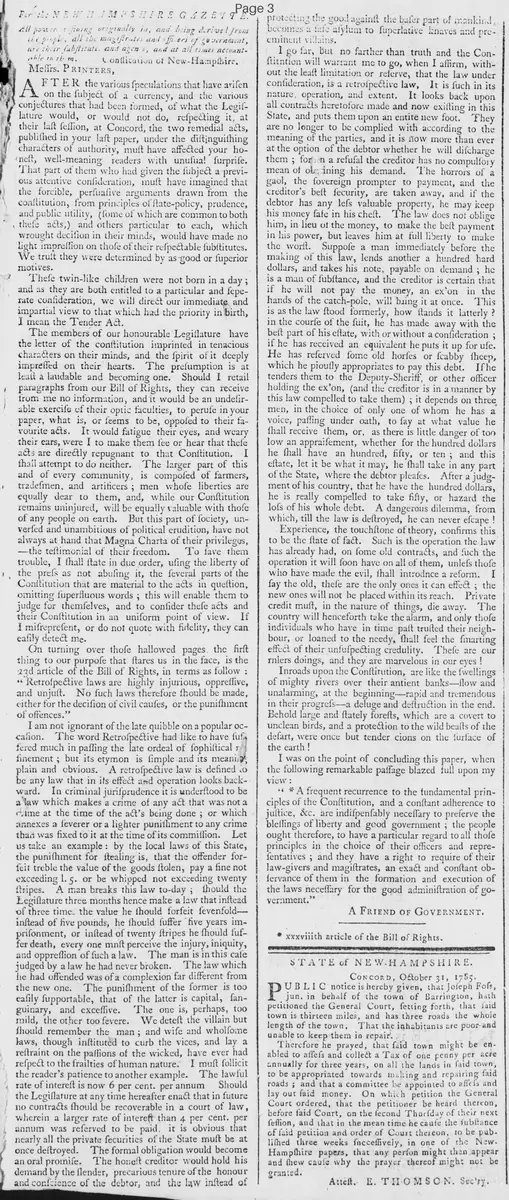
All power residing originally in, and being derived from the people, all the magistrates and officers of government, are their substitutes and agents, and at all times accountable to them.
Constitution of New-Hampshire.
Messrs. PRINTERS,
AFTER the various speculations that have arisen on the subject of a currency, and the various conjectures that had been formed, of what the Legislature would, or would not do, respecting it, at their last session, at Concord, the two remedial acts, published in your last paper, under the distinguishing characters of authority, must have affected your honest, well-meaning readers with unusual surprise.
That part of them who had given the subject a previous attentive consideration, must have imagined that the forcible, persuasive arguments drawn from the constitution, from principles of state-policy, prudence, and public utility, (some of which are common to both these acts,) and others particular to each, which wrought decision in their minds, would have made no light impression on those of their respectable substitutes.
We trust they were determined by as good or superior motives.
These twin-like children were not born in a day ; and as they are both entitled to a particular and separate consideration, we will direct our immediate and impartial view to that which had the priority in birth, I mean the Tender Act.
The members of our honourable Legislature have the letter of the constitution imprinted in tenacious characters on their minds, and the spirit of it deeply impressed on their hearts. The presumption is at least a laudable and becoming one. Should I retail paragraphs from our Bill of Rights, they can receive from me no information, and it would be an undesirable exercise of their optic faculties, to peruse in your paper, what is, or seems to be, opposed to their favourite acts. It would fatigue their eyes, and weary their ears, were I to make them see or hear that these acts are directly repugnant to that Constitution. I shall attempt to do neither. The larger part of this and of every community, is composed of farmers, trademen, and artificers ; men whose liberties are equally dear to them, and, while our Constitution remains uninjured. will be equally valuable with those of any people on earth. But this part of society, unversed and unambitious of political erudition, have not always at hand that Magna Charta of their privileges, --the testimonial of their freedom. To save them trouble, I shall state in due order, using the liberty of the press as not abusing it, the several parts of the Constitution that are material to the acts in question, omitting superfluous words ; this will enable them to judge for themselves, and to consider these acts and their Constitution in an uniform point of view. If I misrepresent, or do not quote with fidelity, they can easily detect me.
On turning over those hallowed pages the first thing to our purpose that stares us in the face, is the 22d article of the Bill of Rights, in terms as follow :
" Retrospective laws are highly injurious, oppressive, and unjust. No such laws therefore should be made. either for the decision of civil causes, or the punishment of offences."
I am not ignorant of the late quibble on a popular occasion. The word Retrospective had like to have suffered much in passing the late ordeal of sophistical refinement ; but its etymon is simple and its meaning plain and obvious. A retrospective law is defined to be any law that in its effect and operation looks backward. In criminal jurisprudence it is understood to be a law which makes a crime of any act that was not a crime at the time of the act's being done ; or which annexes a severer or a lighter punishment to any crime than was fixed to it at the time of its commission. Let us take an example : by the local laws of this State, the punishment for stealing is, that the offender forfeit treble the value of the goods stolen, pay a fine not exceeding l. 5. or be whipped not exceeding twenty stripes. A man breaks this law to-day ; should the Legislature three months hence make a law that instead of three times the value he should forfeit sevenfold-- instead of five pounds, he should suffer five years imprisonment, or instead of twenty stripes he should suffer death, every one must perceive the injury, iniquity, and oppression of such a law. The man is in this case judged by a law he had never broken. The law which he had offended was of a complexion far different from the new one. The punishment of the former is too easily supportable, that of the latter is capital, sanguinary, and excessive. The one is, perhaps, too mild, the other too severe. We detest the villain but should remember the man : and wise and wholesome laws, though instituted to curb the vices, and lay a restraint on the passions of the wicked, have ever had respect to the frailties of human nature. I must solicit the reader's patience to another example. The lawful rate of interest is now 6 per cent. per annum Should the Legislature at any time hereafter enact that in future no contracts should be recoverable in a court of law. wherein a larger rate of interest than 4 per cent. per annum was reserved to be paid, it is obvious that nearly all the private securities of the State must be at once destroyed. The formal obligation would become an oral promise. The honest creditor would hold his demand by the slender, precarious tenure of the honour and conscience of the debtor, and the law instead of
Constitution of New-Hampshire.
Messrs. PRINTERS,
AFTER the various speculations that have arisen on the subject of a currency, and the various conjectures that had been formed, of what the Legislature would, or would not do, respecting it, at their last session, at Concord, the two remedial acts, published in your last paper, under the distinguishing characters of authority, must have affected your honest, well-meaning readers with unusual surprise.
That part of them who had given the subject a previous attentive consideration, must have imagined that the forcible, persuasive arguments drawn from the constitution, from principles of state-policy, prudence, and public utility, (some of which are common to both these acts,) and others particular to each, which wrought decision in their minds, would have made no light impression on those of their respectable substitutes.
We trust they were determined by as good or superior motives.
These twin-like children were not born in a day ; and as they are both entitled to a particular and separate consideration, we will direct our immediate and impartial view to that which had the priority in birth, I mean the Tender Act.
The members of our honourable Legislature have the letter of the constitution imprinted in tenacious characters on their minds, and the spirit of it deeply impressed on their hearts. The presumption is at least a laudable and becoming one. Should I retail paragraphs from our Bill of Rights, they can receive from me no information, and it would be an undesirable exercise of their optic faculties, to peruse in your paper, what is, or seems to be, opposed to their favourite acts. It would fatigue their eyes, and weary their ears, were I to make them see or hear that these acts are directly repugnant to that Constitution. I shall attempt to do neither. The larger part of this and of every community, is composed of farmers, trademen, and artificers ; men whose liberties are equally dear to them, and, while our Constitution remains uninjured. will be equally valuable with those of any people on earth. But this part of society, unversed and unambitious of political erudition, have not always at hand that Magna Charta of their privileges, --the testimonial of their freedom. To save them trouble, I shall state in due order, using the liberty of the press as not abusing it, the several parts of the Constitution that are material to the acts in question, omitting superfluous words ; this will enable them to judge for themselves, and to consider these acts and their Constitution in an uniform point of view. If I misrepresent, or do not quote with fidelity, they can easily detect me.
On turning over those hallowed pages the first thing to our purpose that stares us in the face, is the 22d article of the Bill of Rights, in terms as follow :
" Retrospective laws are highly injurious, oppressive, and unjust. No such laws therefore should be made. either for the decision of civil causes, or the punishment of offences."
I am not ignorant of the late quibble on a popular occasion. The word Retrospective had like to have suffered much in passing the late ordeal of sophistical refinement ; but its etymon is simple and its meaning plain and obvious. A retrospective law is defined to be any law that in its effect and operation looks backward. In criminal jurisprudence it is understood to be a law which makes a crime of any act that was not a crime at the time of the act's being done ; or which annexes a severer or a lighter punishment to any crime than was fixed to it at the time of its commission. Let us take an example : by the local laws of this State, the punishment for stealing is, that the offender forfeit treble the value of the goods stolen, pay a fine not exceeding l. 5. or be whipped not exceeding twenty stripes. A man breaks this law to-day ; should the Legislature three months hence make a law that instead of three times the value he should forfeit sevenfold-- instead of five pounds, he should suffer five years imprisonment, or instead of twenty stripes he should suffer death, every one must perceive the injury, iniquity, and oppression of such a law. The man is in this case judged by a law he had never broken. The law which he had offended was of a complexion far different from the new one. The punishment of the former is too easily supportable, that of the latter is capital, sanguinary, and excessive. The one is, perhaps, too mild, the other too severe. We detest the villain but should remember the man : and wise and wholesome laws, though instituted to curb the vices, and lay a restraint on the passions of the wicked, have ever had respect to the frailties of human nature. I must solicit the reader's patience to another example. The lawful rate of interest is now 6 per cent. per annum Should the Legislature at any time hereafter enact that in future no contracts should be recoverable in a court of law. wherein a larger rate of interest than 4 per cent. per annum was reserved to be paid, it is obvious that nearly all the private securities of the State must be at once destroyed. The formal obligation would become an oral promise. The honest creditor would hold his demand by the slender, precarious tenure of the honour and conscience of the debtor, and the law instead of
What sub-type of article is it?
Persuasive
Political
Informative
What themes does it cover?
Economic Policy
Constitutional Rights
Politics
What keywords are associated?
Tender Act
Retrospective Laws
New Hampshire Constitution
Bill Of Rights
Currency
Legislature
Economic Policy
Interest Rates
What entities or persons were involved?
Messrs. Printers
Letter to Editor Details
Recipient
Messrs. Printers
Main Argument
the tender act is a retrospective law that violates the new hampshire constitution's bill of rights by retroactively altering the validity of past contracts and debts, making it injurious, oppressive, and unjust.
Notable Details
Quotes 22d Article Of The Bill Of Rights On Retrospective Laws
Provides Examples Of Retrospective Laws In Criminal Punishment And Interest Rates
References Constitution Of New Hampshire And Magna Charta