Thank you for visiting SNEWPapers!
Sign up free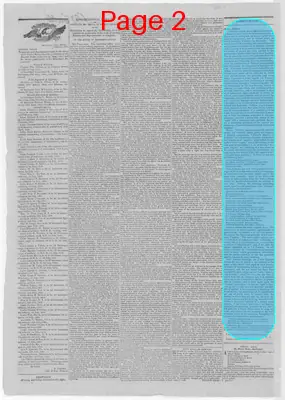
Letter to Editor
July 22, 1820
Daily National Intelligencer
Washington, District Of Columbia
What is this article about?
A letter from F.A. in Baltimore critiques a 'Yankee' correspondent's attack on Southern dialects, defending regional language variations by citing examples from Hume, Shakespeare, Prior, the Bible, and Johnson's dictionary, while noting class distinctions in speech.
Clipping

OCR Quality
98%
Excellent
Full Text
COMMUNICATION
Messrs. Editors:
There is scarcely any subject more frequently discussed than those sectional peculiarities of dialect which distinguish the several grand divisions of our country; nor do I know of any on which less light is thrown by discussion. The ordinary mode of collecting and comparing words and phrases of common use in different sections of the country, is by no means a fair one, because the grades of society are more marked in the southern and middle states than in New England. The people of the latter, who generally throw the gauntlet, collect their examples of improper pronunciation and vulgarism, from the lowest order, while the peculiarities of 'Yankee' pronunciation and dialect may be recognized in their first circles. In a stage coach, in which I travelled yesterday, on my way from Washington to this place, I found your paper of the 18th, and as, under such circumstances, we generally read every thing, I perused a letter signed 'A Yankee,' who, it appears, had been performing a journey of observation through a neighboring state. After recognizing in his exordium the justice of clearing our own vision, and rendering perfect our own characters, before we presume to stare at, or animadvert upon, the faults of others, he is fired with a right christian zeal to correct the vulgarisms, and purify the language, of the illiterate 'southrons,' amongst whom he had travelled.
I am really sorry to observe in the conduct of this learned and benevolent 'Yankee,' a new instance of the melancholy fact, that many in our country lose, in the acquirement of a smattering of the Latin, that time which should be devoted to learning at least the common principles of our own language; and that a writer who ushers in his 'essay' with a pompous Latin quotation, discovers a lamentable ignorance of the correct and classic use of the most common words in our own language.
If your 'Yankee' correspondent will carefully peruse that model of classic purity and elegance in English composition, 'Hume's History of England,' he will find very frequent use made of that mighty word 'mighty,' about which he has made such a 'mighty' ado in his critique, in the very sense he reprobates, i. e. as an adverb, 'in a great degree,' and, shocking as it may sound to his chaste and delicate ear, the monstrously absurd expression 'mighty little,' or 'mighty small'—(I quote from memory.) In Prior he will find the following lines:
Lord of his new hypothesis he reigns;
He reigns—how long? 'Till some usurper rise,
And he, too, mighty thoughtful, mighty wise,
Studies new lines.
And, if his eye has ever even glanced over the pages of the most admired authors in the language, he must have seen the word 'right' used in the same sense precisely. Even in the bible, with which at least, (coming from the land of steady habits,) he should be conversant, he will find it thus used. Witness the following quotations, which, as well as the above from Prior, Johnson's industry has furnished me:
I gat me to my Lord right humbly.—Psalms.
Right noble princes,
He acquaint our duteous citizens.—Shakespeare.
Of thy devotion and right christian zeal.—Shakespeare.
I cannot joy until I be resolved
Where our right valiant is become.—Shakespeare.
When I had climbed a height
Rough, and right hardly accessible, I might
Behold, from Circe's house, that in a grove
Set thicke with trees stood, a vapour rose.—Chapman.
The Senate will smart deep
For your upbraidings: I should be right sorry
To have the means so to venge on you
As I shall shortly on them.—Ben Jonson.
Right many a widow his keen blade,
And many fatherless, had made.—Hudibras.
Johnson defines the word 'expect' thus: 'To expect, v.a.' to have a previous apprehension of good or evil;' 'to expect, v. n.' to wait, to stay.' It is used in the first sense generally in my native state, Virginia. The same author tells us, that, 'to reckon, v. a.' means, not only 'to number, to count,' but, v. n. 'to calculate,' as, we may fairly reckon or calculate on;' and, if we alter the phrase remarked on by 'A Yankee,' 'he will come, I reckon,' to 'I calculate on his coming,' it will be much nearer grammatical correctness, than the phrase quoted is to the one generally used to express the same meaning.
Our 'Yankee' friend (to use a New England phrase, the use of which is not confined to the lower orders there) 'had ought to' have procured letters of introduction, before he journeyed southward, and his ear would not have been wounded by such vulgarisms as 'husk,' 'shuck,' 'big hominy,' 'toted,' &c. &c.; for the class in which these are in common use, if in common use at all, is not, I assure him, the first or genteel class in Virginia; and, to draw again upon the 'Yankee' vocabulary, 'he had not ought to have set up for' a critic, as a man must be 'considerable of a scholar' to be competent to discharge the duties of one; his knowledge of the signification and use of words must be derived from the manner in which they are used by the most approved authors, and not from the imperfect definitions in imperfect editions of a school room lexicon. I am sorry I cannot give our learned friend a Latin quotation, in return for his; but I will give him a couple which serve to close my letter, and explain the true meaning of the word 'persuade,' which he has mistaken. Persuade, 'to influence by argument or expostulation.'
'Twenty merchants have persuaded with him;
But none can drive him from the envious plea
Of forfeiture.'—Shakespeare.
'I should be glad if I could persuade him to write such another critique, for, when he condemns any of my poems, he makes the world have a better opinion of them.'
Dryden,
I am, gentlemen, your obedient servant,
F.A.
Baltimore, July 19, 1820.
Messrs. Editors:
There is scarcely any subject more frequently discussed than those sectional peculiarities of dialect which distinguish the several grand divisions of our country; nor do I know of any on which less light is thrown by discussion. The ordinary mode of collecting and comparing words and phrases of common use in different sections of the country, is by no means a fair one, because the grades of society are more marked in the southern and middle states than in New England. The people of the latter, who generally throw the gauntlet, collect their examples of improper pronunciation and vulgarism, from the lowest order, while the peculiarities of 'Yankee' pronunciation and dialect may be recognized in their first circles. In a stage coach, in which I travelled yesterday, on my way from Washington to this place, I found your paper of the 18th, and as, under such circumstances, we generally read every thing, I perused a letter signed 'A Yankee,' who, it appears, had been performing a journey of observation through a neighboring state. After recognizing in his exordium the justice of clearing our own vision, and rendering perfect our own characters, before we presume to stare at, or animadvert upon, the faults of others, he is fired with a right christian zeal to correct the vulgarisms, and purify the language, of the illiterate 'southrons,' amongst whom he had travelled.
I am really sorry to observe in the conduct of this learned and benevolent 'Yankee,' a new instance of the melancholy fact, that many in our country lose, in the acquirement of a smattering of the Latin, that time which should be devoted to learning at least the common principles of our own language; and that a writer who ushers in his 'essay' with a pompous Latin quotation, discovers a lamentable ignorance of the correct and classic use of the most common words in our own language.
If your 'Yankee' correspondent will carefully peruse that model of classic purity and elegance in English composition, 'Hume's History of England,' he will find very frequent use made of that mighty word 'mighty,' about which he has made such a 'mighty' ado in his critique, in the very sense he reprobates, i. e. as an adverb, 'in a great degree,' and, shocking as it may sound to his chaste and delicate ear, the monstrously absurd expression 'mighty little,' or 'mighty small'—(I quote from memory.) In Prior he will find the following lines:
Lord of his new hypothesis he reigns;
He reigns—how long? 'Till some usurper rise,
And he, too, mighty thoughtful, mighty wise,
Studies new lines.
And, if his eye has ever even glanced over the pages of the most admired authors in the language, he must have seen the word 'right' used in the same sense precisely. Even in the bible, with which at least, (coming from the land of steady habits,) he should be conversant, he will find it thus used. Witness the following quotations, which, as well as the above from Prior, Johnson's industry has furnished me:
I gat me to my Lord right humbly.—Psalms.
Right noble princes,
He acquaint our duteous citizens.—Shakespeare.
Of thy devotion and right christian zeal.—Shakespeare.
I cannot joy until I be resolved
Where our right valiant is become.—Shakespeare.
When I had climbed a height
Rough, and right hardly accessible, I might
Behold, from Circe's house, that in a grove
Set thicke with trees stood, a vapour rose.—Chapman.
The Senate will smart deep
For your upbraidings: I should be right sorry
To have the means so to venge on you
As I shall shortly on them.—Ben Jonson.
Right many a widow his keen blade,
And many fatherless, had made.—Hudibras.
Johnson defines the word 'expect' thus: 'To expect, v.a.' to have a previous apprehension of good or evil;' 'to expect, v. n.' to wait, to stay.' It is used in the first sense generally in my native state, Virginia. The same author tells us, that, 'to reckon, v. a.' means, not only 'to number, to count,' but, v. n. 'to calculate,' as, we may fairly reckon or calculate on;' and, if we alter the phrase remarked on by 'A Yankee,' 'he will come, I reckon,' to 'I calculate on his coming,' it will be much nearer grammatical correctness, than the phrase quoted is to the one generally used to express the same meaning.
Our 'Yankee' friend (to use a New England phrase, the use of which is not confined to the lower orders there) 'had ought to' have procured letters of introduction, before he journeyed southward, and his ear would not have been wounded by such vulgarisms as 'husk,' 'shuck,' 'big hominy,' 'toted,' &c. &c.; for the class in which these are in common use, if in common use at all, is not, I assure him, the first or genteel class in Virginia; and, to draw again upon the 'Yankee' vocabulary, 'he had not ought to have set up for' a critic, as a man must be 'considerable of a scholar' to be competent to discharge the duties of one; his knowledge of the signification and use of words must be derived from the manner in which they are used by the most approved authors, and not from the imperfect definitions in imperfect editions of a school room lexicon. I am sorry I cannot give our learned friend a Latin quotation, in return for his; but I will give him a couple which serve to close my letter, and explain the true meaning of the word 'persuade,' which he has mistaken. Persuade, 'to influence by argument or expostulation.'
'Twenty merchants have persuaded with him;
But none can drive him from the envious plea
Of forfeiture.'—Shakespeare.
'I should be glad if I could persuade him to write such another critique, for, when he condemns any of my poems, he makes the world have a better opinion of them.'
Dryden,
I am, gentlemen, your obedient servant,
F.A.
Baltimore, July 19, 1820.
What sub-type of article is it?
Persuasive
Informative
Social Critique
What themes does it cover?
Social Issues
What keywords are associated?
Dialect Peculiarities
Yankee Critique
Southern Language
English Usage
Literary Quotations
Class Distinctions
Virginia Speech
What entities or persons were involved?
F.A.
Messrs. Editors
Letter to Editor Details
Author
F.A.
Recipient
Messrs. Editors
Main Argument
the letter defends southern and virginian dialects against a 'yankee' critic's judgments by demonstrating proper english usage in classic literature and dictionaries, arguing that the critic ignores class distinctions and lacks scholarly depth in language.
Notable Details
References Hume's History Of England
Quotes From Prior's Poetry
Cites Shakespeare, Psalms, Chapman, Ben Jonson, Hudibras
Uses Johnson's Dictionary Definitions For 'Expect' And 'Reckon'
Mentions Yankee Phrases Like 'Had Ought To' And 'Considerable Of A Scholar'