Thank you for visiting SNEWPapers!
Sign up free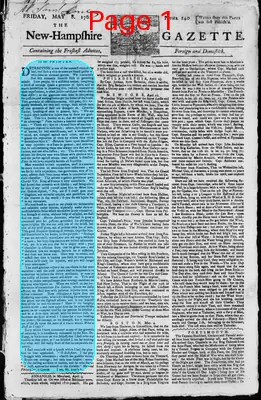
Letter to Editor
May 8, 1761
The New Hampshire Gazette
Portsmouth, Rockingham County, New Hampshire
What is this article about?
A philosophical letter to the printer denouncing detraction as a base vice rooted in envy and revenge, citing classical authors like Tacitus, Plato, Herodotus, and Marcus Antoninus to advocate for reason, religion, and forgiveness as paths to self-mastery and happiness.
Clipping
OCR Quality
98%
Excellent
Full Text
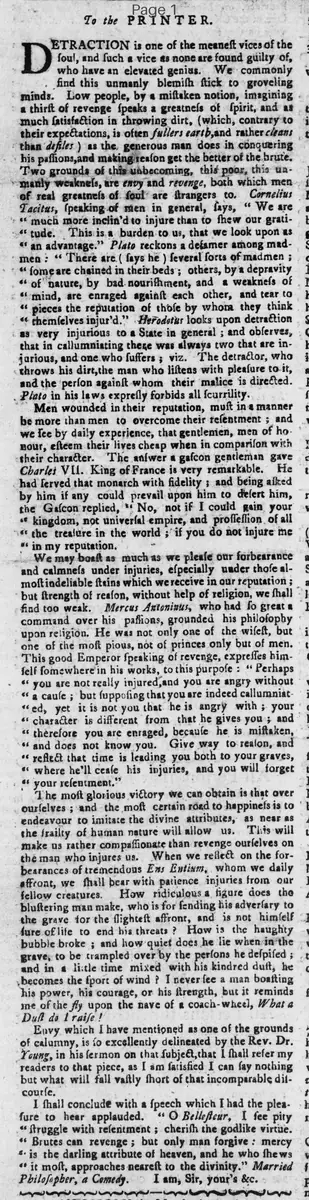
To the PRINTER.
Detraction is one of the meanest vices of the soul, and such a vice as none are found guilty of, who have an elevated genius. We commonly find this unmanly blemish stick to groveling minds. Low people, by a mistaken notion, imagining a thirst of revenge speaks a greatness of spirit, and as much satisfaction in throwing dirt, (which, contrary to their expectations, is often fuller's earth, and rather cleans than defiles) as the generous man does in conquering his passions, and making reason get the better of the brute.
Two grounds of this unbecoming, this poor, this unmanly weakness, are envy and revenge, both which men of real greatness of soul are strangers to. Cornelius Tacitus, speaking of men in general, says, "We are much more inclined to injure than to shew our gratitude. This is a burden to us, that we look upon as an advantage."
Plato reckons a defamer among madmen: "There are," says he, "several sorts of madmen; some are chained in their beds; others, by a depravity of nature, by bad nourishment, and a weakness of mind, are enraged against each other, and tear to pieces the reputation of those by whom they think themselves injured."
Herodotus looks upon detraction as very injurious to a State in general; and observes, that in calumniating there was always two that are injurious, and one who suffers; viz. The detractor, who throws his dirt, the man who listens with pleasure to it, and the person against whom their malice is directed.
Plato in his laws expressly forbids all currility. Men wounded in their reputation, must in a manner be more than men to overcome their resentment; and we see by daily experience, that gentlemen, men of honour, esteem their lives cheap when in comparison with their character. The answer a Gascon gentleman gave Charles VII. King of France is very remarkable. He had served that monarch with fidelity; and being asked by him if any could prevail upon him to desert him, the Gascon replied, "No, not if I could gain your kingdom, not universal empire, and possession of all the treasure in the world; if you do not injure me in my reputation."
We may boast as much as we please our forbearance and calmness under injuries, especially under those almost indelible stains which we receive in our reputation; but strength of reason, without help of religion, we shall find too weak. Marcus Antoninus, who had so great a command over his passions, grounded his philosophy upon religion. He was not only one of the wisest, but one of the most pious, not of princes only but of men.
This good Emperor speaking of revenge, expresses himself somewhere in his works, to this purpose: "Perhaps you are not really injured, and you are angry without a cause; but supposing that you are indeed calumniated, yet it is not you that he is angry with; your character is different from that he gives you; and therefore you are enraged, because he is mistaken, and does not know you. Give way to reason, and reflect that time is leading you both to your graves, where he'll cease his injuries, and you will forget your resentment."
The most glorious victory we can obtain is that over ourselves; and the most certain road to happiness is to endeavour to imitate the divine attributes, as near as the frailty of human nature will allow us. This will make us rather compassionate than revenge ourselves on the man who injures us. When we reflect on the forbearance of tremendous Ens Entium, whom we daily affront, we shall bear with patience injuries from our fellow creatures. How ridiculous a figure does the blustering man make, who is for sending his adversary to the grave for the slightest affront, and is not himself sure of life to end his threats? How is the haughty bubble broke: and how quiet does he lie when in the grave, to be trampled over by the persons he despised; and in a little time mixed with his kindred dust, he becomes the sport of wind? I never see a man boasting his power, his courage, or his strength, but it reminds me of the fly upon the nave of a coach-wheel. What a dust do I raise!
Envy which I have mentioned as one of the grounds of calumny, is so excellently delineated by the Rev. Dr. Young, in his sermon on that subject, that I shall refer my readers to that piece, as I am satisfied I can say nothing but what will fall vastly short of that incomparable discourse.
I shall conclude with a speech which I had the pleasure to hear applauded. "O Bellesteur, I see pity struggle with resentment; cherish the godlike virtue. Brutes can revenge; but only man forgive: mercy is the darling attribute of heaven, and he who shews it most, approaches nearest to the divinity." Married Philosopher, a Comedy. I am, Sir, yours &c.
Detraction is one of the meanest vices of the soul, and such a vice as none are found guilty of, who have an elevated genius. We commonly find this unmanly blemish stick to groveling minds. Low people, by a mistaken notion, imagining a thirst of revenge speaks a greatness of spirit, and as much satisfaction in throwing dirt, (which, contrary to their expectations, is often fuller's earth, and rather cleans than defiles) as the generous man does in conquering his passions, and making reason get the better of the brute.
Two grounds of this unbecoming, this poor, this unmanly weakness, are envy and revenge, both which men of real greatness of soul are strangers to. Cornelius Tacitus, speaking of men in general, says, "We are much more inclined to injure than to shew our gratitude. This is a burden to us, that we look upon as an advantage."
Plato reckons a defamer among madmen: "There are," says he, "several sorts of madmen; some are chained in their beds; others, by a depravity of nature, by bad nourishment, and a weakness of mind, are enraged against each other, and tear to pieces the reputation of those by whom they think themselves injured."
Herodotus looks upon detraction as very injurious to a State in general; and observes, that in calumniating there was always two that are injurious, and one who suffers; viz. The detractor, who throws his dirt, the man who listens with pleasure to it, and the person against whom their malice is directed.
Plato in his laws expressly forbids all currility. Men wounded in their reputation, must in a manner be more than men to overcome their resentment; and we see by daily experience, that gentlemen, men of honour, esteem their lives cheap when in comparison with their character. The answer a Gascon gentleman gave Charles VII. King of France is very remarkable. He had served that monarch with fidelity; and being asked by him if any could prevail upon him to desert him, the Gascon replied, "No, not if I could gain your kingdom, not universal empire, and possession of all the treasure in the world; if you do not injure me in my reputation."
We may boast as much as we please our forbearance and calmness under injuries, especially under those almost indelible stains which we receive in our reputation; but strength of reason, without help of religion, we shall find too weak. Marcus Antoninus, who had so great a command over his passions, grounded his philosophy upon religion. He was not only one of the wisest, but one of the most pious, not of princes only but of men.
This good Emperor speaking of revenge, expresses himself somewhere in his works, to this purpose: "Perhaps you are not really injured, and you are angry without a cause; but supposing that you are indeed calumniated, yet it is not you that he is angry with; your character is different from that he gives you; and therefore you are enraged, because he is mistaken, and does not know you. Give way to reason, and reflect that time is leading you both to your graves, where he'll cease his injuries, and you will forget your resentment."
The most glorious victory we can obtain is that over ourselves; and the most certain road to happiness is to endeavour to imitate the divine attributes, as near as the frailty of human nature will allow us. This will make us rather compassionate than revenge ourselves on the man who injures us. When we reflect on the forbearance of tremendous Ens Entium, whom we daily affront, we shall bear with patience injuries from our fellow creatures. How ridiculous a figure does the blustering man make, who is for sending his adversary to the grave for the slightest affront, and is not himself sure of life to end his threats? How is the haughty bubble broke: and how quiet does he lie when in the grave, to be trampled over by the persons he despised; and in a little time mixed with his kindred dust, he becomes the sport of wind? I never see a man boasting his power, his courage, or his strength, but it reminds me of the fly upon the nave of a coach-wheel. What a dust do I raise!
Envy which I have mentioned as one of the grounds of calumny, is so excellently delineated by the Rev. Dr. Young, in his sermon on that subject, that I shall refer my readers to that piece, as I am satisfied I can say nothing but what will fall vastly short of that incomparable discourse.
I shall conclude with a speech which I had the pleasure to hear applauded. "O Bellesteur, I see pity struggle with resentment; cherish the godlike virtue. Brutes can revenge; but only man forgive: mercy is the darling attribute of heaven, and he who shews it most, approaches nearest to the divinity." Married Philosopher, a Comedy. I am, Sir, yours &c.
What sub-type of article is it?
Philosophical
Ethical Moral
Reflective
What themes does it cover?
Morality
Religion
What keywords are associated?
Detraction
Envy
Revenge
Philosophy
Morality
Forgiveness
Religion
Classical Authors
What entities or persons were involved?
The Printer
Letter to Editor Details
Recipient
The Printer
Main Argument
detraction is a base vice driven by envy and revenge, which great souls avoid; instead, one should use reason and religion to forgive injuries and achieve self-mastery, imitating divine forbearance.
Notable Details
Quotes Cornelius Tacitus On Human Inclination To Injure
Plato On Defamers As Madmen And Forbidding Currility
Herodotus On Detraction's Harm To The State
Marcus Antoninus On Revenge And Reason
Reference To Rev. Dr. Young's Sermon On Envy
Quote From 'Married Philosopher, A Comedy' On Mercy