Thank you for visiting SNEWPapers!
Sign up free
Northern Star, And Warren And Bristol Gazette
Warren, Bristol County, Rhode Island
What is this article about?
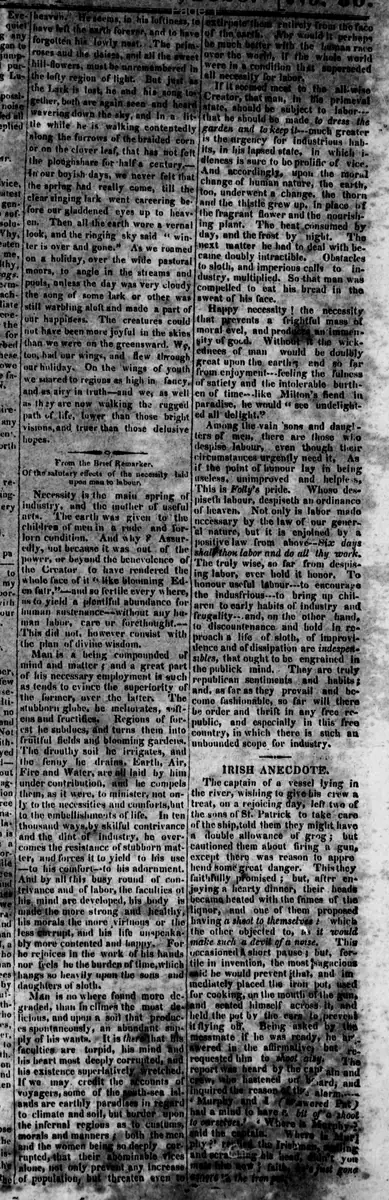
An editorial praising the necessity of labor as divinely ordained, essential for human development, moral virtue, and societal order. It contrasts industrious life with the degradation of idleness, drawing on biblical and natural examples to advocate for honoring work and discouraging sloth.
Merged-components note: Continuation of the same editorial piece 'Of the salutary effects of the necessity laid upon man to labour', with matching topic and flow across sequential reading order.
Clipping
OCR Quality
Full Text
Of the salutary effects of the necessity laid
upon man to labour
Necessity is the main spring of
industry. and the mother of useful
arts. The earth was given to the
children of men in a rude and for-
lorn condition. And why assur-
edly, not because it was out of the
power, or beyond the benevolence of
the Creator. to have rendered the
whole face of it like blooming Ed-
en fair,"and so fertile every where,
as to yield a plentiful abundance for
human sustenance without any hu-
man labour, care or forethought.--
This did not, however consist with
the plan of divine wisdom.
Man is. a being compounded of
mind and matter s and a great part
of his necessary employment is such
as tends to evince the superiority of
the former, over the latter. The
stubborn globe. he meliorates, soft-
ens and fructifies. Regions of for-
est he subdues, and turns them into
fruitful fields and blooming gardens.
The drouthy soil he irrigates, and
the fenny he drains, Earth, Air,
Fire and Water, are all laid by him
under contribution, and he compels
them, as it were, to minister, not on-
ly to the necessities and comforts,but
to the embellishments of life, In ten
thousand ways.by skilful contrivance
and the dint of industry. he over-
comes the resistance of stubborn mat-
ter, and forces it to yield to his use
to his comfort--to his adornment.
And by all this busy round of con-
trivance and of labor, the faculties of
his mind are developed, his body is
made the more strong and healthy,
his morals the more virtuous or the
less corrupt, and his life unques-
tionably more contented and happy. For
he rejoices in the work of his hands
nor feels he the burden of time, which
hangs so heavily upon the sons-and
daughtors of sloth.
Man is no where found more de-
graded, than in climes the most de-
licious, and upon a soil that produc-
es spontaneously, an abundant sup-
ply of his wants. It is there that his
faculties are torpid, his mind and
his heart most deeply corrupted and
his existence superlatively wretched.
If we. may. credit the accounts of
voyagers, some of the south-sea isl-
ands are earthly paradises in regard
to climate and soil, but border upon
the infernal regions as to customs,
morals and manners ;both the men
and the women being so deeply cor-
rupted, that their abominable vices
alone, not only prevent any increase
of population, but threaten even to
to extirpate them entirely from the face
of the earth. Nor would it perhaps
be much better with the human race
over the world, if the whole world
were in condition as supersede
all necessity for labor.
If it seemed meet to the all wise
Creator- that man, in the primeval
state, should be subject to labor--
that he should be made to dress the
garden and to keep it---much greater
is the urgency for industrious hab-
its, in his lapsed state, in which a
change of human nature, the earth,
too, underwent a change. the thorn
and the thistle grew up. in place of
the fragrant flower and the nourish-
ing plant. The heat consumed by
day, and the frost by night. The
next matter he had to deal with be-
came doubly intractable. Obstacles
to sloth, and imperious calls to in-
dustry, multiplied. So-that man was
compelled to eat his bread in the
sweat of his face.
- Happy necessity ! the necessity
that prevents a rightful mass of
moral evil, and produces an immen-
sity of good. Without it the wick-
edness of man would be doubly
great upon the earths and so far
from enjoyment--feeling the fulness
of satiety and the intolerable burthen
of time--like Milton's fiend in
paradise, he would " see undelight-
ed all delight."
Among the vain sons and daugh-
ters of men, there are those who
despise labour, even though their
circumstances urgently need it, As
if the point of honour lay in being
useless, unimproved and helpless,
This is Folly's pride. Whoso des-
piseth labour, despiseth an ordinance
of heaven Not only is labor made
necessary by the law of our gener-
al nature, but it is enjoined, by a
positive law from above--Six days
shal thou labor and do all thy work.
The truly wise, so far from despis-
ing labor, ever hold it honor. To
honour useful labour---to encourage
the industrious---to bring up chil-
dren to early habits of. industry and
frugality--and, on the other hand,
to discountenance and hold in re-
proach a life of sloth, of improvi-
dence and of dissipation are indespen-
sables, that ought to be engrairicd in
the publick mind. They are truly
republican sentiments and habits
and, as far as they prevail and be-
come fashionable, so far will there
be order and thrift in any free re-
public, and especially in this re-
country, in which there is such an
unbounded scope for industry.
What sub-type of article is it?
What keywords are associated?
Editorial Details
Primary Topic
Salutary Effects Of The Necessity Laid Upon Man To Labour
Stance / Tone
Strongly Pro Labor And Anti Sloth, Moral Exhortation
Key Arguments