Thank you for visiting SNEWPapers!
Sign up free
National Gazette
Philadelphia, Philadelphia County, Pennsylvania
What is this article about?
A letter arguing against bounties for manufactures funded by agricultural taxes, proposing instead to tax manufactures to aid agriculture for mutual long-term prosperity. It includes a satirical scheme of reciprocal taxes and bounties that secretly benefits government through administrative profits and patronage. Signed 'A Citizen' in Philadelphia, Sept. 24.
Clipping
OCR Quality
Full Text
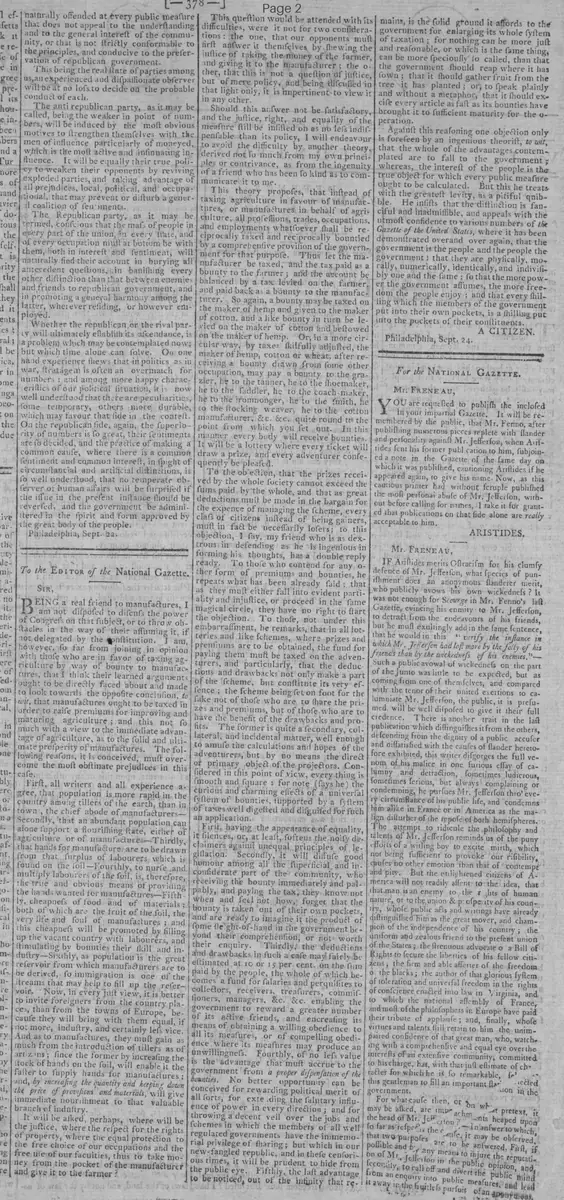
SIR,
Being a real friend to manufactures, I am not disposed to discuss the power of Congress on that subject, or to throw obstacles in the way of their assuming it, if not delegated by the constitution. I am, however, so far from joining in opinion with those who are in favor of taxing agriculture by way of bounty to manufactures, that I think their learned arguments ought to be directly faced about and made to look towards the opposite conclusion, to wit, that manufactures ought to be taxed in order to raise premiums for improving and maturing agriculture; and this not so much with a view to the immediate advantage of agriculture, as to the solid and ultimate prosperity of manufactures. The following reasons, it is conceived, must overcome the most obstinate prejudices in this case.
First, all writers and all experience agree, that population is more rapid in the country among tillers of the earth, than in town, the chief abode of manufacturers.
Secondly, that an abundant population can alone support a flourishing state, either of agriculture or of manufactures.
Thirdly, that hands for manufactures are to be drawn from that surplus of labourers which is found on the soil.
Fourthly, to nurse and multiply labourers of the soil, is, therefore, the true and obvious means of providing the hands wanted for manufactures.
Fifthly, cheapness of food and of materials; both of which are the fruit of the soil, the very life and soul of manufactures; and this cheapness will be promoted by filling up the vacant country with labourers, and stimulating by bounties their skill and industry.
Sixthly, as population is the great reservoir from which manufacturers are to be derived, so immigration is one of the streams that may help to fill up the reservoir. Now, in every just view, it is better to invite foreigners from the country places, than from the towns of Europe, because they will bring with them equal, if not more, industry, and certainly less vice. And as to manufactures, they must gain as much from the introduction of tillers as of artisans; since the former by increasing the stock of hands on the soil, will enable it the faster to supply hands for manufactures; and, by increasing the quantity and keeping down the price of provisions and materials, will give immediate nourishment to that valuable branch of industry.
It will be asked, perhaps, where will be the justice, where the respect for the rights of property, where the equal protection to the free choice of our occupations and the free use of our faculties, thus to take money from the pocket of the manufacturer and give it to the farmer?
This question would be attended with its difficulties, were it not for two considerations: the one, that our opponents must first answer it themselves by shewing the justice of taking the money of the farmer, and giving it to the manufacturer; the other, that this is not a question of justice, but of mere policy, and being discussed in that light only, it is impertinent to view it in any other.
Should this answer not be satisfactory, and the justice, right, and equality of the measure still be insisted on as no less indispensable than its policy, I will endeavour to avoid the difficulty by another theory, derived not so much from my own principles or contrivance, as from the ingenuity of a friend who has been so kind as to communicate it to me.
This theory proposes, that instead of taxing agriculture in favour of manufactures or manufactures in behalf of agriculture, all professions, trades, occupations, and employments whatsoever shall be reciprocally taxed and reciprocally bountied by a comprehensive provision of the government for that purpose. Thus let the manufacturer be taxed, and the tax paid as a bounty to the farmer; and the account be balanced by a tax levied on the farmer, and paid back as a bounty to the manufacturer. So again, a bounty may be taxed on the maker of hemp and given to the maker of cotton, and a like bounty in turn be levied on the maker of cotton and bestowed on the maker of hemp. Or, in a more circular way, by taxes skilfully adjusted, the maker of hemp, cotton or wheat, after receiving a bounty drawn from some other occupation, may pay a bounty to the grazier, he to the tanner, he to the shoemaker, he to the saddler, he to the coach-maker, he to the ironmonger, he to the smith, he to the stocking weaver, he to the cotton manufacturer, &c. &c. quite round to the point from which you set out. In this manner every body will receive bounties. It will be a lottery where every ticket will draw a prize, and every adventurer consequently be pleased.
To the objection, that the prizes received by the whole society cannot exceed the sums paid by the whole, and that as great deductions must be made in this bargain for the expense of managing the scheme, every class of citizens instead of being gainers, must in fact be necessarily losers: to this objection, I say, my friend who is as dexterous in defending as he is ingenious in forming his thoughts, has a double reply ready. To those who contend for any other form of premiums and bounties, he repeats what has been already said; that as they must either fall into evident partiality and injustice, or proceed in the same magical circle, they have no right to start the objection. To those, not under this embarrassment, he remarks, that in all lotteries and like schemes, where prizes and premiums are to be obtained, the fund for paying them must be taxed on the adventurers, and particularly, that the deductions and drawbacks not only make a part of the scheme, but constitute its very essence; the scheme being set on foot for the sake not of those who are to share the prizes and premiums, but of those who are to have the benefit of the drawbacks and profits. The former is quite a secondary, collateral, and incidental matter, well enough to amuse the calculations and hopes of the adventurers, but by no means the direct or primary object of the projectors. Considered in this point of view, every thing is smooth and square: for note (says he) the curious and charming effects of a universal system of bounties, supported by a system of taxes well digested and disguised for such an application.
First, having the appearance of equality, it silences, or, at least, softens the noisy declaimers against unequal principles of legislation.
Secondly, it will diffuse good humour among all the superficial and inconsiderate part of the community, who receiving the bounty immediately and palpably, and paying the tax, they know not when and feel not how, forget that the bounty is taken out of their own pockets, and are ready to imagine it the product of some sleight-of-hand in the government beyond their comprehension, or not worth their enquiry.
Thirdly, the deductions and drawbacks in such a case may fairly be estimated at 10 or 15 per cent. on the sum paid by the people, the whole of which becomes a fund for salaries and perquisites to collectors, receivers, treasurers, commissioners, managers, &c. &c. enabling the government to reward a greater number of its active friends, and increasing its means of obtaining a willing obedience to all its measures, or of compelling obedience where its measures may produce an unwillingness.
Fourthly, of no less value is the advantage that must accrue to the government from a proper dispensation of the bounties. No better opportunity can be conceived for rewarding political merit of all sorts, for extending the salutary influence of power in every direction; and for throwing a decent veil over the jobs and schemes in which the members of all well regulated governments have the immemorial privilege of sharing; but which in our new-fangled republic, and in these censorious times, it will be prudent to hide from the public eye.
Fifthly, the last advantage to be noticed, out of the infinity that remains, is the solid ground it affords to the government for enlarging its whole system of taxation; for nothing can be more just and reasonable, or which is the same thing can be more speciously so called, than that the government should reap where it has sown; that it should gather fruit from the tree it has planted; or, to speak plainly and without a metaphor, that it should exercise every article as fast as its bounties have brought it to sufficient maturity for the operation.
Against this reasoning one objection only is foreseen by an ingenious theorist, to wit, that the whole of the advantages contemplated are to fall to the government; whereas, the interest of the people is the true object for which every public measure ought to be calculated. But this he treats with the greatest levity, as a pitiful quibble. He insists that the distinction is fanciful and inadmissible, and appeals with the utmost confidence to various numbers of the Gazette of the United States, where it has been demonstrated over and over again, that the government is the people and the people the government: that they are physically, morally, numerically, identically, and indivisibly one and the same; so that the more power the government assumes, the more freedom the people enjoy: and that every shilling which the members of the government put into their own pockets, is a shilling put into the pockets of their constituents.
A CITIZEN.
Philadelphia, Sept. 24.
What sub-type of article is it?
What themes does it cover?
What keywords are associated?
What entities or persons were involved?
Letter to Editor Details
Author
A Citizen.
Recipient
Editor Of The National Gazette
Main Argument
opposes taxing agriculture to provide bounties for manufactures, arguing instead for taxing manufactures to support agriculture, which will ultimately benefit manufactures through increased population and cheaper food/materials. proposes a satirical reciprocal system of taxes and bounties that appears equitable but primarily advantages the government.
Notable Details