Thank you for visiting SNEWPapers!
Sign up free
Literary
November 23, 1805
Virginia Argus
Richmond, Virginia
What is this article about?
Conclusion of 'The Traveller's Journal' in the Virginia Argus, exhorting Christians to avoid judgment and slander, promote learning, industry, frugality, benevolence, respect for laws, and gospel veneration. It highlights Christianity's superiority to paganism, submission to God's will, charity from riches or poverty, and unity in worship against atheism and deism.
Merged-components note: Continuation of the same essay 'The Traveller's Journal' across two components.
Clipping
OCR Quality
95%
Excellent
Full Text
FOR THE VIRGINIA ARGUS.
The Traveller's Journal, concluded.
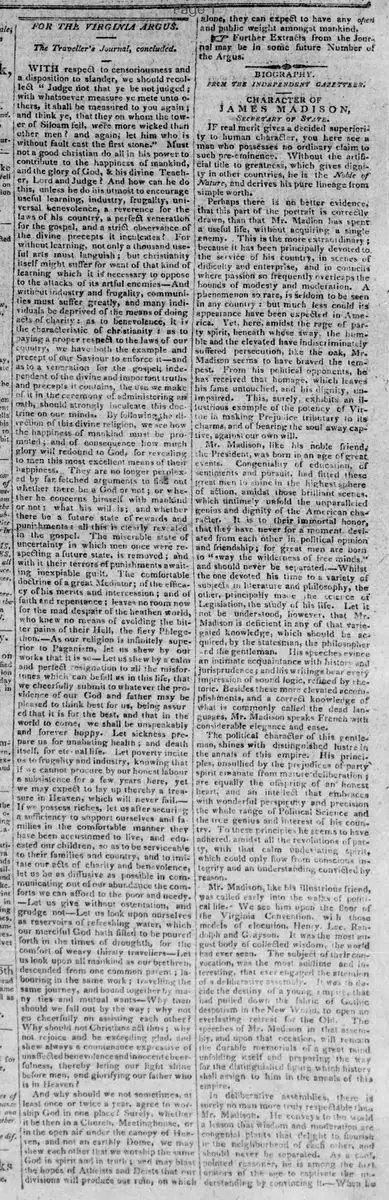
WITH respect to censoriousness and a disposition to slander, we should recollect "Judge not that ye be not judged; with whatsoever measure ye mete unto others, it shall be measured to you again; and think ye, that they on whom the tower of Siloam fell, were more wicked than other men?" and again; "let him who is without fault cast the first stone." Must not a good christian do all in his power to contribute to the happiness of mankind, and the glory of God, & his divine Teacher, Lord and Judge? And how can he do this, unless he do his utmost to encourage useful learning, industry, frugality, universal benevolence, a reverence of the laws of his country, a perfect veneration of the gospel, and a strict observance of the divine precepts it inculcates? For without learning, not only a thousand useful arts must languish; but christianity itself might suffer for want of that kind of learning which it is necessary to oppose to the attacks of its artful enemies—And without industry and frugality, communities must suffer greatly, and many individuals be deprived of the means of doing acts of charity: as to benevolence, it is the characteristic of christianity: as to paying a proper respect to the laws of our country, we have both the example and precept of our Saviour to enforce it—and as to a veneration of the gospel; independent of the divine and important truths and precepts it contains, the use we make of it in the ceremony of administering an oath, should strongly inculcate this doctrine on our minds. By following the direction of this divine religion, we see how the happiness of mankind must be promoted; and of consequence how much glory will redound to God, for revealing to men this most excellent means of their happiness... They are no longer perplexed by far fetched arguments to find out whether there be a God or not; or whether he concerns himself with mankind or not; what his will is; and whether there be a future state of rewards and punishments: all this is clearly revealed in the gospel. The miserable state of uncertainty in which men once were respecting a future state, is removed; and with it their terrors of punishments awaiting inexpiable guilt. The comfortable doctrine of a great Mediator; of the efficacy of his merits and intercession; and of faith and repentance; leaves no room now for the mad despair of the heathen world, who knew no means of avoiding the bitter pains of their Hell, the fiery Phlegethon.—As our religion is infinitely superior to Paganism, let us shew by our works that it is so—Let us shew by a calm and perfect resignation to all the misfortunes which can befall us in this life, that we cheerfully submit to whatever the providence of our God and father may be pleased to think best for us, being assured that it is for the best, and that in the world to come, we shall be unspeakably and forever happy. Let sickness prepare us for unabating health; and death itself, for eternal life. Let poverty incite us to frugality and industry, knowing that if we cannot procure by our honest labour a subsistence for a few years here, yet we may expect to lay up thereby a treasure in Heaven, which will never fail.— If we possess riches, let us after securing a sufficiency to support ourselves and families in the comfortable manner they have been accustomed to live, and educated our children, so as to be serviceable to their families and country, and to imitate our acts of charity and benevolence, let us be as diffusive as possible in communicating out of our abundance the comforts we can afford to the poor and needy. -Let us give without ostentation, and grudge not—Let us look upon ourselves as reservoirs of refreshing water, which our merciful God hath filled to be poured forth in the times of drought, for the comfort of weary thirsty travellers—Let us look upon all mankind as our brethren, labouring in the same work; travelling the same journey, and bound together by many ties and mutual wants—Why then should we fall out by the way; why not go cheerfully on assisting each other? Why should not Christians act thus; why not rejoice and be exceeding glad, and shew always a countenance expressive of unaffected benevolence and innocent cheerfulness, thereby letting our light shine before men, and glorifying our father who is in Heaven?
And why should we not sometimes, at least once or twice a year, agree to worship God in one place? Surely, whether it be then in a Church, Meetinghouse, or in the open air under the canopy of Heaven, and not an earthly Dome, we may shew each other that we worship the same God in spirit and in truth; and may blast the hopes of Atheists and Deists that our divisions will produce our ruin, on which alone, they can expect to have any offer and public weight amongst mankind.
To Further Extracts from the Jour. nal may be in some future Number of the Argus.
The Traveller's Journal, concluded.
WITH respect to censoriousness and a disposition to slander, we should recollect "Judge not that ye be not judged; with whatsoever measure ye mete unto others, it shall be measured to you again; and think ye, that they on whom the tower of Siloam fell, were more wicked than other men?" and again; "let him who is without fault cast the first stone." Must not a good christian do all in his power to contribute to the happiness of mankind, and the glory of God, & his divine Teacher, Lord and Judge? And how can he do this, unless he do his utmost to encourage useful learning, industry, frugality, universal benevolence, a reverence of the laws of his country, a perfect veneration of the gospel, and a strict observance of the divine precepts it inculcates? For without learning, not only a thousand useful arts must languish; but christianity itself might suffer for want of that kind of learning which it is necessary to oppose to the attacks of its artful enemies—And without industry and frugality, communities must suffer greatly, and many individuals be deprived of the means of doing acts of charity: as to benevolence, it is the characteristic of christianity: as to paying a proper respect to the laws of our country, we have both the example and precept of our Saviour to enforce it—and as to a veneration of the gospel; independent of the divine and important truths and precepts it contains, the use we make of it in the ceremony of administering an oath, should strongly inculcate this doctrine on our minds. By following the direction of this divine religion, we see how the happiness of mankind must be promoted; and of consequence how much glory will redound to God, for revealing to men this most excellent means of their happiness... They are no longer perplexed by far fetched arguments to find out whether there be a God or not; or whether he concerns himself with mankind or not; what his will is; and whether there be a future state of rewards and punishments: all this is clearly revealed in the gospel. The miserable state of uncertainty in which men once were respecting a future state, is removed; and with it their terrors of punishments awaiting inexpiable guilt. The comfortable doctrine of a great Mediator; of the efficacy of his merits and intercession; and of faith and repentance; leaves no room now for the mad despair of the heathen world, who knew no means of avoiding the bitter pains of their Hell, the fiery Phlegethon.—As our religion is infinitely superior to Paganism, let us shew by our works that it is so—Let us shew by a calm and perfect resignation to all the misfortunes which can befall us in this life, that we cheerfully submit to whatever the providence of our God and father may be pleased to think best for us, being assured that it is for the best, and that in the world to come, we shall be unspeakably and forever happy. Let sickness prepare us for unabating health; and death itself, for eternal life. Let poverty incite us to frugality and industry, knowing that if we cannot procure by our honest labour a subsistence for a few years here, yet we may expect to lay up thereby a treasure in Heaven, which will never fail.— If we possess riches, let us after securing a sufficiency to support ourselves and families in the comfortable manner they have been accustomed to live, and educated our children, so as to be serviceable to their families and country, and to imitate our acts of charity and benevolence, let us be as diffusive as possible in communicating out of our abundance the comforts we can afford to the poor and needy. -Let us give without ostentation, and grudge not—Let us look upon ourselves as reservoirs of refreshing water, which our merciful God hath filled to be poured forth in the times of drought, for the comfort of weary thirsty travellers—Let us look upon all mankind as our brethren, labouring in the same work; travelling the same journey, and bound together by many ties and mutual wants—Why then should we fall out by the way; why not go cheerfully on assisting each other? Why should not Christians act thus; why not rejoice and be exceeding glad, and shew always a countenance expressive of unaffected benevolence and innocent cheerfulness, thereby letting our light shine before men, and glorifying our father who is in Heaven?
And why should we not sometimes, at least once or twice a year, agree to worship God in one place? Surely, whether it be then in a Church, Meetinghouse, or in the open air under the canopy of Heaven, and not an earthly Dome, we may shew each other that we worship the same God in spirit and in truth; and may blast the hopes of Atheists and Deists that our divisions will produce our ruin, on which alone, they can expect to have any offer and public weight amongst mankind.
To Further Extracts from the Jour. nal may be in some future Number of the Argus.
What sub-type of article is it?
Essay
What themes does it cover?
Religious
Moral Virtue
Temperance
What keywords are associated?
Christian Morality
Frugality
Benevolence
Gospel Veneration
Industry
Charity
Unity Worship
Literary Details
Title
The Traveller's Journal, Concluded.
Key Lines
Judge Not That Ye Be Not Judged; With Whatsoever Measure Ye Mete Unto Others, It Shall Be Measured To You Again;
Let Him Who Is Without Fault Cast The First Stone.
As Our Religion Is Infinitely Superior To Paganism, Let Us Shew By Our Works That It Is So—
Let Us Look Upon All Mankind As Our Brethren, Labouring In The Same Work; Travelling The Same Journey, And Bound Together By Many Ties And Mutual Wants—
Why Not Go Cheerfully On Assisting Each Other?