Thank you for visiting SNEWPapers!
Sign up free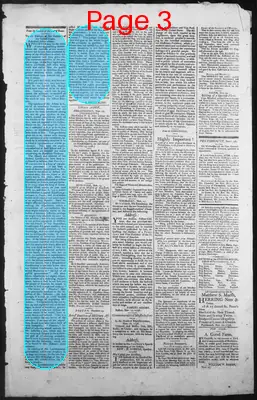
Editorial
November 26, 1796
The New Hampshire Gazette
Portsmouth, Rockingham County, New Hampshire
What is this article about?
An editorial urging electors to reject John Adams for president due to his advocacy for hereditary monarchy and senate, contrasting him with Pinckney and Washington as supporters of republican government. It critiques 'Phocion's' defense and quotes Adams on Lacedaemonian government.
Clipping
OCR Quality
95%
Excellent
Full Text
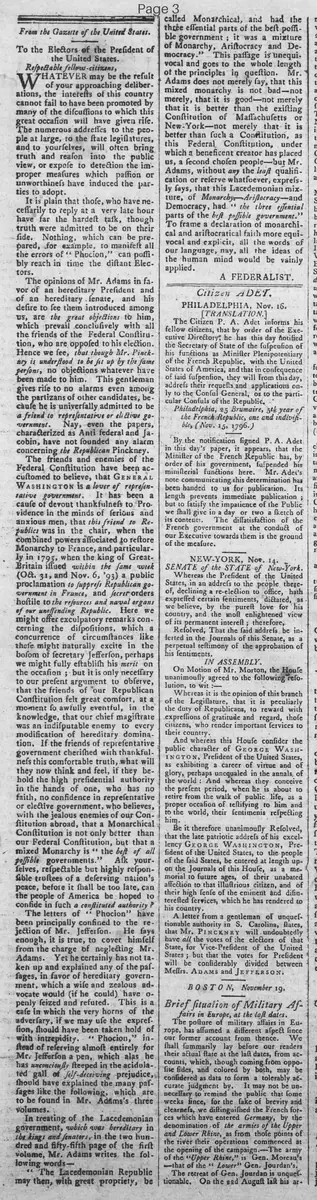
From the Gazette of the United States.
To the Electors of the President of the United States.
Respectable fellow-citizens,
Whatever may be the result of your approaching deliberations, the interests of this country cannot fail to have been promoted by many of the discussions to which this great occasion will have given rise. The numerous addresses to the people at large, to the state legislatures, and to yourselves, will often bring truth and reason into the public view, or expose to detection the improper measures which passion or unworthiness have induced the parties to adopt.
It is plain that those, who have necessarily to reply at a very late hour have far the hardest task, though truth were admitted to be on their side. Nothing, which can be prepared, for example, to manifest all the errors of "Phocion," can possibly reach in time the distant Electors.
The opinions of Mr. Adams in favor of an hereditary President and of an hereditary Senate, and his desire to see them introduced among us, are the great objections to him, which prevail conclusively with all the friends of the Federal Constitution, who are opposed to his election. Hence we see, that though Mr. Pinckney is understood to be set up by the same persons, no objections whatever have been made to him. This gentleman gives rise to no alarms even among the partisans of other candidates, because he is universally admitted to be a friend to representative or elective government. Nay, even the papers, characterized as Anti-federal and Jacobin, have not sounded any alarm concerning the Republican Pinckney.
The friends and enemies of the Federal Constitution have been accustomed to believe, that GENERAL WASHINGTON is a lover of representative government. It has been a cause of devout thankfulness to Providence in the minds of serious and anxious men, that this friend to Republics was in the chair, when the combined powers associated to restore Monarchy to France, and particularly in 1793, when the king of Great-Britain issued within the same week (Oct. 31, and Nov. 6, '93) a public proclamation to suppress Republican government in France, and secret orders hostile to the resources and naval organs of our unoffending Republic. Here we might offer exculpatory remarks concerning the dispositions, which a concurrence of circumstances like these might naturally excite in the bosom of Secretary Jefferson, perhaps we might fully establish his merit on the occasion; but it is only necessary to our present argument to observe, that the friends of our Republican Constitution felt great comfort, at a moment so awfully eventful, in the knowledge, that our chief magistrate was an indisputable enemy to every modification of hereditary domination. If the friends of representative government cherished with thankfulness this comfortable truth, what will they now think and feel, if they behold the high presidential authority in the hands of one, who has no faith, no confidence in representative or elective government, who believes, with the jealous enemies of our Constitution abroad, that a Monarchical Constitution is not only better than our Federal Constitution, but that a mixed Monarchy is "the best of all possible governments." Ask yourselves, respectable but highly responsible trustees of a deserving nation's peace, before it shall be too late, can the people of America be hoped to confide in such a constituted authority?
The letters of "Phocion" have been principally confined to the rejection of Mr. Jefferson. He says enough, it is true, to cover himself from the charge of neglecting Mr. Adams. Yet he certainly has not taken up and explained any of the passages, in favor of hereditary government, which a wise and zealous advocate would (if he could) have openly seized and refuted. This is a case in which the very horns of the adversary, if we may use the expression, should have been taken hold of with intrepidity. "Phocion," instead of reserving almost entirely for Mr. Jefferson a pen, which alas he has unconsciously steeped in the acidulated gall of self-deceiving prejudice, should have explained the many passages like the following, which are to be found in Mr. Adams's three volumes.
In treating of the Lacedemonian government, which was hereditary in the kings and senators, in the two hundred and fifty-fifth page of the first volume, Mr. Adams writes the following words:
"The Lacedemonian Republic may then, with great propriety, be called Monarchical. and had the three essential parts of the best possible government : it was a mixture of Monarchy, Aristocracy and Democracy."
This passage is unequivocal and goes to the whole length of the principles in question. Mr. Adams does not merely say, that this mixed monarchy is not bad-not merely, that it is good-not merely that it is better than the existing Constitution of Massachusetts or New-York-not merely that-it is better than such a Constitution, as this Federal Constitution, under which a beneficent creator has placed us, a second chosen people-but Mr. Adams, without any the least qualification or reserve whatsoever, expressly says, that this Lacedemonian mixture, of Monarchy-Aristocracy-and Democracy, had." the three essential parts of the best possible government."
To frame a declaration of monarchical and aristocratical faith more unequivocal and explicit, all the words of our language, nay, all the ideas of the human mind would be vainly applied.
A FEDERALIST.
To the Electors of the President of the United States.
Respectable fellow-citizens,
Whatever may be the result of your approaching deliberations, the interests of this country cannot fail to have been promoted by many of the discussions to which this great occasion will have given rise. The numerous addresses to the people at large, to the state legislatures, and to yourselves, will often bring truth and reason into the public view, or expose to detection the improper measures which passion or unworthiness have induced the parties to adopt.
It is plain that those, who have necessarily to reply at a very late hour have far the hardest task, though truth were admitted to be on their side. Nothing, which can be prepared, for example, to manifest all the errors of "Phocion," can possibly reach in time the distant Electors.
The opinions of Mr. Adams in favor of an hereditary President and of an hereditary Senate, and his desire to see them introduced among us, are the great objections to him, which prevail conclusively with all the friends of the Federal Constitution, who are opposed to his election. Hence we see, that though Mr. Pinckney is understood to be set up by the same persons, no objections whatever have been made to him. This gentleman gives rise to no alarms even among the partisans of other candidates, because he is universally admitted to be a friend to representative or elective government. Nay, even the papers, characterized as Anti-federal and Jacobin, have not sounded any alarm concerning the Republican Pinckney.
The friends and enemies of the Federal Constitution have been accustomed to believe, that GENERAL WASHINGTON is a lover of representative government. It has been a cause of devout thankfulness to Providence in the minds of serious and anxious men, that this friend to Republics was in the chair, when the combined powers associated to restore Monarchy to France, and particularly in 1793, when the king of Great-Britain issued within the same week (Oct. 31, and Nov. 6, '93) a public proclamation to suppress Republican government in France, and secret orders hostile to the resources and naval organs of our unoffending Republic. Here we might offer exculpatory remarks concerning the dispositions, which a concurrence of circumstances like these might naturally excite in the bosom of Secretary Jefferson, perhaps we might fully establish his merit on the occasion; but it is only necessary to our present argument to observe, that the friends of our Republican Constitution felt great comfort, at a moment so awfully eventful, in the knowledge, that our chief magistrate was an indisputable enemy to every modification of hereditary domination. If the friends of representative government cherished with thankfulness this comfortable truth, what will they now think and feel, if they behold the high presidential authority in the hands of one, who has no faith, no confidence in representative or elective government, who believes, with the jealous enemies of our Constitution abroad, that a Monarchical Constitution is not only better than our Federal Constitution, but that a mixed Monarchy is "the best of all possible governments." Ask yourselves, respectable but highly responsible trustees of a deserving nation's peace, before it shall be too late, can the people of America be hoped to confide in such a constituted authority?
The letters of "Phocion" have been principally confined to the rejection of Mr. Jefferson. He says enough, it is true, to cover himself from the charge of neglecting Mr. Adams. Yet he certainly has not taken up and explained any of the passages, in favor of hereditary government, which a wise and zealous advocate would (if he could) have openly seized and refuted. This is a case in which the very horns of the adversary, if we may use the expression, should have been taken hold of with intrepidity. "Phocion," instead of reserving almost entirely for Mr. Jefferson a pen, which alas he has unconsciously steeped in the acidulated gall of self-deceiving prejudice, should have explained the many passages like the following, which are to be found in Mr. Adams's three volumes.
In treating of the Lacedemonian government, which was hereditary in the kings and senators, in the two hundred and fifty-fifth page of the first volume, Mr. Adams writes the following words:
"The Lacedemonian Republic may then, with great propriety, be called Monarchical. and had the three essential parts of the best possible government : it was a mixture of Monarchy, Aristocracy and Democracy."
This passage is unequivocal and goes to the whole length of the principles in question. Mr. Adams does not merely say, that this mixed monarchy is not bad-not merely, that it is good-not merely that it is better than the existing Constitution of Massachusetts or New-York-not merely that-it is better than such a Constitution, as this Federal Constitution, under which a beneficent creator has placed us, a second chosen people-but Mr. Adams, without any the least qualification or reserve whatsoever, expressly says, that this Lacedemonian mixture, of Monarchy-Aristocracy-and Democracy, had." the three essential parts of the best possible government."
To frame a declaration of monarchical and aristocratical faith more unequivocal and explicit, all the words of our language, nay, all the ideas of the human mind would be vainly applied.
A FEDERALIST.
What sub-type of article is it?
Partisan Politics
Constitutional
What keywords are associated?
Presidential Election
Hereditary Government
Federal Constitution
John Adams
Republican Principles
Charles Pinckney
George Washington
What entities or persons were involved?
John Adams
Charles Cotesworth Pinckney
George Washington
Thomas Jefferson
Phocion
Editorial Details
Primary Topic
Opposition To John Adams Due To Support For Hereditary Government
Stance / Tone
Strongly Anti Adams And Pro Republican Principles
Key Figures
John Adams
Charles Cotesworth Pinckney
George Washington
Thomas Jefferson
Phocion
Key Arguments
Adams Favors Hereditary President And Senate, Opposing Federal Republicanism
Pinckney Raises No Alarms As A Friend To Elective Government
Washington's Republican Stance Provided Comfort During 1793 Crises
Electors Should Reject Adams To Preserve Trust In Republican Authority
Phocion Fails To Refute Adams' Monarchical Views
Adams Praises Lacedaemonian Mixed Monarchy As The Best Government