Thank you for visiting SNEWPapers!
Sign up free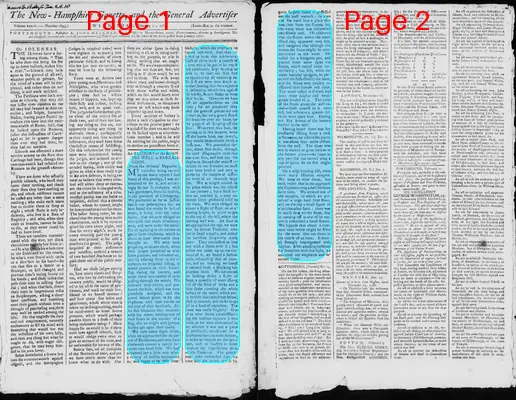
The New Hampshire Gazette And General Advertiser
Portsmouth, Rockingham County, New Hampshire
What is this article about?
Travelers from Ismadab in Chittagong province journey to Barrah Coon to witness the burning well, a natural phenomenon where cold water surfaces with blue flames from hot rocks. They describe the elephant ride through woods, encounters with Fakeers, and a nearby fiery rock and sulfurous temple stone.
Merged-components note: Continuation of the account of the burning well at Barrah Coon across pages 1 and 2.
Clippings
1 of 2
OCR Quality
Full Text
[From the Oriental Magazine]
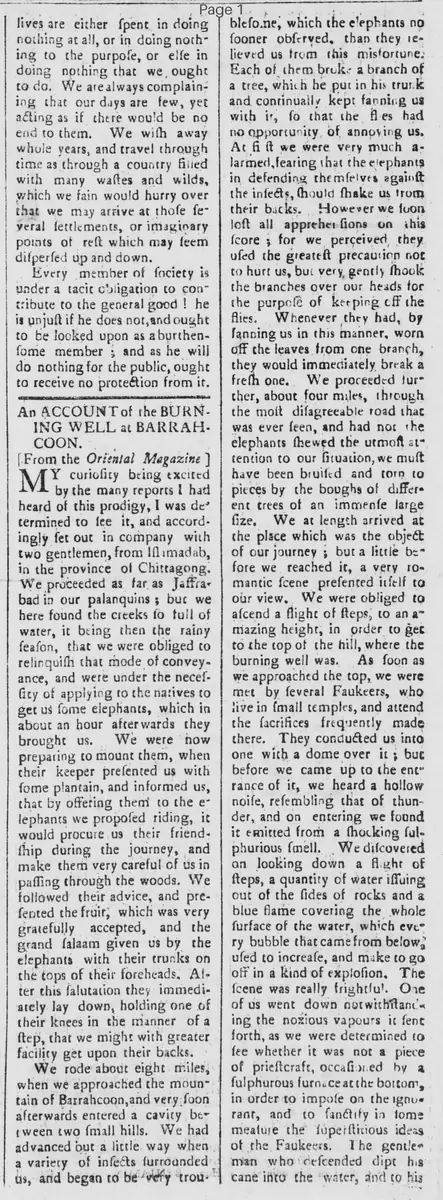
MY curiosity being excited by the many reports I had heard of this prodigy, I was determined to see it, and accordingly set out in company with two gentlemen, from Ismadab, in the province of Chittagong. We proceeded as far as Jaffrabad in our palanquins; but we here found the creeks so full of water, it being then the rainy season, that we were obliged to relinquish that mode of conveyance, and were under the necessity of applying to the natives to get us some elephants, which in about an hour afterwards they brought us. We were now preparing to mount them, when their keeper presented us with some plantain, and informed us, that by offering them to the elephants we proposed riding, it would procure us their friendship during the journey, and make them very careful of us in passing through the woods. We followed their advice, and presented the fruit, which was very gratefully accepted, and the grand salaam given us by the elephants with their trunks on the tops of their foreheads. After this salutation they immediately lay down, holding one of their knees in the manner of a step, that we might with greater facility get upon their backs.
We rode about eight miles, when we approached the mountain of Barrahcoon, and very soon afterwards entered a cavity between two small hills. We had advanced but a little way when a variety of insects surrounded us, and began to be very troublesome, which the elephants no sooner observed, than they relieved us from this misfortune. Each of them broke a branch of a tree, which he put in his trunk and continually kept fanning us with it, so that the flies had no opportunity of annoying us. At first we were very much alarmed fearing that the elephants in defending themselves against the insects, should shake us from their backs. However we soon lost all apprehensions on this score; for we perceived they used the greatest precaution not to hurt us, but very gently shook the branches over our heads for the purpose of keeping off the flies. Whenever they had, by fanning us in this manner, worn off the leaves from one branch, they would immediately break a fresh one. We proceeded further, about four miles, through the most disagreeable road that was ever seen, and had not the elephants shewed the utmost attention to our situation, we must have been bruised and torn to pieces by the boughs of different trees of an immense large size. We at length arrived at the place which was the object of our journey; but a little before we reached it, a very romantic scene presented itself to our view. We were obliged to ascend a flight of steps, to an amazing height, in order to get to the top of the hill, where the burning well was. As soon as we approached the top, we were met by several Fakeers, who live in small temples, and attend the sacrifices frequently made there. They conducted us into one with a dome over it: but before we came up to the entrance of it, we heard a hollow noise, resembling that of thunder, and on entering we found it emitted from a shocking sulphureous smell. We discovered on looking down a flight of steps, a quantity of water issuing out of the sides of rocks and a blue flame covering the whole surface of the water, which every bubble that came from below used to increase, and make to go off in a kind of explosion. The scene was really frightful. One of us went down notwithstanding the noxious vapours it sent forth, as we were determined to see whether it was not a piece of priestcraft, occasioned by a sulphureous furnace at the bottom, in order to impose on the ignorant, and to sanctify in some measure the superstitious ideas of the Fakeers. The gentleman who descended dipt his cane into the water, and to his great surprise found it possessed not the least warmth : he then put his hand into a place that was clear from the flames, but the water there was discovered excessively cold. He observed that the stones where the water issued out, appeared very hot, and imagined that through this means the flame might be communicated to the water. He called for a kedgeree pot, and poured some water upon the stones. which cooled them immediately : but still. when the water bubbled up again. he perceived the flash directly the same. and the stones very quickly reassumed their former red color. The water tasted as if there had been some sulphur and verdigris infused in it. The color of the stones about the well varied those nearest to it were red, but others at a greater distance were quite blue. During our stay several of the bearers bathed in the well. Having heard there was fire constantly issuing from a rock at Secacoon, we visited the place; it was about four miles distant from the well. The blaze was not so violent or great here as at the former place--the flame in any part did not exceed what a cup of spirits set on fire might produce. On a neighbouring hill, there were many Hindoo temples. We went to view them. but took notice that in our approach the Faqueers rung a bell for some little time. We entered one of the temples. in which we perceived a large hard blue stone, and on the top a small figure of a bacchanalian form : there was so much dew on the stone. that in running off at one of its corners it resembled a small stream. We suppose that about a common wine bottle might be filled by the water that ran down in the course of an hour. It seemed strongly impregnated with sulphur. After amusing ourselves for sometime with this sight, we mounted our elephants and returned home.
What sub-type of article is it?
What keywords are associated?
What entities or persons were involved?
Where did it happen?
Foreign News Details
Primary Location
Barrah Coon, Chittagong Province
Key Persons
Event Details
Travelers set out from Ismadab to Barrah Coon during rainy season, switching to elephants after palanquins. Elephants protected them from insects and rough terrain. At the site, they observed a well with cold water issuing from hot rocks, covered in blue flames that explode with bubbles. Water tastes of sulphur and verdigris. Stones near well are red, farther blue. Bearers bathed there. Visited nearby Secacoon rock with smaller flame and Hindoo temples with sulfurous dew on blue stone.