Thank you for visiting SNEWPapers!
Sign up free
Story
February 18, 1920
The Laramie Republican
Laramie, Albany County, Wyoming
What is this article about?
A speaker counters objections to ceding public lands to states, arguing that federal management has historically incurred deficits (e.g., $126M loss from 1784-1883), while state management in their state generates over $1M annual revenue with low costs (3-41% of revenues).
Clipping
OCR Quality
95%
Excellent
Full Text
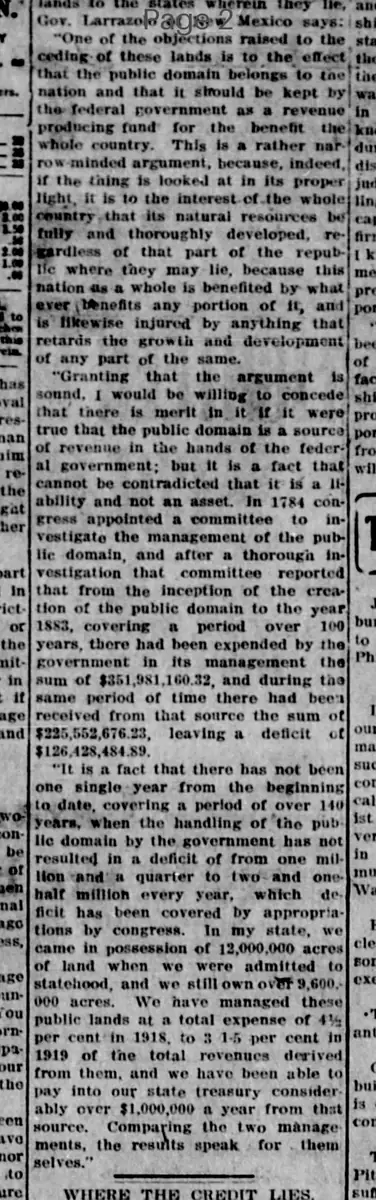
"One of the objections raised to the ceding of these lands is to the effect that the public domain belongs to the nation and that it should be kept by the federal government as a revenue producing fund for the benefit the whole country. This is a rather narrow-minded argument, because, indeed, if the thing is looked at in its proper light, it is to the interest of the whole country, that its natural resources be fully and thoroughly developed, regardless of that part of the republic where they may lie, because this nation as a whole is benefited by whatever benefits any portion of it, and is likewise injured by anything that retards the growth and development of any part of the same.
"Granting that the argument is sound, I would be willing to concede that there is merit in it if it were true that the public domain is a source of revenue in the hands of the federal government; but it is a fact that cannot be contradicted that it is a liability and not an asset. In 1784 congress appointed a committee to investigate the management of the public domain, and after a thorough investigation that committee reported that from the inception of the creation of the public domain to the year 1883, covering a period over 100 years, there had been expended by the government in its management the sum of $351,981,160.32, and during the same period of time there had been received from that source the sum of $225,552,676.23, leaving a deficit of $126,428,484.89.
"It is a fact that there has not been one single year from the beginning to date, covering a period of over 140 years, when the handling of the public domain by the government has not resulted in a deficit of from one million and a quarter to two and one-half million every year, which deficit has been covered by appropriations by congress. In my state, we came in possession of 12,000,000 acres of land when we were admitted to statehood, and we still own over 9,600,000 acres. We have managed these public lands at a total expense of 41 per cent in 1915 to 3 1/5 per cent in 1919 of the total revenues derived from them, and we have been able to pay into our state treasury considerably over $1,000,000 a year from that source. Comparing the two managements, the results speak for themselves."
"Granting that the argument is sound, I would be willing to concede that there is merit in it if it were true that the public domain is a source of revenue in the hands of the federal government; but it is a fact that cannot be contradicted that it is a liability and not an asset. In 1784 congress appointed a committee to investigate the management of the public domain, and after a thorough investigation that committee reported that from the inception of the creation of the public domain to the year 1883, covering a period over 100 years, there had been expended by the government in its management the sum of $351,981,160.32, and during the same period of time there had been received from that source the sum of $225,552,676.23, leaving a deficit of $126,428,484.89.
"It is a fact that there has not been one single year from the beginning to date, covering a period of over 140 years, when the handling of the public domain by the government has not resulted in a deficit of from one million and a quarter to two and one-half million every year, which deficit has been covered by appropriations by congress. In my state, we came in possession of 12,000,000 acres of land when we were admitted to statehood, and we still own over 9,600,000 acres. We have managed these public lands at a total expense of 41 per cent in 1915 to 3 1/5 per cent in 1919 of the total revenues derived from them, and we have been able to pay into our state treasury considerably over $1,000,000 a year from that source. Comparing the two managements, the results speak for themselves."
What sub-type of article is it?
Historical Event
What themes does it cover?
Moral Virtue
What keywords are associated?
Public Domain
Federal Management
State Lands
Revenue Deficit
Land Ceding
Where did it happen?
United States Public Domain
Story Details
Location
United States Public Domain
Event Date
1784 To 1919
Story Details
Speaker argues for ceding public lands to states, citing federal deficits in management over 140 years versus profitable state handling yielding over $1M annually.