Thank you for visiting SNEWPapers!
Sign up free
Letter to Editor
February 18, 1843
The Cecil Whig
Elkton, Cecil County, Maryland
What is this article about?
In Elkton, 'Liberty' writes to the editor opposing the temperance movement, arguing it harms merchants, professionals, magistrates, and county revenue from liquor licenses, while satirizing reformers' fanaticism, biblical misuse, and effects on blacks. He demands equal space to counter pro-temperance pieces. Dated Feb. 13, 1843.
Clipping
OCR Quality
95%
Excellent
Full Text
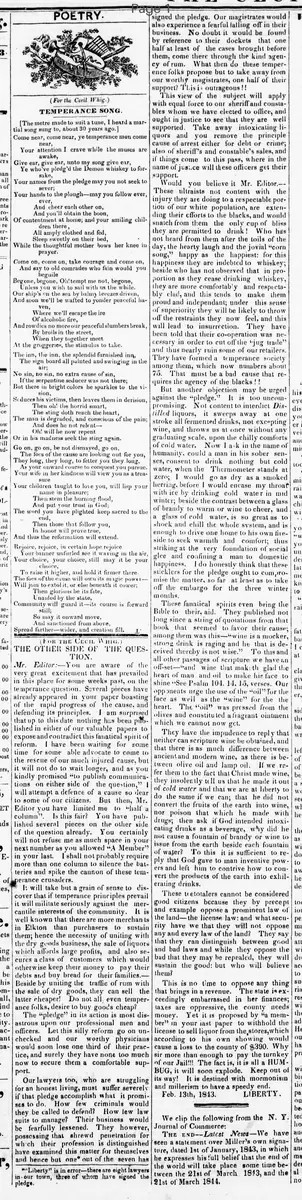
THE OTHER SIDE OF THE QUESTION.
Mr. Editor:—You are aware of the very great excitement that has prevailed in this place for some weeks past, on the temperance question. Several pieces have already appeared in your paper boasting of the rapid progress of the cause, and defending its principles. I am surprised that up to this date nothing has been published in either of our valuable papers to expose and contradict this fanatical spirit of reform. I have been waiting for some time for some able advocate to come to the rescue of our much injured cause, but it will not do to wait longer, and as you kindly promised "to publish communications on either side of the question," I will attempt a defence of a cause so dear to some of our citizens. But then, Mr. Editor you have limited me to "half a column". Is this fair? You have published several pieces on the other side of the question already. You certainly will not refuse me as much space in your next number as you allowed "A Member" in your last. I shall not probably require more than one column to silence the batteries and spike the cannon of these temperance crusaders.
It will take but a grain of sense to discover that if temperance principles prevail it will militate seriously against the mercantile interests of the community. It is well known that there are more merchants in Elkton than purchasers to sustain them; hence the necessity of uniting with the dry goods business, the sale of liquors which affords large profits, and also secures a class of customers which would otherwise keep their money to pay their debts and buy bread for their families. Beside by uniting the traffic of rum with the sale of dry goods, they can sell the latter cheaper! Do not all, even temperance folks, desire to buy goods cheap?
The "pledge" in its action is most disastrous upon our professional men and officers. Let this silly reform go on unchecked and our worthy physicians would soon lose one third of their practice, and surely they have none too much now to secure them a comfortable support.
Our lawyers too, who are struggling for an honest living, must suffer severely if that pledge accomplish what it promises to do. How few criminals would they be called to defend? How few law suits to manage? Their business would be fearfully lessened. They however, possessing that shrewd penetration for which their profession is distinguished have examined this matter for themselves and hence but one out of the seven has signed the pledge. "Liberty" is in error—there are eight lawyers in our town, three of whom have signed the pledge.
Our magistrates would also experience a fearful falling off in their business. No doubt it would be found by reference to their dockets that one half at least of the cases brought before them, come there through the kind agency of rum. What then do these temperance folks propose but to take away from our worthy magistrates, one half of their support? This is outrageous!!
This view of the subject will apply with equal force to our sheriff and constables whom we have elected to office, and ought in justice to see that they are well supported. Take away intoxicating liquors and you remove the principle cause of arrest either for debt or crime also of sheriff's and constable's sales, and if things come to this pass, where in the name of justice will these officers get their support.
Would you believe it Mr. Editor.—These ultraists not content with the injury they are doing to a respectable portion of our white population, are extending their efforts to the blacks, and would snatch from them the only cup of bliss they are permitted to drink! Who has not heard from them after the toils of the day, the hearty laugh and the jovial "corn song," happy as the happiest: for this happiness they are indebted to whiskey; beside who has not observed that in proportion as they cease drinking whiskey. they are more comfortably and respectably clad, and this tends to make them proud and independent; under this sense of superiority they will be likely to throw off the restraints they now feel. and this will lead to insurrection. They have been told that their co-operation was necessary in order to cut off the "jug trade" and thus nearly ruin some of our retailers. They have formed a temperance society among them, which now numbers about 75. That must be a bad cause that requires the agency of the blacks!!
But another objection may be urged against the "pledge." It is too uncompromising. Not content to interdict Distilled liquors, it sweeps away at one stroke all fermented drinks, not excepting wine, and throws us at once without any graduating scale, upon the chilly comforts of cold water. Now I ask in the name of humanity, could a man in his sober senses, consent to drink nothing but cold water, when the Thermometer stands at zero; I would go as dry as a smoked herring, before I would encase my throat with ice by drinking cold water in mid winter; beside the contrast between a glass of brandy to warm or wine to cheer, and a glass of cold water, is so great as to shock and chill the whole system, and is enough to drive one home to his own fireside to seek warmth and comfort; thus striking at the very foundation of social glee and confining a man to domestic happiness. I do honestly think that these sticklers for the pledge ought to compromise the matter, so far at least as to take off the embargo for the three winter months.
These fanatical spirits even bring the Bible to their aid. They published not long since a string of quotations from that book that seemed to favor their cause: among them was this—“wine is a mocker, strong drink is raging and he that is deceived thereby is not wise.” To this and all other passages of scripture we have an off-set—“and wine that maketh glad the heart of man and oil to make his face to shine” See Psalm 104. 14, 15, verses. Our opponents urge the use of the "oil" for the face as well as the "wine" for the heart. The "oil" was pressed from the olives and constituted a fragrant ointment which we cannot now get.
They have the impudence to reply that neither can scripture wine be obtained, and that there is as much difference between ancient and modern wine, as there is between olive oil and lamp oil. If we refer them to the fact that Christ made wine they insolently tell us that he made it out of cold water and that we are at liberty to do the same if we can: that he did not convert the fruits of the earth into wine, nor poison that which he made with drugs; then ask if God intended intoxicating drinks as a beverage, why did he not cause a fountain of brandy or wine to issue from the earth beside each fountain of water? To this it is sufficient to reply that God gave to man inventive powers and left him to contrive how to convert the products of the earth into exhilarating drinks.
These teetotalers cannot be considered good citizens because they by precept and example oppose a prominent law of the land—the license law: and what security have we that they will not oppose any and every law of the land? They say that they can distinguish between good and bad laws and while they oppose the bad that they may be repealed, they will sustain the good: but who will believe them?
This is no time to oppose any thing that brings in a revenue. The state is exceedingly embarrassed in her finances; taxes are oppressive, the county needs money. Yet it is proposed by "a member" in your last paper to withhold the license to sell liquor from the stores, which according to his own showing would cause a loss to the county of $390. Why sir more than enough to pay the turnkey of our Jail!!! The fact is, it is all a HUMBUG, it will soon explode. Keep out of its way! It is destined with mormonism and millerism to have a speedy end.
Feb. 13th, 1843
LIBERTY.
Mr. Editor:—You are aware of the very great excitement that has prevailed in this place for some weeks past, on the temperance question. Several pieces have already appeared in your paper boasting of the rapid progress of the cause, and defending its principles. I am surprised that up to this date nothing has been published in either of our valuable papers to expose and contradict this fanatical spirit of reform. I have been waiting for some time for some able advocate to come to the rescue of our much injured cause, but it will not do to wait longer, and as you kindly promised "to publish communications on either side of the question," I will attempt a defence of a cause so dear to some of our citizens. But then, Mr. Editor you have limited me to "half a column". Is this fair? You have published several pieces on the other side of the question already. You certainly will not refuse me as much space in your next number as you allowed "A Member" in your last. I shall not probably require more than one column to silence the batteries and spike the cannon of these temperance crusaders.
It will take but a grain of sense to discover that if temperance principles prevail it will militate seriously against the mercantile interests of the community. It is well known that there are more merchants in Elkton than purchasers to sustain them; hence the necessity of uniting with the dry goods business, the sale of liquors which affords large profits, and also secures a class of customers which would otherwise keep their money to pay their debts and buy bread for their families. Beside by uniting the traffic of rum with the sale of dry goods, they can sell the latter cheaper! Do not all, even temperance folks, desire to buy goods cheap?
The "pledge" in its action is most disastrous upon our professional men and officers. Let this silly reform go on unchecked and our worthy physicians would soon lose one third of their practice, and surely they have none too much now to secure them a comfortable support.
Our lawyers too, who are struggling for an honest living, must suffer severely if that pledge accomplish what it promises to do. How few criminals would they be called to defend? How few law suits to manage? Their business would be fearfully lessened. They however, possessing that shrewd penetration for which their profession is distinguished have examined this matter for themselves and hence but one out of the seven has signed the pledge. "Liberty" is in error—there are eight lawyers in our town, three of whom have signed the pledge.
Our magistrates would also experience a fearful falling off in their business. No doubt it would be found by reference to their dockets that one half at least of the cases brought before them, come there through the kind agency of rum. What then do these temperance folks propose but to take away from our worthy magistrates, one half of their support? This is outrageous!!
This view of the subject will apply with equal force to our sheriff and constables whom we have elected to office, and ought in justice to see that they are well supported. Take away intoxicating liquors and you remove the principle cause of arrest either for debt or crime also of sheriff's and constable's sales, and if things come to this pass, where in the name of justice will these officers get their support.
Would you believe it Mr. Editor.—These ultraists not content with the injury they are doing to a respectable portion of our white population, are extending their efforts to the blacks, and would snatch from them the only cup of bliss they are permitted to drink! Who has not heard from them after the toils of the day, the hearty laugh and the jovial "corn song," happy as the happiest: for this happiness they are indebted to whiskey; beside who has not observed that in proportion as they cease drinking whiskey. they are more comfortably and respectably clad, and this tends to make them proud and independent; under this sense of superiority they will be likely to throw off the restraints they now feel. and this will lead to insurrection. They have been told that their co-operation was necessary in order to cut off the "jug trade" and thus nearly ruin some of our retailers. They have formed a temperance society among them, which now numbers about 75. That must be a bad cause that requires the agency of the blacks!!
But another objection may be urged against the "pledge." It is too uncompromising. Not content to interdict Distilled liquors, it sweeps away at one stroke all fermented drinks, not excepting wine, and throws us at once without any graduating scale, upon the chilly comforts of cold water. Now I ask in the name of humanity, could a man in his sober senses, consent to drink nothing but cold water, when the Thermometer stands at zero; I would go as dry as a smoked herring, before I would encase my throat with ice by drinking cold water in mid winter; beside the contrast between a glass of brandy to warm or wine to cheer, and a glass of cold water, is so great as to shock and chill the whole system, and is enough to drive one home to his own fireside to seek warmth and comfort; thus striking at the very foundation of social glee and confining a man to domestic happiness. I do honestly think that these sticklers for the pledge ought to compromise the matter, so far at least as to take off the embargo for the three winter months.
These fanatical spirits even bring the Bible to their aid. They published not long since a string of quotations from that book that seemed to favor their cause: among them was this—“wine is a mocker, strong drink is raging and he that is deceived thereby is not wise.” To this and all other passages of scripture we have an off-set—“and wine that maketh glad the heart of man and oil to make his face to shine” See Psalm 104. 14, 15, verses. Our opponents urge the use of the "oil" for the face as well as the "wine" for the heart. The "oil" was pressed from the olives and constituted a fragrant ointment which we cannot now get.
They have the impudence to reply that neither can scripture wine be obtained, and that there is as much difference between ancient and modern wine, as there is between olive oil and lamp oil. If we refer them to the fact that Christ made wine they insolently tell us that he made it out of cold water and that we are at liberty to do the same if we can: that he did not convert the fruits of the earth into wine, nor poison that which he made with drugs; then ask if God intended intoxicating drinks as a beverage, why did he not cause a fountain of brandy or wine to issue from the earth beside each fountain of water? To this it is sufficient to reply that God gave to man inventive powers and left him to contrive how to convert the products of the earth into exhilarating drinks.
These teetotalers cannot be considered good citizens because they by precept and example oppose a prominent law of the land—the license law: and what security have we that they will not oppose any and every law of the land? They say that they can distinguish between good and bad laws and while they oppose the bad that they may be repealed, they will sustain the good: but who will believe them?
This is no time to oppose any thing that brings in a revenue. The state is exceedingly embarrassed in her finances; taxes are oppressive, the county needs money. Yet it is proposed by "a member" in your last paper to withhold the license to sell liquor from the stores, which according to his own showing would cause a loss to the county of $390. Why sir more than enough to pay the turnkey of our Jail!!! The fact is, it is all a HUMBUG, it will soon explode. Keep out of its way! It is destined with mormonism and millerism to have a speedy end.
Feb. 13th, 1843
LIBERTY.
What sub-type of article is it?
Persuasive
Satirical
Provocative
What themes does it cover?
Temperance
Economic Policy
Social Issues
What keywords are associated?
Temperance Opposition
Liquor Sales Defense
Economic Impact
License Law
Pledge Criticism
Biblical Debate
County Revenue
What entities or persons were involved?
Liberty.
Mr. Editor
Letter to Editor Details
Author
Liberty.
Recipient
Mr. Editor
Main Argument
the temperance movement is fanatical and harmful, as it undermines mercantile profits, professional practices, judicial business, law enforcement support, county revenue from liquor licenses, and social harmony, while misusing scripture and opposing established laws.
Notable Details
References To Elkton Merchants Combining Dry Goods And Liquor Sales
Physicians Losing One Third Of Practice
Eight Lawyers In Town, Three Signed Pledge
Black Temperance Society With 75 Members
Biblical Quotes From Proverbs And Psalm 104
Criticism Of Pledge As Uncompromising, Suggesting Winter Exemption
County Revenue Loss Of $390 From Withholding Licenses