Thank you for visiting SNEWPapers!
Sign up free
Editorial
April 4, 1811
Alexandria Daily Gazette, Commercial & Political
Alexandria, Virginia
What is this article about?
Editorial in Alexandria Daily Gazette critiques violent internal Republican Party disputes over cabinet changes, highlighting rivalry between Duane and Gallatin, potential removal of Robert Smith to Russia, and public distrust, quoting Aurora extract from March 25, 1811.
Clipping
OCR Quality
98%
Excellent
Full Text
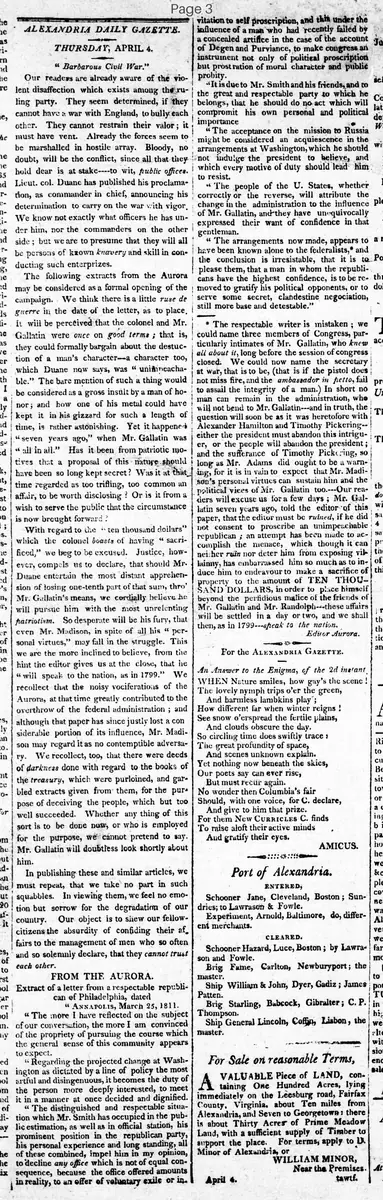
ALEXANDRIA DAILY GAZETTE.
THURSDAY, APRIL 4.
"Barbarous Civil War."
Our readers are already aware of the violent disaffection which exists among the ruling party. They seem determined, if they cannot have a war with England, to bully each other. They cannot restrain their valor; it must have vent. Already the forces seem to be marshalled in hostile array. Bloody, no doubt, will be the conflict, since all that they hold dear is at stake----to wit, public offices.
Lieut. col. Duane has published his proclamation, as commander in chief, announcing his determination to carry on the war with vigor. We know not exactly what officers he has under him, nor the commanders on the other side; but we are to presume that they will all be persons of known knavery and skill in conducting such enterprizes.
The following extracts from the Aurora may be considered as a formal opening of the campaign. We think there is a little ruse de guerre in the date of the letter, as to place.
It will be perceived that the colonel and Mr. Gallatin were once on good terms; that is, they could formerly bargain about the destruction of a man's character--a character too, which Duane says, was "unimpeachable." The bare mention of such a thing would be considered as a gross insult by a man of honor; and how one of his metal could have kept it in his gizzard for such a length of time, is rather astonishing. Yet it happened "seven years ago," when Mr. Gallatin was "all in all." Has it been from patriotic motives that a proposal of this nature should have been so long kept secret? Was it at that time regarded as too trifling, too common an affair, to be worth disclosing? Or is it from a wish to serve the public that the circumstance is now brought forward?
With regard to the "ten thousand dollars" which the colonel boasts of having "sacrificed," we beg to be excused. Justice, however, compels us to declare, that should Mr. Duane entertain the most distant apprehension of losing one-tenth part of that sum, thro' Mr. Gallatin's means, we cordially believe he will pursue him with the most unrelenting patriotism. So desperate will be his fury, that even Mr. Madison, in spite of all his "personal virtues," may fall in the struggle. This we are the more inclined to believe, from the hint the editor gives us at the close, that he "will speak to the nation, as in 1799." We recollect that the noisy vociferations of the Aurora, at that time greatly contributed to the overthrow of the federal administration; and although that paper has since justly lost a considerable portion of its influence, Mr. Madison may regard it as no contemptible adversary.
We recollect, too, that there were deeds of darkness done with regard to the books of the treasury, which were purloined, and garbled extracts given from them, for the purpose of deceiving the people, which but too well succeeded. Whether any thing of this sort is to be done now, or who is employed for the purpose, we cannot pretend to say. Mr. Gallatin will doubtless look shortly about him.
In publishing these and similar articles, we must repeat, that we take no part in such squabbles. In viewing them, we feel no emotion but sorrow for the degradation of our country. Our object is to show our fellow-citizens the absurdity of confiding their affairs to the management of men who so often and so solemnly declare, that they cannot trust each other.
FROM THE AURORA.
Extract of a letter from a respectable republican of Philadelphia, dated
"Annapolis, March 25, 1811."
"The more I have reflected on the subject of our conversation, the more I am convinced of the propriety of pursuing the course which the general sense of this community appears to expect.
"Regarding the projected change at Washington as dictated by a line of policy the most artful and disingenuous, it becomes the duty of the person more deeply interested, to meet it in a manner at once decided and dignified.
"The distinguished and respectable situation which Mr. Smith has occupied in the public estimation, as well as in official station, his prominent position in the republican party, his personal experience and long standing, all of these combined, impel him in my opinion, to decline any office which is not of equal consequence, because the office offered amounts in reality, to an offer of voluntary exile or invitation to self proscription, and this under the influence of a man who had recently failed by a concealed artifice in the case of the account of Degen and Purviance, to make congress an instrument not only of political proscription but prostration of moral character and public probity.
"It is due to Mr. Smith and his friends, and to the great and respectable party to which he belongs, that he should do no act which will compromit his own personal and political importance.
"The acceptance of the mission to Russia might be considered an acquiescence in the arrangements at Washington, which he should not indulge the president to believe, and which every motive of duty should lead him to resist.
The people of the U. States, whether correctly or the reverse, will attribute the change in the administration to the influence of Mr. Gallatin, and they have unequivocally expressed their want of confidence in that gentleman.
"The arrangements now made, appears to have been known alone to the federalists,* and the conclusion is irresistible, that it is to please them, that a man in whom the republicans have the highest confidence, is to be removed to gratify his political opponents, or to serve some secret, clandestine negociation, still more base and detestable."
* The respectable writer is mistaken; we could name three members of Congress, particularly intimates of Mr. Gallatin, who knew all about it, long before the session of congress closed: We could now name the secretary at war, that is to be, (that is if the pistol does not miss fire, and the ambassador to St. Petersburg, fail to assail the integrity of a man.) In short no man can remain in the administration, who will not bend to Mr. Gallatin---and in truth, the question will soon be as it was heretofore with Alexander Hamilton and Timothy Pickering-- either the president must abandon this intriguer, or the people will abandon the president; and the sufferance of Timothy Pickering, so long as Mr. Adams did ought to be a warning, for it is in vain to expect that Mr. Madison's personal virtues can sustain him and the political vices of Mr. Gallatin too.---Our readers will excuse us for a few days; Mr. Gallatin seven years ago, told the editor of this paper, that the editor must be ruined, if he did not consent to proscribe an unimpeachable republican; an attempt has been made to accomplish the menace, which though it can neither ruin nor deter him from exposing villany, has embarrassed him so much as to induce him to endeavour to make a sacrifice of property to the amount of TEN THOUSAND DOLLARS, in order to place himself beyond the perfidious malice of the friends of Mr. Gallatin and Mr. Randolph--these affairs will be settled in a day or two, and we shall then, as in 1799---speak to the nation.
Editor Aurora.
THURSDAY, APRIL 4.
"Barbarous Civil War."
Our readers are already aware of the violent disaffection which exists among the ruling party. They seem determined, if they cannot have a war with England, to bully each other. They cannot restrain their valor; it must have vent. Already the forces seem to be marshalled in hostile array. Bloody, no doubt, will be the conflict, since all that they hold dear is at stake----to wit, public offices.
Lieut. col. Duane has published his proclamation, as commander in chief, announcing his determination to carry on the war with vigor. We know not exactly what officers he has under him, nor the commanders on the other side; but we are to presume that they will all be persons of known knavery and skill in conducting such enterprizes.
The following extracts from the Aurora may be considered as a formal opening of the campaign. We think there is a little ruse de guerre in the date of the letter, as to place.
It will be perceived that the colonel and Mr. Gallatin were once on good terms; that is, they could formerly bargain about the destruction of a man's character--a character too, which Duane says, was "unimpeachable." The bare mention of such a thing would be considered as a gross insult by a man of honor; and how one of his metal could have kept it in his gizzard for such a length of time, is rather astonishing. Yet it happened "seven years ago," when Mr. Gallatin was "all in all." Has it been from patriotic motives that a proposal of this nature should have been so long kept secret? Was it at that time regarded as too trifling, too common an affair, to be worth disclosing? Or is it from a wish to serve the public that the circumstance is now brought forward?
With regard to the "ten thousand dollars" which the colonel boasts of having "sacrificed," we beg to be excused. Justice, however, compels us to declare, that should Mr. Duane entertain the most distant apprehension of losing one-tenth part of that sum, thro' Mr. Gallatin's means, we cordially believe he will pursue him with the most unrelenting patriotism. So desperate will be his fury, that even Mr. Madison, in spite of all his "personal virtues," may fall in the struggle. This we are the more inclined to believe, from the hint the editor gives us at the close, that he "will speak to the nation, as in 1799." We recollect that the noisy vociferations of the Aurora, at that time greatly contributed to the overthrow of the federal administration; and although that paper has since justly lost a considerable portion of its influence, Mr. Madison may regard it as no contemptible adversary.
We recollect, too, that there were deeds of darkness done with regard to the books of the treasury, which were purloined, and garbled extracts given from them, for the purpose of deceiving the people, which but too well succeeded. Whether any thing of this sort is to be done now, or who is employed for the purpose, we cannot pretend to say. Mr. Gallatin will doubtless look shortly about him.
In publishing these and similar articles, we must repeat, that we take no part in such squabbles. In viewing them, we feel no emotion but sorrow for the degradation of our country. Our object is to show our fellow-citizens the absurdity of confiding their affairs to the management of men who so often and so solemnly declare, that they cannot trust each other.
FROM THE AURORA.
Extract of a letter from a respectable republican of Philadelphia, dated
"Annapolis, March 25, 1811."
"The more I have reflected on the subject of our conversation, the more I am convinced of the propriety of pursuing the course which the general sense of this community appears to expect.
"Regarding the projected change at Washington as dictated by a line of policy the most artful and disingenuous, it becomes the duty of the person more deeply interested, to meet it in a manner at once decided and dignified.
"The distinguished and respectable situation which Mr. Smith has occupied in the public estimation, as well as in official station, his prominent position in the republican party, his personal experience and long standing, all of these combined, impel him in my opinion, to decline any office which is not of equal consequence, because the office offered amounts in reality, to an offer of voluntary exile or invitation to self proscription, and this under the influence of a man who had recently failed by a concealed artifice in the case of the account of Degen and Purviance, to make congress an instrument not only of political proscription but prostration of moral character and public probity.
"It is due to Mr. Smith and his friends, and to the great and respectable party to which he belongs, that he should do no act which will compromit his own personal and political importance.
"The acceptance of the mission to Russia might be considered an acquiescence in the arrangements at Washington, which he should not indulge the president to believe, and which every motive of duty should lead him to resist.
The people of the U. States, whether correctly or the reverse, will attribute the change in the administration to the influence of Mr. Gallatin, and they have unequivocally expressed their want of confidence in that gentleman.
"The arrangements now made, appears to have been known alone to the federalists,* and the conclusion is irresistible, that it is to please them, that a man in whom the republicans have the highest confidence, is to be removed to gratify his political opponents, or to serve some secret, clandestine negociation, still more base and detestable."
* The respectable writer is mistaken; we could name three members of Congress, particularly intimates of Mr. Gallatin, who knew all about it, long before the session of congress closed: We could now name the secretary at war, that is to be, (that is if the pistol does not miss fire, and the ambassador to St. Petersburg, fail to assail the integrity of a man.) In short no man can remain in the administration, who will not bend to Mr. Gallatin---and in truth, the question will soon be as it was heretofore with Alexander Hamilton and Timothy Pickering-- either the president must abandon this intriguer, or the people will abandon the president; and the sufferance of Timothy Pickering, so long as Mr. Adams did ought to be a warning, for it is in vain to expect that Mr. Madison's personal virtues can sustain him and the political vices of Mr. Gallatin too.---Our readers will excuse us for a few days; Mr. Gallatin seven years ago, told the editor of this paper, that the editor must be ruined, if he did not consent to proscribe an unimpeachable republican; an attempt has been made to accomplish the menace, which though it can neither ruin nor deter him from exposing villany, has embarrassed him so much as to induce him to endeavour to make a sacrifice of property to the amount of TEN THOUSAND DOLLARS, in order to place himself beyond the perfidious malice of the friends of Mr. Gallatin and Mr. Randolph--these affairs will be settled in a day or two, and we shall then, as in 1799---speak to the nation.
Editor Aurora.
What sub-type of article is it?
Partisan Politics
What keywords are associated?
Republican Infighting
Cabinet Changes
Gallatin Influence
Duane Gallatin Rivalry
Robert Smith Proscription
Aurora Attacks
Madison Administration
What entities or persons were involved?
Lieut. Col. Duane
Mr. Gallatin
Mr. Madison
Mr. Smith
Aurora Editor
Alexander Hamilton
Timothy Pickering
John Adams
Editorial Details
Primary Topic
Republican Party Infighting Over Cabinet Changes And Gallatin's Influence
Stance / Tone
Critical Of Internal Political Squabbles And Their Degradation Of The Country
Key Figures
Lieut. Col. Duane
Mr. Gallatin
Mr. Madison
Mr. Smith
Aurora Editor
Alexander Hamilton
Timothy Pickering
John Adams
Key Arguments
Ruling Party Engaged In Internal 'Civil War' Over Public Offices
Duane's Past Dealings With Gallatin Reveal Character Assassination Attempts
Cabinet Changes, Like Offering Smith Mission To Russia, Seen As Proscription Influenced By Gallatin
Public Distrust Of Gallatin And Arrangements Favoring Federalists
Aurora Vows To Expose Villany As In 1799, Potentially Threatening Madison's Administration
Treasury Books Previously Manipulated To Deceive People