Thank you for visiting SNEWPapers!
Sign up free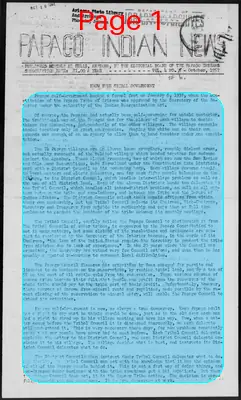
Papago Indian News
Sells, Pima County, Arizona
What is this article about?
The Papago Tribe of Arizona formalized self-government on January 6, 1937, via a constitution approved under the Indian Reorganization Act, evolving from traditional village autonomy into a democratic structure of village, district, and tribal councils handling local to external matters.
Clipping
OCR Quality
Full Text
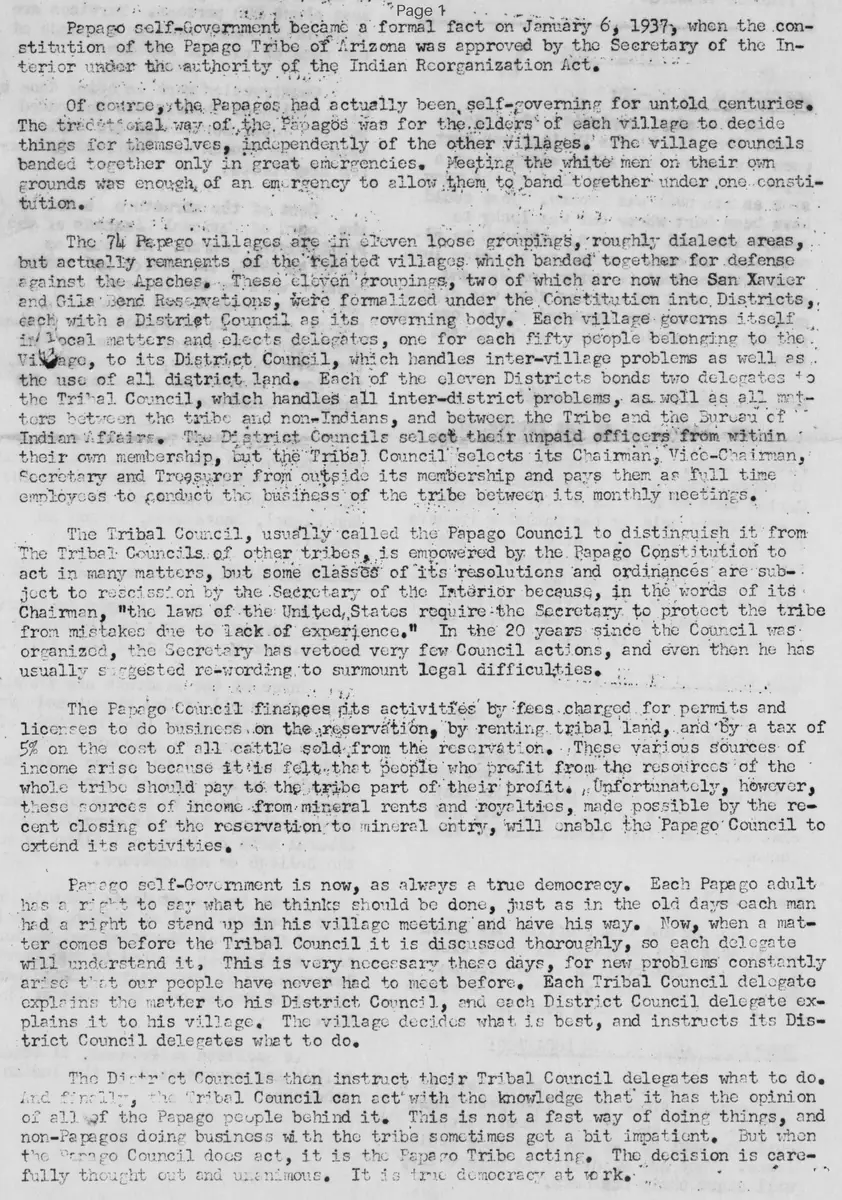
Of course, the Papagos had actually been self-governing for untold centuries. The traditional way of the Papagos was for the elders of each village to decide things for themselves, independently of the other villages. The village councils banded together only in great emergencies. Meeting the white men on their own grounds was enough of an emergency to allow them to band together under one constitution.
The Papago villages are in eleven loose groupings, roughly dialect areas but actually remnants of the related villages which banded together for defense against the Apaches. These eleven groupings, two of which are now the San Xavier and Gila Bend Reservations, were formalized under the Constitution into Districts each with a District Council as its governing body. Each village governs itself in local matters and elects delegates, one for each fifty people belonging to the Village, to its District Council, which handles inter-village problems as well as the use of all district land. Each of the eleven Districts sends two delegates to the Tribal Council, which handles all inter-district problems, as well as all matters between the tribe and non-Indians, and between the Tribe and the Bureau of Indian Affairs. The District Councils select their unpaid officers from within their own membership, but the Tribal Council selects its Chairman, Vice-Chairman, Secretary and Treasurer from outside its membership and pays them as full time employees to conduct the business of the tribe between its monthly meetings.
The Tribal Council, usually called the Papago Council to distinguish it from Tribal Councils of other tribes, is empowered by the Papago Constitution to act in many matters, but some classes of its resolutions and ordinances are subject to rescission by the Secretary of the Interior because, in the words of its Chairman, "the laws of the United States require the Secretary to protect the tribe from mistakes due to lack of experience." In the 20 years since the Council was organized, the Secretary has vetoed very few Council actions, and even then he has usually suggested re-wording to surmount legal difficulties.
The Papago Council finances its activities by fees charged for permits and licenses to do business on the reservation, by renting tribal land, and by a tax of 5% on the cost of all cattle sold from the reservation. These various sources of income arise because it is felt that people who profit from the resources of the whole tribe should pay to the tribe part of their profit. Unfortunately, however, these sources of income from mineral rents and royalties, made possible by the recent closing of the reservation to mineral entry, will enable the Papago Council to extend its activities.
Papago self-Government is now, as always, a true democracy. Each Papago adult has a right to say what he thinks should be done, just as in the old days each man had a right to stand up in his village meeting and have his say. Now, when a matter comes before the Tribal Council it is discussed thoroughly, so each delegate will understand it. This is very necessary these days, for new problems constantly arise that our people have never had to meet before. Each Tribal Council delegate explains the matter to his District Council, and each District Council delegate explains it to his village. The village decides what is best and instructs its District Council delegates what to do. The District Councils then instruct their Tribal Council delegates what to do. And finally, a Tribal Council can act with the knowledge that it has the opinion of all of the Papago people behind it. This is not a fast way of doing things, and non-Papagos doing business with the tribe sometimes get a bit impatient. But when the Papago Council does act, it is the Papago Tribe acting. The decision is carefully thought out and unanimous. It is true democracy at work.
What sub-type of article is it?
What themes does it cover?
What keywords are associated?
What entities or persons were involved?
Where did it happen?
Story Details
Key Persons
Location
Arizona, Papago Reservations Including San Xavier And Gila Bend
Event Date
January 6, 1937
Story Details
The Papago Tribe formalized self-government through a 1937 constitution under the Indian Reorganization Act, structuring traditional village autonomy into district and tribal councils for democratic decision-making on internal and external affairs, financed by tribal resources.