Thank you for visiting SNEWPapers!
Sign up free
Domestic News
November 1, 1855
Fayetteville Observer
Fayetteville, Lincoln County, Tennessee
What is this article about?
Instructional article on teaching young farm workers proper cow milking techniques, stressing gentleness, speed, correct positioning, and starting with less productive cows to maximize yield and safety.
Clipping
OCR Quality
98%
Excellent
Full Text
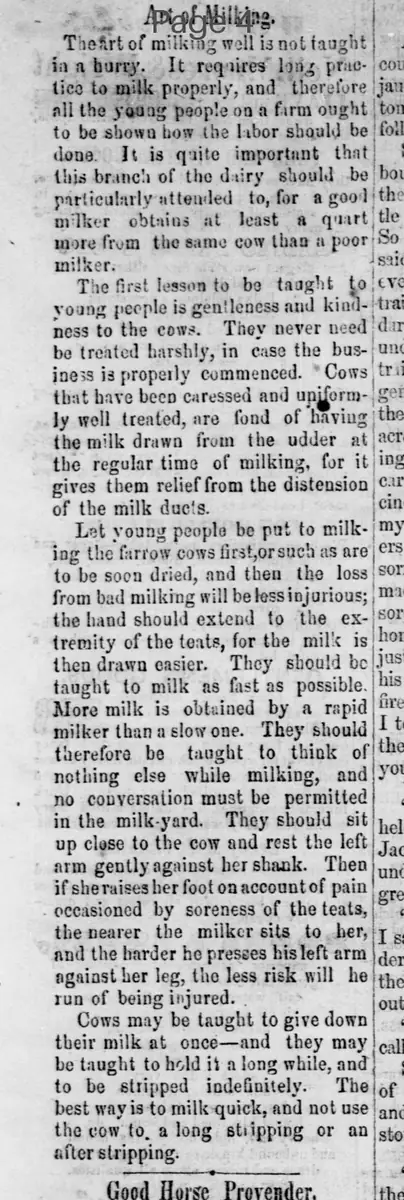
The art of milking well is not taught in a hurry. It requires long practice to milk properly, and therefore all the young people on a farm ought to be shown how the labor should be done. It is quite important that this branch of the dairy should be particularly attended to, or a good milker obtains at least a quart more from the same cow than a poor milker.
The first lesson to be taught to young people is gentleness and kindness to the cows. They never need be treated harshly, in case the business is properly commenced. Cows that have been caressed and uniformly well treated, are fond of having the milk drawn from the udder at the regular time of milking. or it gives them relief from the distension of the milk ducts.
Let young people be put to milking the farrow cows first, or such as are to be soon dried, and then the loss from bad milking will be less injurious: the hand should extend to the extremity of the teats, for the milk is then drawn easier. They should be taught to milk as fast as possible. More milk is obtained by a rapid milker than a slow one. They should therefore be taught to think of nothing else while milking, and no conversation must be permitted in the milk-yard. They should sit up close to the cow and rest the left arm gently against her flank. Then if she raises her foot on account of pain occasioned by soreness of the teats. the nearer the milker sits to her. and the harder he presses his left arm against her leg, the less risk will he run of being injured.
Cows may be taught to give down their milk at once--and they may be taught to hold it a long while, and to be stripped indefinitely. The best way is to milk quick, and not use the cow to a long stripping or an after stripping.
The first lesson to be taught to young people is gentleness and kindness to the cows. They never need be treated harshly, in case the business is properly commenced. Cows that have been caressed and uniformly well treated, are fond of having the milk drawn from the udder at the regular time of milking. or it gives them relief from the distension of the milk ducts.
Let young people be put to milking the farrow cows first, or such as are to be soon dried, and then the loss from bad milking will be less injurious: the hand should extend to the extremity of the teats, for the milk is then drawn easier. They should be taught to milk as fast as possible. More milk is obtained by a rapid milker than a slow one. They should therefore be taught to think of nothing else while milking, and no conversation must be permitted in the milk-yard. They should sit up close to the cow and rest the left arm gently against her flank. Then if she raises her foot on account of pain occasioned by soreness of the teats. the nearer the milker sits to her. and the harder he presses his left arm against her leg, the less risk will he run of being injured.
Cows may be taught to give down their milk at once--and they may be taught to hold it a long while, and to be stripped indefinitely. The best way is to milk quick, and not use the cow to a long stripping or an after stripping.
What sub-type of article is it?
Agriculture
What keywords are associated?
Milking Techniques
Dairy Farming
Cow Care
Farm Training
Domestic News Details
Event Details
The art of milking well requires long practice; young people should be taught gentleness and kindness to cows, starting with farrow cows, milking quickly with proper hand position and close seating to avoid injury, and avoiding conversation during milking to obtain more milk.