Thank you for visiting SNEWPapers!
Sign up free
Chicago Citizen
Chicago, Cook County, Illinois
What is this article about?
A Chicago editorial from June 6, 1925, condemns England's opium policy, accusing it of exploiting China through historical trade and wars, and refusing to end the traffic at the recent Geneva conference despite U.S. proposals.
Clipping
OCR Quality
Full Text
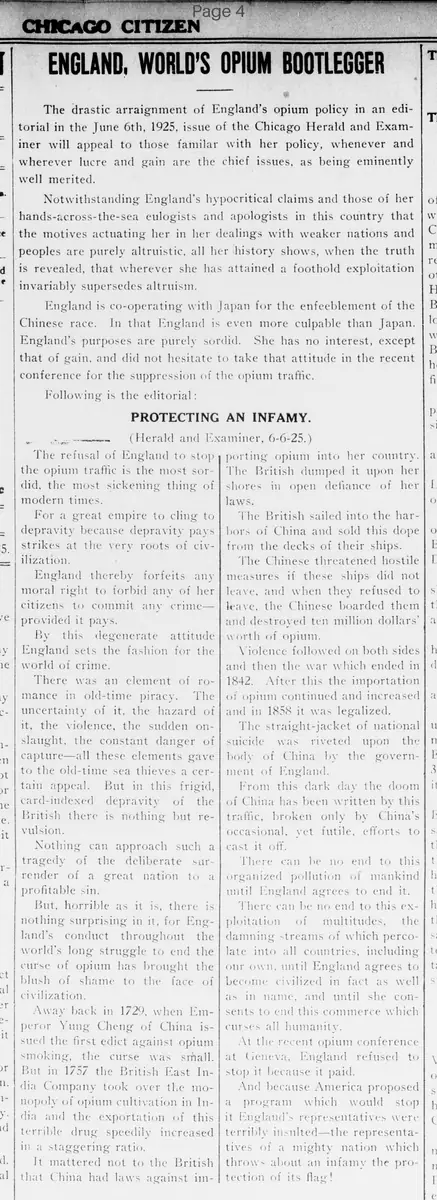
ENGLAND, WORLD'S OPIUM BOOTLEGGER
The drastic arraignment of England's opium policy in an editorial in the June 6th, 1925, issue of the Chicago Herald and Examiner will appeal to those familiar with her policy, whenever and wherever lucre and gain are the chief issues, as being eminently well merited.
Notwithstanding England's hypocritical claims and those of her hands-across-the-sea eulogists and apologists in this country that the motives actuating her in her dealings with weaker nations and peoples are purely altruistic, all her history shows, when the truth is revealed, that wherever she has attained a foothold exploitation invariably supersedes altruism.
England is co-operating with Japan for the enfeeblement of the Chinese race. In that England is even more culpable than Japan. England's purposes are purely sordid. She has no interest, except that of gain, and did not hesitate to take that attitude in the recent conference for the suppression of the opium traffic.
Following is the editorial:
PROTECTING AN INFAMY.
The refusal of England to stop the opium traffic is the most sordid, the most sickening thing of modern times.
For a great empire to cling to depravity because depravity pays strikes at the very roots of civilization.
England thereby forfeits any moral right to forbid any of her citizens to commit any crime—provided it pays.
By this degenerate attitude England sets the fashion for the world of crime.
There was an element of romance in old-time piracy. The uncertainty of it, the hazard of it, the violence, the sudden onslaught, the constant danger of capture—all these elements gave to the old-time sea thieves a certain appeal. But in this frigid, card-indexed depravity of the British there is nothing but revulsion.
Nothing can approach such a tragedy of the deliberate surrender of a great nation to a profitable sin.
But, horrible as it is, there is nothing surprising in it, for England's conduct throughout the world's long struggle to end the curse of opium has brought the blush of shame to the face of civilization.
Away back in 1729, when Emperor Yung Cheng of China issued the first edict against opium smoking, the curse was small.
But in 1757 the British East India Company took over the monopoly of opium cultivation in India and the exportation of this terrible drug speedily increased in a staggering ratio.
It mattered not to the British that China had laws against importing opium into her country.
The British dumped it upon her shores in open defiance of her laws.
The British sailed into the harbors of China and sold this dope from the decks of their ships.
The Chinese threatened hostile measures if these ships did not leave, and when they refused to leave, the Chinese boarded them and destroyed ten million dollars' worth of opium.
Violence followed on both sides and then the war which ended in 1842. After this the importation of opium continued and increased and in 1858 it was legalized.
The straight-jacket of national suicide was riveted upon the body of China by the government of England.
From this dark day the doom of China has been written by this traffic, broken only by China's occasional, yet futile, efforts to cast it off.
There can be no end to this organized pollution of mankind until England agrees to end it.
There can be no end to this exploitation of multitudes, the damning streams of which percolate into all countries, including our own, until England agrees to become civilized in fact as well as in name, and until she consents to end this commerce which curses all humanity.
At the recent opium conference at Geneva, England refused to stop it because it paid.
And because America proposed a program which would stop it England's representatives were terribly insulted—the representatives of a mighty nation which throws about an infamy the protection of its flag!
What sub-type of article is it?
What keywords are associated?
What entities or persons were involved?
Where did it happen?
Foreign News Details
Primary Location
England
Event Date
June 6th, 1925
Key Persons
Outcome
destruction of ten million dollars' worth of opium; opium war ended in 1842; importation legalized in 1858; england refused to stop traffic at geneva conference.
Event Details
England criticized for continuing opium trade to exploit China, cooperating with Japan; historical monopoly by British East India Company from 1757, defiance of Chinese laws leading to 1842 war; refusal at recent Geneva conference to end traffic despite American proposals.