Thank you for visiting SNEWPapers!
Sign up free
Story
August 21, 1896
The Herald
Los Angeles, Los Angeles County, California
What is this article about?
Dr. McCook discovers a spider crossing water without leg movement by using silken threads as invisible sails, allowing it to skim the surface like a tiny boat.
Clipping
OCR Quality
98%
Excellent
Full Text
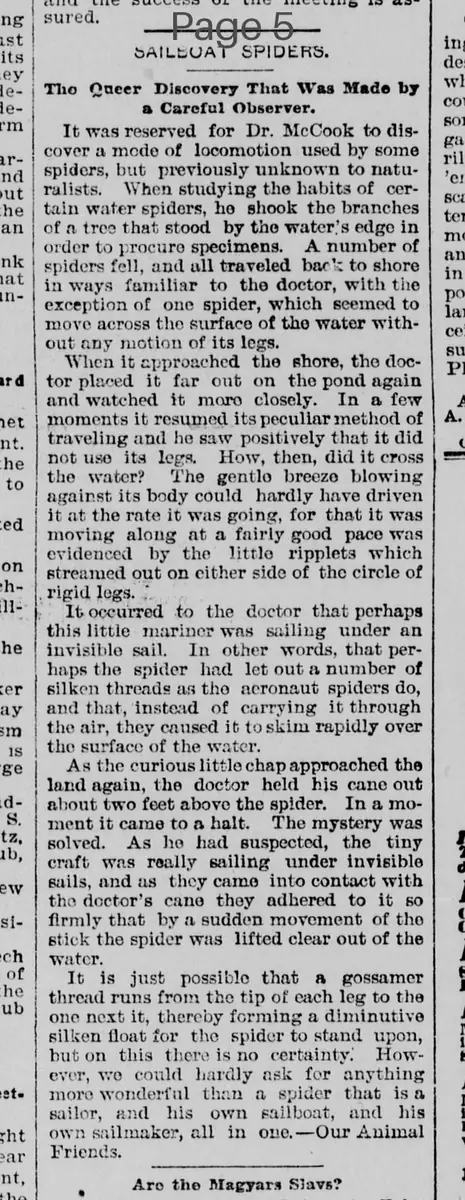
SAILING SPIDERS
The Queer Discovery That Was Made by a Careful Observer
It was reserved for Dr. McCook to discover a mode of locomotion used by some spiders, but previously unknown to naturalists. When studying the habits of certain water spiders, he shook the branches of a tree that stood by the water's edge in order to procure specimens. A number of spiders fell, and all traveled back to shore in ways familiar to the doctor, with the exception of one spider, which seemed to move across the surface of the water without any motion of its legs.
When it approached the shore, the doctor placed it far out on the pond again and watched it more closely. In a few moments it resumed its peculiar method of traveling and he saw positively that it did not use its legs. How, then, did it cross the water? The gentle breeze blowing against its body could hardly have driven it at the rate it was going, for that it was moving along at a fairly good pace was evidenced by the little ripplets which streamed out on either side of the circle of rigid legs.
It occurred to the doctor that perhaps this little mariner was sailing under an invisible sail. In other words, that perhaps the spider had let out a number of silken threads as the aeronaut spiders do, and that, instead of carrying it through the air, they caused it to skim rapidly over the surface of the water.
As the curious little chap approached the land again, the doctor held his cane out about two feet above the spider. In a moment it came to a halt. The mystery was solved. As he had suspected, the tiny craft was really sailing under invisible sails, and as they came into contact with the doctor's cane they adhered to it so firmly that by a sudden movement of the stick the spider was lifted clear out of the water.
It is just possible that a gossamer thread runs from the tip of each leg to the one next it, thereby forming a diminutive silken float for the spider to stand upon, but on this there is no certainty. However, we could hardly ask for anything more wonderful than a spider that is a sailor, and his own sailboat, and his own sailmaker, all in one.—Our Animal Friends.
The Queer Discovery That Was Made by a Careful Observer
It was reserved for Dr. McCook to discover a mode of locomotion used by some spiders, but previously unknown to naturalists. When studying the habits of certain water spiders, he shook the branches of a tree that stood by the water's edge in order to procure specimens. A number of spiders fell, and all traveled back to shore in ways familiar to the doctor, with the exception of one spider, which seemed to move across the surface of the water without any motion of its legs.
When it approached the shore, the doctor placed it far out on the pond again and watched it more closely. In a few moments it resumed its peculiar method of traveling and he saw positively that it did not use its legs. How, then, did it cross the water? The gentle breeze blowing against its body could hardly have driven it at the rate it was going, for that it was moving along at a fairly good pace was evidenced by the little ripplets which streamed out on either side of the circle of rigid legs.
It occurred to the doctor that perhaps this little mariner was sailing under an invisible sail. In other words, that perhaps the spider had let out a number of silken threads as the aeronaut spiders do, and that, instead of carrying it through the air, they caused it to skim rapidly over the surface of the water.
As the curious little chap approached the land again, the doctor held his cane out about two feet above the spider. In a moment it came to a halt. The mystery was solved. As he had suspected, the tiny craft was really sailing under invisible sails, and as they came into contact with the doctor's cane they adhered to it so firmly that by a sudden movement of the stick the spider was lifted clear out of the water.
It is just possible that a gossamer thread runs from the tip of each leg to the one next it, thereby forming a diminutive silken float for the spider to stand upon, but on this there is no certainty. However, we could hardly ask for anything more wonderful than a spider that is a sailor, and his own sailboat, and his own sailmaker, all in one.—Our Animal Friends.
What sub-type of article is it?
Curiosity
Animal Story
Extraordinary Event
What themes does it cover?
Nature
What keywords are associated?
Sailing Spiders
Silken Sails
Dr. Mccook
Water Spiders
Natural Discovery
What entities or persons were involved?
Dr. Mccook
Where did it happen?
Water's Edge, Pond
Story Details
Key Persons
Dr. Mccook
Location
Water's Edge, Pond
Story Details
Dr. McCook observes a spider moving across water without leg motion, deduces it uses silken threads as sails caught by the breeze, confirmed by catching the threads with his cane.