Thank you for visiting SNEWPapers!
Sign up free
Daily National Intelligencer
Washington, District Of Columbia
What is this article about?
In a House debate on the New Army Bill to raise 20,000 men for the war with Britain, Mr. Kent supports it despite cost concerns, argues economy is inadmissible in war, refutes claims of danger to liberties, defends U.S. propositions on impressment, and criticizes British aggressions and opponents' inconsistencies.
Clipping
OCR Quality
Full Text
HOUSE OF REPRESENTATIVES.
DEBATE ON THE NEW ARMY BILL.
CONTINUED.
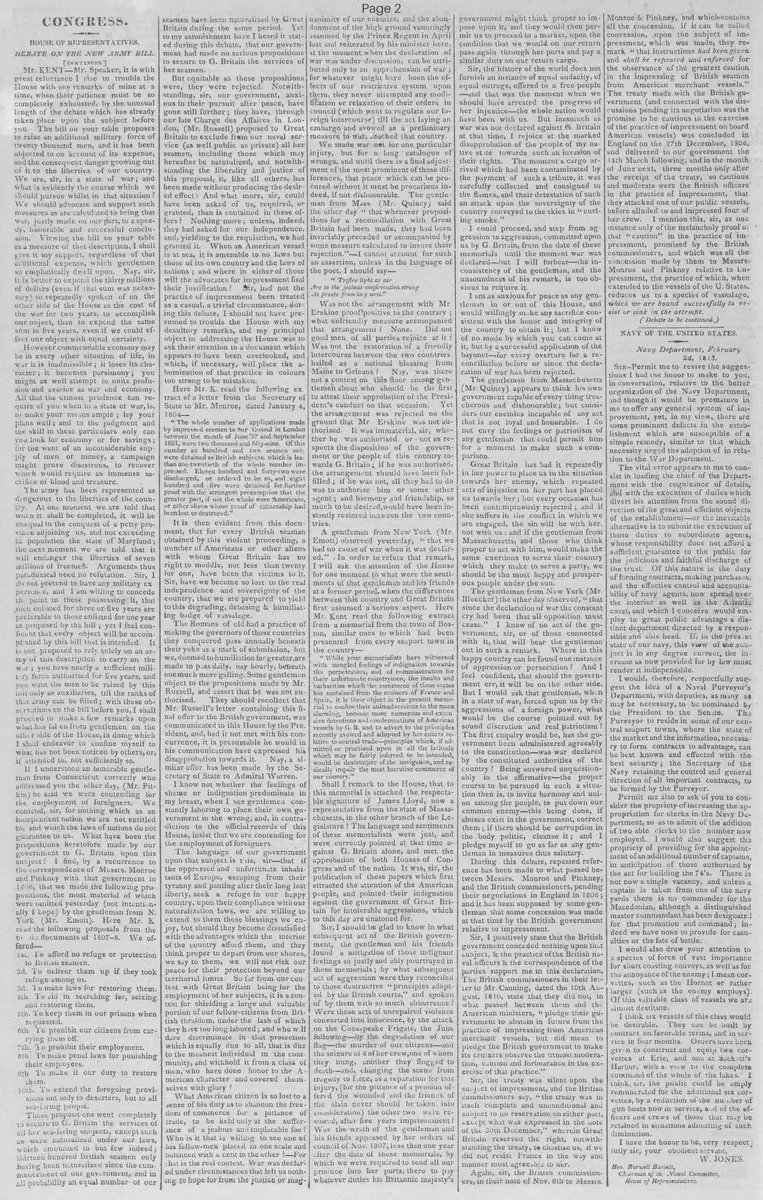
Mr. KENT Mr. Speaker, it is with great reluctance I rise to trouble the House with any remarks of mine at a time, when their patience must be so completely exhausted, by the unusual length of the debate which has already taken place upon the subject before you. The bill on your table proposes to raise an additional military force of twenty thousand men, and it has been objected to on account of its expense. and the consequent danger growing out of it to the liberties of our country. We are, sir, in a state of war; and what is evidently the course which we should pursue whilst in that situation? We should advocate and support such measures as are calculated to bring that war, justly made on our part, to a speedy, honorable and successful conclusion. Viewing the bill on your table as a measure of that description, I shall give it my support, regardless of that additional expense, which gentlemen so emphatically dwell upon. Nay, sir, it is better to expend the thirty millions of dollars (even if that sum was necessary) so repeatedly spoken of on the other side of the House as the cost of the war for two years, to accomplish our object, than to expend the same sum in five years, even if we could effect our object with equal certainty. However commendable economy may be in every other situation of life, in war it is inadmissible; it loses its character; it becomes parsimony; you might as well attempt to unite profusion and avarice as war and economy. All that the utmost prudence can require of you when in a state of war, is, to make your means ample; lay your plans well; and to the judgment and the skill in these particulars only can you look for economy or for savings; for the want of an inconsiderable supply of men or money, a campaign might prove disastrous, to recover which would require an immense sacrifice of blood and treasure. The army has been represented as dangerous to the liberties of the country. At one moment we are told that when it shall be completed, it will be unequal to the conquest of a petty province adjoining us, and not exceeding in population the state of Maryland; the next moment we are told that it will endanger the liberties of seven millions of freemen. Arguments thus paradoxical need no refutation. Sir, I do not pretend to have any military experience, and I am willing to concede the point to those possessing it, that men enlisted for three or five years are preferable to those enlisted for one year as proposed by the bill; yet I feel confident that every object will be accomplished by this bill that is intended. It is not proposed to rely solely on an army of this description to carry on the war; you have nearly a sufficient military force authorised for five years, and you want the men to be raised by this bill only as auxiliaries, till the ranks of that army can be filled; with these observations on the bill before you, I shall proceed to make a few remarks upon what has fallen from gentlemen on the other side of the House, in doing which I shall endeavor to confine myself to what has not been noticed by others, or, if attended to, not sufficiently so. If I understood an honorable gentleman from Connecticut correctly who addressed you the other day, (Mr. Pitkin) he said we were contending for the employment of foreigners. We contend, sir, for nothing which as an independent nation we are not entitled to, and which the laws of nations do not guarantee to us. What have been the propositions heretofore made by our government to G. Britain upon this subject? I find, by a recurrence to the correspondence of Messrs. Monroe and Pinkney with that government in 1806, that we made the following propositions, the most material of which were omitted yesterday (not intentionally I hope) by the gentleman from N. York (Mr. Emott). Here Mr. K. read the following proposals from the vol. documents of 1807-8. We offered
1st. to afford no refuge or protection to British seamen.
2d. To deliver them up if they took refuge among us.
3d. To make laws for restoring them
4th. To aid in searching for, seizing and restoring them.
5th. To keep them in our prisons when requested.
6th To prohibit our citizens from carrying them off.
7th. To prohibit their employment.
8th. To make penal laws for punishing their employers.
9th To make it our duty to restore them.
10th. To extend the foregoing provisions not only to deserters, but to all sea-faring people.
These propositions went completely to secure to G. Britain the services of all her sea-faring subjects, except such as were naturalized under our laws which amounted to but few indeed; thirteen hundred British seamen only having been naturalized since the commencement of our government, and in all probability an equal number of our seamen have been naturalised by Great Britain during the same period. Yet to my astonishment have I heard it stated during this debate, that our government had made no serious propositions to secure to G. Britain the services of her seamen. But equitable as these propositions were, they were rejected. Notwithstanding, sir, our government, anxious in their pursuit after peace, have gone still further; they have, through our late Charge des Affaires in London, (Mr. Russell) proposed to Great Britain to exclude from our naval service (as well public as private) all her seamen, including those which may hereafter be naturalized, and notwithstanding the liberality and justice of this proposal, it, like all others, has been made without producing the desired effect: And what more, sir. could have been asked of us, required, or granted, than is contained in these offers? Nothing more; unless, indeed, they had asked for our independence, and, yielding to the requisition, we had granted it. When an American vessel is at sea, it is amenable to no laws but those of its own country and the laws of nations; and where in either of those will the advocates for impressment find their justification? Sir, had not the practice of impressment been treated as a casual, a trivial circumstance, during this debate, I should not have presumed to trouble the House with my desultory remarks, and my principal object in addressing the House was to ask their attention to a document which appears to have been overlooked, and which, if necessary, will place the abomination of that practice in colours too strong to be mistaken. Here Mr. K. read the following extract of a letter from the Secretary of State to Mr. Monroe, dated January 4, 1804-
"The whole number of applications made by impressed seamen to our Consul in London between the month of June '97 and September 1801, were two thousand and fifty-nine. Of this number an hundred and two seamen only were detained as British subjects; which is less than one-twentieth of the whole number impressed. Eleven hundred and forty-two were discharged, or ordered to be so, and eight hundred and fifteen were detained for further proof with the strongest presumption that the greater part, if not the whole were Americans, or other aliens whose proof of citizenship had been lost or destroyed."
It is then evident from this document, that for every British seaman obtained by this violent proceeding, a number of Americans or other aliens with whom Great Britain has no right to meddle, not less than twenty for one. have been the victims to it. Sir, have we become so lost to the real independence and sovereignty of the country, that we are prepared to yield to this degrading, debasing & humiliating badge of vassalage. The Romans of old had a practice of making the governors of those countries they conquered pass annually beneath their yoke as a mark of submission, but we, doomed to humiliation far greater, are made to pass daily, nay hourly, beneath one much more galling. Some gentlemen object to the propositions made by Mr. Russell, and assert that he was not authorised. They should recollect that Mr. Russell's letter containing this final offer to the British government, was communicated to this House by the President, and. had it not met with his concurrence, it is presumable he would in his communication have expressed his disapprobation towards it. Nay, a similar offer has been made by the Secretary of State to Admiral Warren. I know not whether the feelings of shame or indignation predominate in my breast, when I see gentlemen constantly laboring to place their own government in the wrong, and, in contradiction to the official records of this House, insist that we are contending for the employment of foreigners. The language of our government upon that subject is this, sir--that if the oppressed and unfortunate inhabitants of Europe, escaping from their tyranny and panting after their long lost liberty, seek a refuge in our happy country, upon their compliance with our naturalization laws, we are willing to extend to them those blessings we enjoy, but should they become dissatisfied with the advantages which the interior of the country afford them, and they think proper to depart from our shores, we say to them, we will not risk our peace for their protection beyond our territorial limits. So far from our contest with Great Britain being for the employment of her subjects, it is a contest for shielding a large and valuable portion of our fellow-citizens from British thraldom, under the lash of which they have too long labored; and who will dare discriminate in that protection which is equally due to all, that is due to the meanest individual in the community, and withhold it from a class of men, who have done honor to the American character and covered themselves with glory? What American citizen is so lost to a sense of his duty as to abandon the freedom of commerce for a pittance of trade, to be held only at the sufferance of a jealous and implacable foe? Who is it that is willing to see one of his fellow-men placed in one scale and balanced with a cent in the other?—For that is the real contest. War was declared under circumstances that left us nothing to hope for from the justice or magnanimity of our enemies, and the abandonment of the high ground vauntingly assumed by the Prince Regent in April last and reiterated by his minister here, at the moment when the declaration of war was under discussion, can be attributed only to an apprehension of war; for whatever might have been the effects of our restrictive system upon them, they never attempted any modification or relaxation of their orders in council (which went to regulate our foreign intercourse) till the act laying an embargo and avowed as a preliminary measure to war, reached that country. We made war not for one particular injury, but for a long catalogue of wrongs, and until there is a final adjustment of the most prominent of those differences, that peace which can be procured without it must be precarious indeed, if not dishonorable. The gentleman from Mass. (Mr. Quincy) said the other day "that whenever propositions for a reconciliation with Great Britain had been made, they had been invariably preceded or accompanied by some measure calculated to insure their rejection."-I cannot account for such an assertion, unless in the language of the poet, I should say-
"Trifles light as air
Are to the jealous confirmation strong
As proofs from holy writ."
Was not the arrangement with Mr Erskine proof positive to the contrary; what unfriendly measure accompanied that arrangement? None. Did not good men of all parties rejoice at it? Was not the restoration of a friendly intercourse between the two countries hailed as a national blessing from Maine to Orleans? Nay, was there not a contest on this floor among gentlemen about who should be the first to attest their approbation of the President's conduct on that occasion. Yet the arrangement was rejected on the ground that Mr. Erskine was not authorised. It was immaterial, sir, whether he was authorised or not as respects the disposition of the government or the people of this country towards G. Britain: if he was authorised, the arrangement should have been fulfilled: if he was not, all they had to do was to authorise him or some other agent; and harmony and friendship, so much to be desired, would have been instantly restored between the two countries. A gentleman from New York (Mr. Emott) observed yesterday, "that we had no cause of war when it was declared." , In order to refute that remark. I will ask the attention of the House for one moment to what were the sentiments of that gentleman and his friends at a former period, when the differences between this country and Great Britain first assumed a serious aspect. Here Mr. Kent read the following extract from a memorial from the town of Boston, similar ones to which had been presented from every seaport town in the country
"While your memorialists have witnessed with mingled feelings of indignation towards the perpetrators, and of commisseration for their unfortunate countrymen. the insults and barbarities which the commerce of these states has sustained from the cruisers of France and Spain, it is their object in the present memorial to confine their animadversions to the more alarming, because more numerous and extensive detentions and condemnations of American vessels by G. B. and to advert to the principles recently avowed and adopted by her courts relative to neutral trade-principles which, if admitted or practised upon in all the latitude which may be fairly inferred to be intended. would be destructive of the navigation, and radically impair the most lucrative commerce of our country."
Shall I remark to the House, that to this memorial is attached the respectable signature of James Lloyd, now a representative from the state of Massachusetts, in the other branch of the Legislature? The language and sentiments of these memorialists were just, and were correctly pointed at that time against G. Britain alone, and met the approbation of both Houses of Congress and of the nation. It was, sir, the publication of these papers which first attracted the attention of the American people, and pointed their indignation against the government of Great Britain for intolerable aggressions, which to this day are unatoned for. Sir, I should be glad to know in what subsequent act or the British government, the gentleman and his friends found a mitigation of those indignant feelings so justly and ably pourtrayed in those memorials; by what subsequent act of aggression were they reconciled to those destructive "principles adopted by the British courts," and spoken of by them with so much abhorrence Were those acts of unrepaired violence converted into innocence, by the attack on the Chesapeake Frigate, the June following-by the degradation of our flag-the murder of our citizens-and the seizure of 4 of her crew, one of whom they hung, another they flogged to death-and, changing the scene from tragedy to farce, as a reparation for this injury, (for the pittance of a pension offered the wounded and the friends of the slain never should be taken, into consideration) the other two were restored, after five years imprisonment? Was the wrath of the gentleman and his friends appeased by her orders of council of Nov. 1807, less than one year after the date of these memorials, by which we were required to send all our produce into her ports, there to pay whatever duties his Britannic majesty's government might think proper to impose upon it, and they would then permit us to proceed to a market, upon the condition that we would on our return pass again through her ports and pay a similar duty on our return cargo. Sir, the history of the world does not furnish an instance of equal audacity, of equal outrage, offered to a free people -and that was the moment when we should have arrested the progress of her injustice—the whole nation would have been with us. But inasmuch as war was not declared against G. Britain at that time, I rejoice at the marked disapprobation of the people of my native state towards such an invasion of their rights. The moment a cargo arrived which had been contaminated by the payment of such a tribute, it was carefully collected and consigned to the flames, and their detestation of such an attack upon the sovereignty of the country conveyed to the skies in "curling smoke." I could proceed, and step from aggression to aggression, committed upon us by G. Britain, from the date of these memorials until the moment war was declared-but I will forbear-the inconsistency of the gentleman, and the unsoundness of his remark. is too obvious to require it. I am as anxious for peace as any gentleman in or out of this House, and would willingly make any sacrifice consistent with the honor and integrity of the country to obtain it; but I know of no mode by which you can come at it, but by a successful application of the bayonet-for every overture for a reconciliation before or since the declaration of war has been rejected. The gentleman from Massachusetts (Mr. Quincy) appears to think his own government capable of every thing treacherous and dishonorable: but considers our enemies incapable of any act that is not loyal and honorable. I do not envy the feelings or patriotism of any gentleman that could permit him for a moment to make such a comparison. Great Britain has had it repeatedly in her power to place us in the situation towards her enemy, which repeated acts of injustice on her part has placed us towards her; but every occasion has been contemptuously rejected; and if she suffers in the conflict in which we are engaged, the sin will be with her, not with us: and if the gentleman from Massachusetts, and those who think proper to act with him, would make the same exertions to serve their country which they make to serve a party, we should be the most happy and prosperous people under the sun. The gentleman from New York (Mr Bleecker) the other day observed, "that since the declaration of war the constant cry had been that all opposition must cease." I know of no act of the government, sir, or of those connected with it, that will bear the gentleman out in such a remark. Where in this happy country can be found one instance of oppression or persecution? And I feel confident, that should the government err, it will be on the other side. But I would ask that gentleman, when in a state of war, forced upon us by the aggressions of a foreign power, what would be the course pointed out by sound discretion and real patriotism The first enquiry would be, has the government been administered agreeably to the constitution-was war declared by the constituted authorities of the country? Being answered unquestionably in the affirmative-the proper course to be pursued in such a situation then is, to invite harmony and union among the people, to put down our common enemy-this being done, if abuses exist in the government, correct them; if there should be corruption in the body politic, cleanse it; and I pledge myself to go as far as any gentleman in measures thus salutary. During this debate, repeated reference has been made to what passed between Messrs. Monroe and Pinkney, and the British commissioners, pending their negociations in England in 1806; and it has been supposed by some gentleman that some concession was made at that time by the British government relative to impressment. Sir, I positively state that the British government conceded nothing upon that subject, & the practice of the British naval officers & the correspondence of the parties support me in this declaration. The British commissioners in their letter to Mr. Canning, dated the 10th August, 1810, state that they did not, in what passed between them and the American ministers, "pledge their government to abstain in future from the practice of impressing from American merchant vessels, but did mean to pledge the British government to make its cruizers observe the utmost moderation, Caution and forbearance in the exercise of that practice." Sir, the treaty was silent upon the subject of impressment, and the British commissioners say, "the treaty was in itself complete and unconditional and subject to no reservation on either part, except what was expressed in the note of the 30th December," wherein Great Britain reserved the right, notwithstanding the treaty, to chastise us, if we did not resist France in the way and manner most agreeable to her. Again, sir, the British commissioners, in their note of Nov. 8th to Messrs
What sub-type of article is it?
What themes does it cover?
What keywords are associated?
What entities or persons were involved?
Where did it happen?
Story Details
Key Persons
Location
House Of Representatives
Story Details
Mr. Kent delivers a speech supporting the bill to raise 20,000 auxiliary troops for one year to support the ongoing war with Britain, counters objections on expense and threat to liberties, reviews U.S. diplomatic propositions on impressment rejected by Britain, cites statistics on impressed American seamen, and refutes opponents' arguments on war causes and government actions.