Thank you for visiting SNEWPapers!
Sign up free
The Daily Phoenix
Columbia, Richland County, South Carolina
What is this article about?
US Cabinet holds protracted meeting discussing recent correspondence between Minister Adams and Earl Russell on demands against England, but no action taken. President Johnson focuses on restoring the Union before addressing foreign issues. Democratic party advocates strong measures, including potential war, against Britain.
Clipping
OCR Quality
Full Text
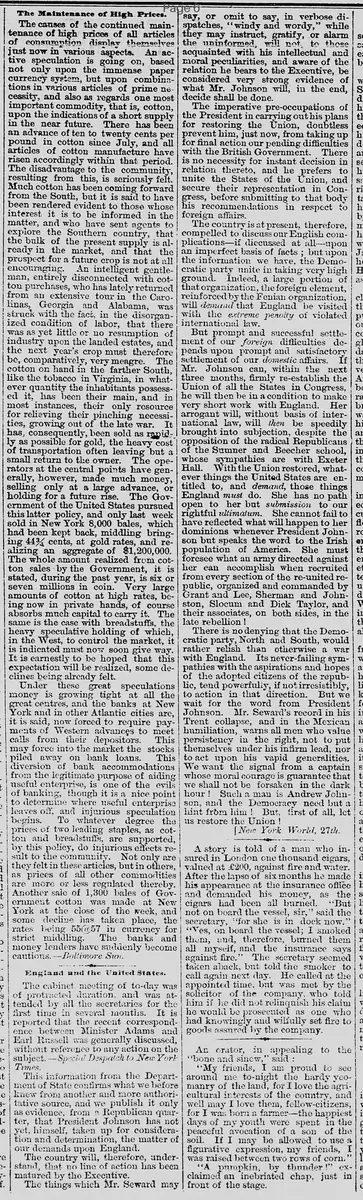
The cabinet meeting of to-day was of protracted duration, and was attended by all the secretaries for the first time in several months. It is reported that the recent correspondence between Minister Adams and Earl Russell was generally discussed, without reference to any action on the subject.--Special Despatch to New York Times.
This information from the Department of State confirms what we before knew from another and more authoritative source, and we publish it only as evidence, from a Republican quarter, that President Johnson has not yet, himself, taken up for consideration and determination, the matter of our demands upon England.
The country will, therefore, understand that no line of action has been matured by the Executive.
The things which Mr. Seward may say, or omit to say, in verbose dispatches, "windy and wordy," while they may instruct, gratify, or alarm the uninformed, will not, to those acquainted with his intellectual and moral peculiarities, and aware of the relation he bears to the Executive, be considered very strong evidence of what Mr. Johnson will, in the end, decide shall be done.
The imperative pre-occupations of the President in carrying out his plans for restoring the Union, doubtless prevent him, just now, from taking up for final action our pending difficulties with the British Government. There is no necessity for instant decision in relation thereto, and he prefers to unite the States of the Union, and secure their representation in Congress, before submitting to that body his recommendations in respect to foreign affairs.
The country is at present, therefore, compelled to discuss our English complications--if discussed at all--upon an imperfect basis of facts; but upon the information we have, the Democratic party unite in taking very high ground. Indeed, a large portion of that organization, the foreign element, reinforced by the Fenian organization, will demand that England be visited with the extreme penalty of violated international law.
But prompt and successful settlement of our foreign difficulties depends upon prompt and satisfactory settlement of our domestic affairs. If Mr. Johnson can, within the next three months, firmly re-establish the Union of all the States in Congress, he will then be in a condition to make very short work with England. Her arrogant will, without basis of international law, will then be speedily brought into subjection, despite the opposition of the radical Republicans of the Sumner and Beecher school, whose sympathies are with Exeter Hall. With the Union restored, whatever things the United States are entitled to, and demand, those things England must do. She has no path open to her but submission to our rightful ultimatum. She cannot fail to have reflected what will happen to her dominions whenever President Johnson but speaks the word to the Irish population of America. She must foresee what an army directed against her can accomplish when recruited from every section of the re-united republic, organized and commanded by Grant and Lee, Sherman and Johnston, Slocum and Dick Taylor, and their associates, on both sides, in the late rebellion!
There is no denying that the Democratic party, North and South, would rather relish than otherwise a war with England. Its never-failing sympathies with the aspirations and hopes of the adopted citizens of the republic, tend powerfully, if not irresistibly, to action in that direction. But we wait for the word from President Johnson. Mr. Seward's record in his Trent collapse, and in the Mexican humiliation, warns all men who value persistency in the right, not to put themselves under his infirm lead, nor to act upon his vapid generalities.
We want the signal from a captain whose moral courage is guarantee that we shall not be forsaken in the dark hour! Such a man is Andrew Johnson, and the Democracy need but a hint from him! But, first of all, let us restore the Union!
What sub-type of article is it?
What keywords are associated?
What entities or persons were involved?
Where did it happen?
Foreign News Details
Primary Location
England
Event Date
To Day
Key Persons
Outcome
no action taken on demands against england; president prioritizes union restoration before addressing foreign affairs; democratic party urges strong measures including potential war.
Event Details
US Cabinet meeting discusses recent correspondence between Minister Adams and Earl Russell without deciding on action. President Johnson has not yet considered demands upon England, focusing on restoring the Union. Commentary suggests Democratic party supports aggressive stance against Britain, potentially involving Fenians and Irish Americans, and warns against following Mr. Seward's lead.