Thank you for visiting SNEWPapers!
Sign up free
Story
July 31, 1879
The Cincinnati Daily Star
Cincinnati, Hamilton County, Ohio
What is this article about?
A Springfield sewing-girl jokingly replies to a matrimonial ad from a Dubuque man, posing as a widow. After correspondence and his visit in disguise, she regrets rejecting him and they marry happily, turning her life around.
Clipping
OCR Quality
98%
Excellent
Full Text
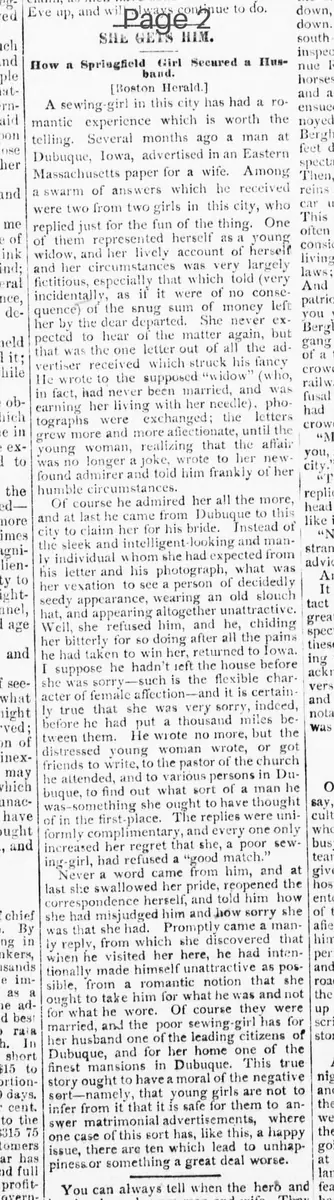
SHE GETS HIM.
How a Springfield Girl Secured a Husband.
A sewing-girl in this city has had a romantic experience which is worth the telling. Several months ago a man at Dubuque, Iowa, advertised in an Eastern Massachusetts paper for a wife. Among a swarm of answers which he received were two from two girls in this city, who replied just for the fun of the thing. One of them represented herself as a young widow, and her lively account of herself and her circumstances was very largely fictitious, especially that which told (very incidentally, as if it were of no consequence) of the snug sum of money left her by the dear departed. She never expected to hear of the matter again, but that was the one letter out of all the advertiser received which struck his fancy. He wrote to the supposed "widow" (who, in fact, had never been married, and was earning her living with her needle), photographs were exchanged; the letters grew more and more affectionate, until the young woman, realizing that the affair was no longer a joke, wrote to her new-found admirer and told him frankly of her humble circumstances.
Of course he admired her all the more, and at last he came from Dubuque to this city to claim her for his bride. Instead of the sleek and intelligent-looking and manly individual whom she had expected from his letter and his photograph, what was her vexation to see a person of decidedly seedy appearance, wearing an old slouch hat, and appearing altogether unattractive. Well, she refused him, and he, chiding her bitterly for so doing after all the pains he had taken to win her, returned to Iowa. I suppose he hadn't left the house before she was sorry—such is the flexible character of female affection—and it is certainly true that she was very sorry, indeed, before he had put a thousand miles between them. He wrote no more, but the distressed young woman wrote, or got friends to write, to the pastor of the church he attended, and to various persons in Dubuque, to find out what sort of a man he was—something she ought to have thought of in the first place. The replies were uniformly complimentary, and every one only increased her regret that she, a poor sewing-girl, had refused a "good match." Never a word came from him, and at last she swallowed her pride, reopened the correspondence herself, and told him how she had misjudged him and how sorry she was that she had. Promptly came a manly reply, from which she discovered that when he visited her here, he had intentionally made himself unattractive as possible, from a romantic notion that she ought to take him for what he was and not for what he wore. Of course they were married, and the poor sewing-girl has for her husband one of the leading citizens of Dubuque, and for her home one of the finest mansions in Dubuque. This true story ought to have a moral of the negative sort—namely, that young girls are not to infer from it that it is safe for them to answer matrimonial advertisements, where one case of this sort has, like this, a happy issue, there are ten which lead to unhappiness or something a great deal worse.
How a Springfield Girl Secured a Husband.
A sewing-girl in this city has had a romantic experience which is worth the telling. Several months ago a man at Dubuque, Iowa, advertised in an Eastern Massachusetts paper for a wife. Among a swarm of answers which he received were two from two girls in this city, who replied just for the fun of the thing. One of them represented herself as a young widow, and her lively account of herself and her circumstances was very largely fictitious, especially that which told (very incidentally, as if it were of no consequence) of the snug sum of money left her by the dear departed. She never expected to hear of the matter again, but that was the one letter out of all the advertiser received which struck his fancy. He wrote to the supposed "widow" (who, in fact, had never been married, and was earning her living with her needle), photographs were exchanged; the letters grew more and more affectionate, until the young woman, realizing that the affair was no longer a joke, wrote to her new-found admirer and told him frankly of her humble circumstances.
Of course he admired her all the more, and at last he came from Dubuque to this city to claim her for his bride. Instead of the sleek and intelligent-looking and manly individual whom she had expected from his letter and his photograph, what was her vexation to see a person of decidedly seedy appearance, wearing an old slouch hat, and appearing altogether unattractive. Well, she refused him, and he, chiding her bitterly for so doing after all the pains he had taken to win her, returned to Iowa. I suppose he hadn't left the house before she was sorry—such is the flexible character of female affection—and it is certainly true that she was very sorry, indeed, before he had put a thousand miles between them. He wrote no more, but the distressed young woman wrote, or got friends to write, to the pastor of the church he attended, and to various persons in Dubuque, to find out what sort of a man he was—something she ought to have thought of in the first place. The replies were uniformly complimentary, and every one only increased her regret that she, a poor sewing-girl, had refused a "good match." Never a word came from him, and at last she swallowed her pride, reopened the correspondence herself, and told him how she had misjudged him and how sorry she was that she had. Promptly came a manly reply, from which she discovered that when he visited her here, he had intentionally made himself unattractive as possible, from a romantic notion that she ought to take him for what he was and not for what he wore. Of course they were married, and the poor sewing-girl has for her husband one of the leading citizens of Dubuque, and for her home one of the finest mansions in Dubuque. This true story ought to have a moral of the negative sort—namely, that young girls are not to infer from it that it is safe for them to answer matrimonial advertisements, where one case of this sort has, like this, a happy issue, there are ten which lead to unhappiness or something a great deal worse.
What sub-type of article is it?
Romance
Deception Fraud
Personal Triumph
What themes does it cover?
Love
Fortune Reversal
Moral Virtue
What keywords are associated?
Matrimonial Advertisement
Romantic Correspondence
Disguised Suitor
Sewing Girl Marriage
Happy Ending Romance
What entities or persons were involved?
Springfield Sewing Girl
Dubuque Advertiser
Where did it happen?
Springfield, Massachusetts; Dubuque, Iowa
Story Details
Key Persons
Springfield Sewing Girl
Dubuque Advertiser
Location
Springfield, Massachusetts; Dubuque, Iowa
Story Details
A sewing-girl jokingly answers a matrimonial ad as a widow, leading to affectionate correspondence. She confesses her true humble status, but rejects him upon his unattractive arrival. Regretting it after learning his good character, she reconciles; he reveals his disguise tested her. They marry, and she gains a prosperous life.