Thank you for visiting SNEWPapers!
Sign up free
Canton Weekly Register
Canton, Fulton County, Illinois
What is this article about?
In 1808 Hamburg, a conceited young Prussian lieutenant insults a quiet man in a cafe, mistaking him for a schoolmaster. The man, a skilled British naval captain, challenges him to a duel, demonstrates marksmanship, and spares his life after he misses, humiliating the officer who then flees.
Clipping
OCR Quality
Full Text
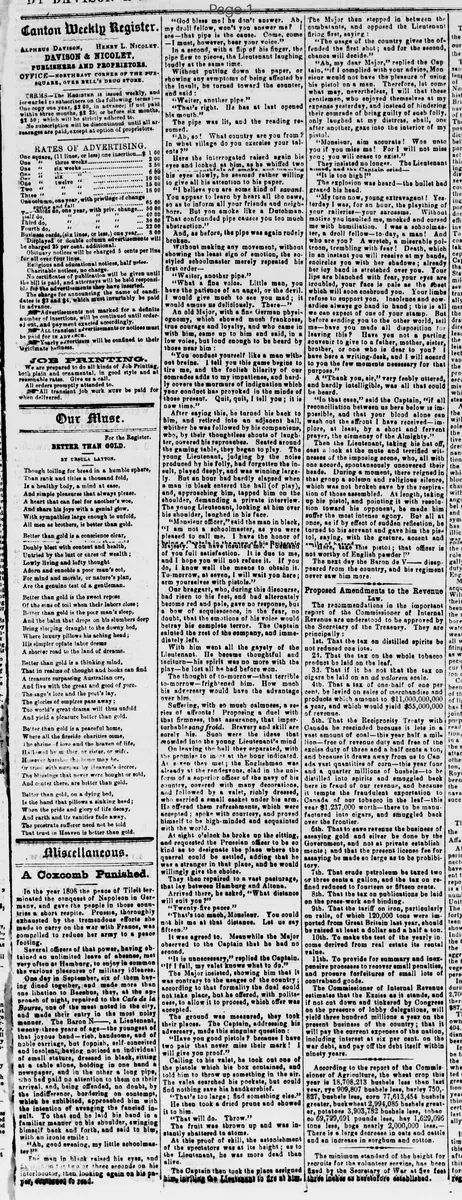
A Coxcomb Punished.
In the year 1808 the peace of Tilsit terminated the conquest of Napoleon in Germany, and gave the people in those countries a short respite. Prussia, thoroughly exhausted by the tremendous efforts she made to carry on the war with France, was compelled to reduce her army to a peace footing.
Several officers of that power, having obtained an unlimited leave of absence, met very often at Hamburg, to enjoy in common the various pleasures of military idleness.
One day in September, six of them having dined together, and made more than one libation to Bacchus, they, at the approach of night, repaired to the Cafe de la Bourse, one of the most noted in the city, and made their entry in the most noisy manner. The Baron N—, a Lieutenant, twenty-three years of age—the youngest of that joyous band—rich, handsome, and of noble carriage, but foppish, self-conceited and insolent, having noticed an individual of small stature, dressed in black, sitting at a table alone, holding in one hand a newspaper, and in the other a long pipe, who had paid no attention to them on their arrival, and, being offended, no doubt, by the indifference, bordering on contempt, which he exhibited, approached him with the intention of avenging the fancied insult. To that end he laid his hand in a familiar manner on his shoulder, swinging himself back and forth, and said to him, with an ironical smile:
"Ah, good evening, my little schoolmaster!"
The man in black raised his eyes, and fixed them for two or three seconds on his interlocutor, then looking again on his paper, continued to read.
"God bless me! he don't answer. Ah, my droll fellow, won't you answer me? See—that pipe is the cause. Come, come—I must, however, hear your voice."
In a second, with a flip of his finger, the pipe flew to pieces, the Lieutenant laughing loudly at the same time.
Without putting down the paper, or showing any symptoms of being affected by the insult, he turned toward the waiter, and said:
"Waiter, another pipe."
"That's right. He has at last opened his mouth."
The pipe was lit, and the reading resumed.
"Ah, so! What country are you from? In what village do you exercise your talents?"
Here the interrogated raised again his eyes and looked at him, as he whiffed two or three times, and then slowly closing his eyes, he seemed rather willing to give all his attention to his paper.
"I believe you are some kind of savant. You appear to learn by heart all the news, so as to inform all your friends and neighbors. But you smoke like a Dutchman. That confounded pipe causes you too much abstraction."
And, as before, the pipe was again rudely broken.
Without making any movement, without showing the least sign of emotion, the so-styled schoolmaster merely repeated his first order—
"Waiter, another pipe."
"What a fine voice. Little man, you have the patience of an angel, or the devil. I would give much to see you mad; it would amuse us delightfully. There—"
An old Major, with a fine German physiognomy, which showed much frankness, true courage and loyalty, and who came in with him, came up to him and said, in a low voice, but loud enough to be heard by those near him:
"You conduct yourself like a man without brains. I tell you this game begins to tire me, and the foolish hilarity of our comrades adds to my impatience, and hardly covers the murmurs of indignation which your conduct has provoked in the minds of those present. Quit, quit, I tell you; it is now time."
After saying this, he turned his back to him, and retired into an adjacent hall, whither he was followed by his companions, who, by their thoughtless shouts or laughter, covered his reproaches. Seated around the gaming table, they began to play. The young Lieutenant, judging by the noise produced by his folly, had forgotten the insult, played deeply, and was winning largely. But an hour had hardly elapsed when a man in black entered the hall (of play), and, approaching him, tapped him on the shoulder, demanding a private interview.
The young Lieutenant, looking at him over his shoulder, laughed in his face.
"Monsieur officer," said the man in black, "I am not a schoolmaster, as you were pleased to call me. I have the honor of demanding of you full satisfaction. It is due to me, and I hope you will not refuse it. If you do, I know well the means to obtain it. To-morrow, at seven, I will wait for you here; arm yourselves with pistols."
Our braggart, who, during this discourse, had risen to his feet, and had alternately become red and pale, gave no response, but a bow of acquiescence, in the fear, no doubt, that the emotions of his voice would betray his complete terror. The Captain saluted the rest of the company, and immediately left,
With him went all the gayety of the Lieutenant. He became thoughtful and taciturn—his spirit was no more with the play—he lost all he had before won. The thought of to-morrow—that terrible to-morrow—frightened him. How much his adversary would have the advantage over him. Suffering, with so much calmness, a series of affronts! Proposing a duel with that firmness, that assurance, that imperturbable sang froid. Bravery and skill are surely his. Such were the ideas that crowded into the young Lieutenant's mind
On leaving the hall they separated, with the promise to meet at the hour indicated. At seven they met; the Englishman was already at the rendezvous, clad in the uniform of a superior officer of the navy of his country, covered with many decorations, and followed by a valet, richly dressed, who carried a small casket under his arm. He offered them refreshments, which were accepted; spoke with courtesy, and proved himself to be high-minded and acquainted with the world.
At eight o'clock he broke up the sitting, and requested the Prussian officer to be so kind as to designate the place where the quarrel could be settled, adding that he was a stranger in that place, and he would willingly give the choice.
They then repaired to a vast pasturage, that lay between Hamburg and Altona. Arrived there, he asked, "what distance will suit you?"
"Twenty-five paces."
"That's too much, Monsieur. You could not hit me at that distance. Let us say fifteen."
It was agreed to. Meanwhile the Major observed to the Captain that he had no second.
"It is unnecessary," replied the Captain. "If I fall, my valet knows what to do."
The Major insisted, showing him that it was contrary to the usages of the country; according to that formality the duel could not take place, but he offered, with politeness, to allow it to proceed, which offer was accepted.
The ground was measured, they took their places. The Captain, addressing his adversary, made this singular question:
"Have you good pistols? because I have two pair that never miss their mark! I will give you proof."
Calling to his valet, he took out one of the pistols which his box contained, and told him to throw up something in the air.
The valet searched his pockets, but could find nothing save his handkerchief.
"That's too large; find something else."
He then took a dried prune and showed it to him.
"That will do. Throw."
The fruit was thrown up and was instantly shattered to atoms.
At this proof of skill, the astonishment of the spectators was at its height; as to the Lieutenant, he was more dead than alive.
The Captain then took the place assigned him, inviting the Lieutenant to draw first.
The Major then stepped in between the combatants, and opposed the Lieutenant firing first, saying:
"The usage of the country gives the offended the first shot; and for the second, chance will decide."
"Ah, my dear Major," replied the Captain, "if I complied with your advice, Monsieur would not have the pleasure of seeing his pistol on a man. Therefore, let come what may, nevertheless, I will that these gentlemen, who enjoyed themselves at my expense yesterday, and instead of hindering their comrade of being guilty of such folly, only laughed at my distress, shall, one after another, gaze into the interior of my pistol."
"Monsieur, aim accurately! Woe unto you if you miss me! For I will not miss you; you will cease to exist."
They insisted no longer. The Lieutenant aimed, and the Captain cried—
"It is too high!"
The explosion was heard—the bullet had grazed his head.
"My turn now, young extravagant! Yesterday I was, for an hour, the plaything of your raileries—your sarcasms. Without motive you insulted me, mocked and cursed me with humiliation. I was a schoolmaster, a droll fellow—to-day, a man! And who are you? A wretch, a miserable poltroon, trembling with fear! Death, which in an instant you will receive at my hands, encircles you with her shadows; already her icy hand is stretched over you. Your lips are blanched with fear, your eyes are troubled, your face is pale as the sheet which will soon enshroud you. Your limbs refuse to support you. Insolence and cowardice always go hand in hand; this is all we can expect of one of your stamp. But before sending you to the other world, tell me—have you made all disposition for leaving this? Have you not a parting souvenir to give to a father, mother, sister, brother, or one who is dear to you? I have here a writing-desk, and I will accord to you the few moments necessary for that purpose."
"Thank you, sir," very feebly uttered, and hardly intelligible, was all that could be heard.
"In that case," said the Captain, "if all reconciliation between us here below is impossible, and that your blood alone can wash out the affront I have received—implore, at least, by a short and fervent prayer, the clemency of the Almighty."
Then the Lieutenant, taking his hat off, cast a look at the mute and terrified witnesses of the imposing scene, who, all with one accord, spontaneously uncovered their heads. During a moment, there reigned in that group a solemn and religious silence, which was not broken save by the respiration of those assembled. At length, taking up his pistol, and pointing it with resolution toward his opponent, he made him suffer the most intense agony. But all at once, as if by effect of sudden reflection, he turned to his servant and gave him the pistol, saying, with the gesture of a man content and without hatred
"Miserere, take his pistol; that officer is not worthy of English powder!"
The next day the Baron de V— disappeared from the country, and his regiment never saw him more.
What sub-type of article is it?
What themes does it cover?
What keywords are associated?
What entities or persons were involved?
Where did it happen?
Story Details
Key Persons
Location
Hamburg
Event Date
1808, September
Story Details
A foppish young Prussian lieutenant insults a quiet man in a Hamburg cafe, breaking his pipe twice. The man challenges him to a duel, revealing himself as a decorated British naval captain. He demonstrates expert marksmanship by shooting a prune mid-air, lets the lieutenant shoot first (who misses), then spares his life with a magnanimous speech, leading to the lieutenant's disgrace and disappearance.