Thank you for visiting SNEWPapers!
Sign up free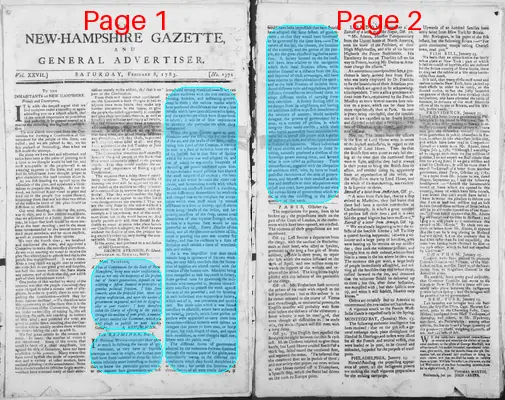
The New Hampshire Gazette And General Advertiser
Portsmouth, Exeter, Rockingham County, New Hampshire
What is this article about?
A Republican submits a series of letters titled 'The Examiner' for publication, discussing the nature of government, origins of society, and various forms of governance, in the context of New Hampshire's proposed state constitution emphasizing political freedom.
Merged-components note: Merging the introductory letter to the editor announcing the 'Examiner' series with the first installment (No. I), which continues seamlessly across pages 1 and 2. The content is a reader's political essay on the nature and forms of government, fitting as a letter to the editor.
Clippings
1 of 2
OCR Quality
Full Text
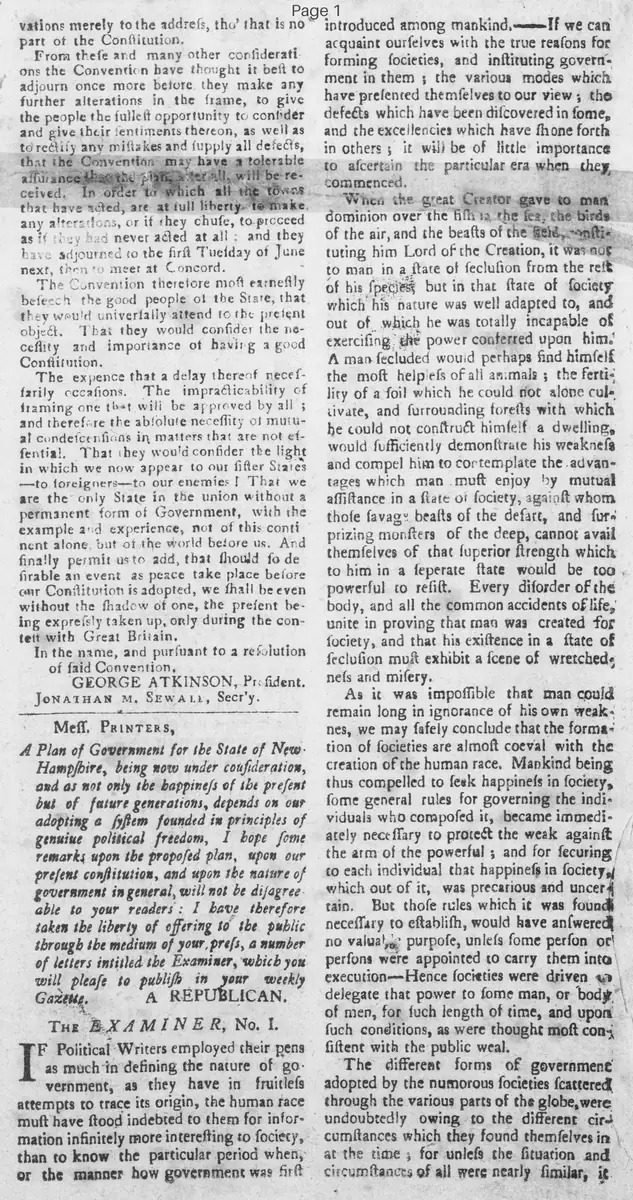
A Plan of Government for the State of New Hampshire, being now under consideration, and as not only the happiness of the present but of future generations, depends on our adopting a system founded in principles of genuine political freedom, I hope some remarks upon the proposed plan, upon our present constitution, and upon the nature of government in general, will not be disagreeable to your readers: I have therefore taken the liberty of offering to the public through the medium of your press, a number of letters entitled the Examiner, which you will please to publish in your weekly Gazette.
A REPUBLICAN.
THE EXAMINER. NO. I.
Political Writers have employed their pens as much in defining the nature of government, as they have in fruitless attempts to trace its origin, the human race must have stood indebted to them for information infinitely more interesting to society, than to know the particular period when, or the manner how government was first introduced among mankind.--If we can acquaint ourselves with the true reasons for forming societies, and instituting government in them; the various modes which have presented themselves to our view; those defects which have been discovered in some, and the excellencies which have shone forth in others; it will be of little importance to ascertain the particular era when they commenced.
When the great Creator gave to man dominion over the fish of the sea, the birds of the air, and the beasts of the field, constituting him Lord of the Creation, it was given to man in a state of seclusion from the rest of his species but in that state of society which his nature was well adapted to, and out of which he was totally incapable of exercising: the power conferred upon him.
A man secluded would perhaps find himself the most helpless of all animals; the fertility of a soil which he could not alone cultivate, and surrounding forests with which he could not construct himself a dwelling, would sufficiently demonstrate his weakness and compel him to contemplate the advantages which man must enjoy by mutual assistance in a state of society, against whom those savage beasts of the desert, and surprising monsters of the deep, cannot avail themselves of that superior strength which to him in a separate state would be too powerful to resist. Every disorder of the body, and all the common accidents of life, unite in proving that man was created for society, and that his existence in a state of seclusion must exhibit a scene of wretchedness and misery.
As it was impossible that man could remain long in ignorance of his own weakness, we may safely conclude that the formation of societies are almost coeval with the creation of the human race. Mankind being thus compelled to seek happiness in society, some general rules for governing the individuals who composed it, became immediately necessary to protect the weak against the arm of the powerful; and for securing to each individual that happiness in society which out of it, was precarious and uncertain. But those rules which it was found necessary to establish, would have answered no valuable purpose, unless some person or persons were appointed to carry them into execution--Hence societies were driven delegate that power to some man, or body of men, for such length of time, and upon such conditions, as were thought most consistent with the public weal.
The different forms of government adopted by the numerous societies scattered through the various parts of the globe, were undoubtedly owing to the different circumstances which they found themselves in at the time; for unless the situation and circumstances of all were nearly similar, it
would have been impossible that each should have adopted the same system of government; or that they would have submitted to be governed by the same laws. The nature of the soil, the climate, the situation of the country, and the genius of the people, are the great objects of legislative attention. A society formed on the sea coast will have laws relative to the navigation which their local situation offers, while another situated at a distance from the sea and deprived of those advantages, will have laws relative to the cultivation of the earth; and as the local situation of societies introduced different rules and regulations for their different circumstances occasioned them to adopt different modes of carrying them into execution. A society finding itself in no danger from its neighbours and having no ambitious desires to possess themselves of the territory of another, would naturally delegate the powers of government for a time to a number of persons in whose integrity they could confide: while those who feared an invasion from ambitious foes were led to intrust this power with a person of military abilities, and oftentimes without any restriction or limitation. Many individuals of equal abilities and influence in some societies, naturally produced a division of the sovereign power among them, and formed what is now called an aristocracy. These circumstances, together with the usurpation of ambitious men, who, by force or fraud, possessed themselves of the reins of government, and became in their conduct as absolute and detestable as their usurpations were unjust and cruel, have presented to our view the various forms of government which we see at this day inhabiting in the several quarters of the earth.
What sub-type of article is it?
What themes does it cover?
What keywords are associated?
What entities or persons were involved?
Letter to Editor Details
Author
A Republican.
Recipient
Mess. Printers,
Main Argument
emphasizes the importance of adopting a new hampshire government based on genuine political freedom; introduces 'the examiner' series to discuss the nature, origins, and forms of government to inform societal choices.
Notable Details