Thank you for visiting SNEWPapers!
Sign up free
New Haven Daily Herald
New Haven, New Haven County, Connecticut
What is this article about?
During the War of 1812, Thomas Higgins, a Kentucky ranger in Illinois, heroically survives an Indian ambush near Vandalia, fighting multiple warriors despite severe wounds, and is rescued by fellow garrison members led by Mrs. Pursley. He later self-operates to remove a bullet and dies in Fayette County, Illinois.
Clipping
OCR Quality
Full Text
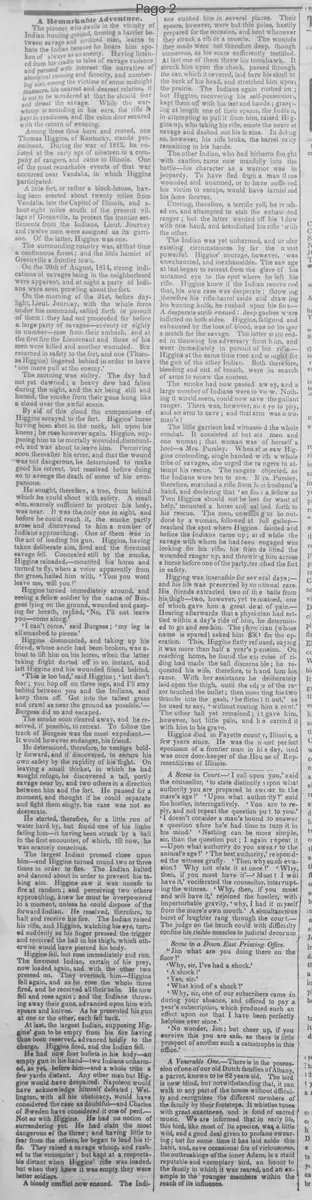
Among these thus born and reared, one Thomas Higgins, of Kentucky, stands pre-eminent. During the war of 1812, he enlisted at the early age of nineteen in a company of rangers, and came to Illinois. One of the most remarkable events of that war occurred near Vandalia, in which Higgins participated.
A little fort, or rather a block-house, having been erected about twenty miles from Vandalia, late the Capitol of Illinois, and about eight miles south of the present village of Greenville, to protect the frontier settlements from the Indians, Lieut. Journay and twelve men were assigned as its garrison. Of the latter, Higgins was one.
The surrounding country was, at that time, a continuous forest; and the little hamlet of Greenville a frontier town.
On the 26th of August, 1814, strong indications of savages being in the neighborhood were apparent, and at night a party of Indians were seen prowling about the fort.
On the morning of the 31st, before daylight, Lieut. Journay, with the whole force under his command, sallied forth in pursuit of them: they had not proceeded far before a large party of savages—seventy or eighty in number—rose from their ambush, and at the first fire the Lieutenant and three of his men were killed and another wounded. Six returned in safety to the fort, and one (Thomas Higgins) lingered behind in order to have one more pull at the enemy.
The morning was sultry. The day had not yet dawned; a heavy dew had fallen during the night, and the air being still and humid, the smoke from their guns hung like a cloud over the awful scene.
By aid of this cloud the companions of Higgins escaped to the fort. Higgins' horse having been shot in the neck, fell upon his knees; he rose however again. Higgins, supposing him to be mortally wounded, dismounted, and was about to leave him. Perceiving soon thereafter his error, and that the wound was not dangerous, he determined to make good his retreat, but resolved before doing so to avenge the death of some of his companions.
He sought, therefore, a tree, from behind which he could shoot with safety. A small elm, scarcely sufficient to protect his body, was near. It was the only one in sight, and before he could reach it, the smoke partly arose and discovered to him a number of Indians approaching. One of them was in the act of loading his gun. Higgins, having taken deliberate aim, fired and the foremost savage fell. Concealed still by the smoke, Higgins reloaded,—mounted his horse and turned to fly, when a voice apparently from the grass, hailed him with, 'Tom you wont leave me, will you?'
Higgins turned immediately around, and seeing a fellow soldier by the name of Burgess lying on the ground, wounded and gasping for breath, replied, 'No, I'll not leave you—come along.'
'I can't come,' said Burgess; 'my leg is all smashed to pieces.'
Higgins dismounted, and taking up his friend, whose ankle had been broken, was about to lift him on his horse, when the latter taking fright darted off in an instant, and left Higgins and his wounded friend behind.
'This is too bad,' said Higgins; 'but don't fear: you hop off on three legs, and I'll stay behind between you and the Indians, and keep them off. Get into the tallest grass and crawl as near the ground as possible.'—
Burgess did so and escaped.
The smoke soon cleared away, and he resolved, if possible, to retreat. To follow the track of Burgess was the most expedient.—It would however endanger his friend.
He determined, therefore, to venture boldly forward, and if discovered, to secure his own safety by the rapidity of his flight. On leaving a small thicket, in which he had sought refuge, he discovered a tall, portly savage near by, and two others in a direction between him and the fort. He paused for a moment, and thought if he could separate and fight them singly, his case was not so desperate.
He started, therefore, for a little run of water hard by, but found one of his limbs failing him—it having been struck by a ball in the first encounter, of which, till now, he was scarcely conscious.
The largest Indian pressed close upon him—and Higgins turned round two or three times in order to fire. The Indian halted and danced about in order to prevent his taking aim. Higgins saw it was unsafe to fire at random; and perceiving two others approaching, knew he must be overpowered in a moment, unless he could dispose of the forward Indian. He resolved, therefore, to halt and receive his fire. The Indian raised his rifle, and Higgins, watching his eye, turned suddenly as his finger pressed the trigger and received the ball in his thigh, which otherwise would have pierced his body.
Higgins fell, but rose immediately and run. The foremost Indian, certain of his prey, now loaded again, and with the other two pressed on. They overtook him—Higgins fell again, and as he rose the whole three fired, and he received all their balls. He now fell and rose again; and the Indians throwing away their guns, advanced upon him with spears and knives. As he presented his gun at one or the other, each fell back.
At last, the largest Indian, supposing Higgins' gun to be empty from his fire having thus been reserved, advanced boldly to the charge. Higgins fired, and the Indian fell.
He had now four bullets in his body—an empty gun in his hand—two Indians unharmed, as yet, before him—and a whole tribe a few yards distant. Any other man but Higgins would have despaired. Napoleon would have acknowledged himself defeated; Wellington, with all his obstinacy, would have considered the case as doubtful—and Charles of Sweden have considered it one of peril.—
Not so with Higgins. He had no notion of surrendering yet. He had slain the most dangerous of the three; and having little to fear from the others, he began to load his rifle. They raised a savage whoop, and rushed to the encounter; but kept at a respectable distance when Higgins' rifle was loaded, but when they knew it was empty they were better soldiers.
A bloody conflict now ensued. The Indians stabbed him in several places. Their spears, however, were but thin poles, hastily prepared for the occasion, and bent whenever they struck a rib or a muscle. The wounds they made were not therefore deep, though numerous, as his scars sufficiently testified.
At last one of them threw his tomahawk. It struck him upon the cheek, passed through the ear, which it severed, laid bare his skull to the back of his head, and stretched him upon the prairie. The Indians again rushed on; but Higgins, recovering his self-possession, kept them off with his feet and hands; grasping at length one of their spears, the Indian, in attempting to pull it from him, raised Higgins up, who taking his rifle, smote the nearest savage and dashed out his brains. In doing so, however, his rifle broke, the barrel only remaining in his hands.
The other Indian, who had hitherto fought with caution, came now manfully into the battle—his character as a warrior was in jeopardy. To have fled from a man thus wounded and unarmed, or to have suffered his victim to escape, would have tarnished his fame forever.
Uttering, therefore, a terrific yell, he rushed on, and attempted to stab the exhausted ranger; but the latter warded off his blow with one hand, and brandished his rifle with the other.
The Indian was yet unharmed, and under existing circumstances by far the most powerful. Higgins' courage, however, was unexhausted, and inexhaustible. The savage at last began to retreat from the glare of his untamed eye to the spot where he left his rifle. Higgins knew if the Indian recovered that, his own case was desperate: throwing therefore his rifle-barrel aside and drawing his hunting knife, he rushed upon his foe.—
A desperate strife ensued: deep gashes were inflicted on both sides. Higgins, fatigued and exhausted by the loss of blood, was no longer a match for the savage. The latter succeeded in throwing his adversary from him, and went immediately in pursuit of his rifle.—
Higgins at the same time rose and sought for the gun of the other Indian. Both therefore, bleeding and out of breath, were in search of arms to renew the contest.
The smoke had now passed away, and a large number of Indians were in view. Nothing it would seem, could now save the gallant ranger. There was, however, an eye to pity, and an arm to save; and that arm was a woman's!
The little garrison had witnessed the whole combat. It consisted of but six men and one woman; that woman was of herself a host—Mrs. Pursley. When she saw Higgins contending, single handed with a whole tribe of savages, she urged the rangers to attempt his rescue. The rangers objected, as the Indians were ten to one. Mrs. Pursley, therefore, snatched a rifle from her husband's hand, and declaring that 'so fine a fellow as Tom Higgins should not be lost for want of help,' mounted a horse and sallied forth to his rescue. The men, unwilling to be out-done by a woman, followed at full gallop—reached the spot where Higgins fainted and before the Indians came up; and while the savage with whom he had been engaged was looking for his rifle, his friends lifted the wounded ranger up, and throwing him across a horse before one of the party, reached the fort in safety.
Higgins was insensible for several days;—and his life was preserved by continual care. His friends extracted two of the balls from his thigh—two, however, yet remained, one of which gave him a great deal of pain.—
Hearing afterwards that a physician had settled within a day's ride of him, he determined to go and see him. The physician (whose name is spared) asked him $50 for the operation. This, Higgins flatly refused, saying it was more than half a year's pension. On reaching home, he found the exercise of riding had made the ball discernible; he requested his wife, therefore, to hand him his razor. With her assistance he deliberately laid open the thigh, until the edge of the razor touched the bullet; then inserting his two thumbs into the gash, he flirted it out,' as he used to say, 'without costing him a cent.'
The other ball yet remained; it gave him, however, but little pain, and he carried it with him to his grave.
Higgins died in Fayette county, Illinois, a few years since. He was the most perfect specimen of a frontier man in his day, and was once door-keeper of the House of Representatives of Illinois.
What sub-type of article is it?
What themes does it cover?
What keywords are associated?
What entities or persons were involved?
Where did it happen?
Story Details
Key Persons
Location
Near Vandalia, Illinois
Event Date
August 31, 1814
Story Details
Thomas Higgins, a ranger in a small fort near Vandalia during the War of 1812, survives an ambush by 70-80 Indians, fights and kills several despite multiple wounds, rescues wounded comrade Burgess, and is ultimately saved by Mrs. Pursley leading a rescue from the garrison.