Thank you for visiting SNEWPapers!
Sign up free
Domestic News
June 24, 1911
The Guthrie Daily Leader
Guthrie, Logan County, Oklahoma
What is this article about?
A local farmer urges immediate preparation for the 1912 wheat crop by adopting new tactics to conserve soil moisture and prevent evaporation loss, using tools like disk harrows post-harvest to ensure steady success.
Clipping
OCR Quality
85%
Good
Full Text
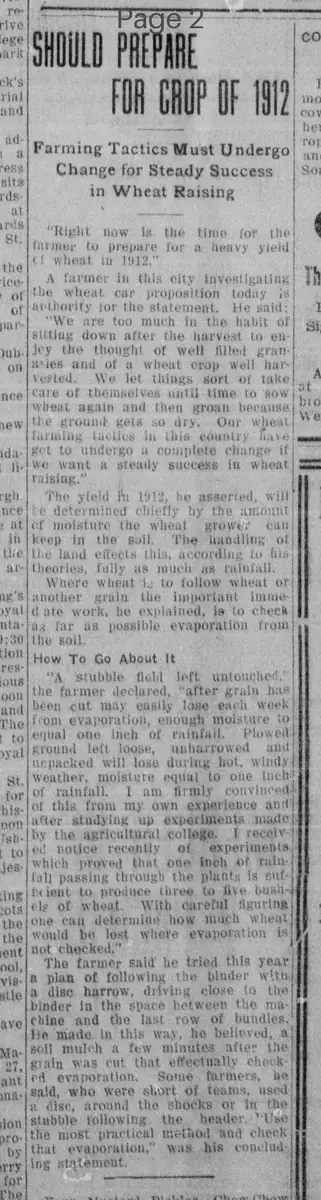
SHOULD PREPARE
FOR CROP OF 1912
Farming Tactics Must Undergo
Change for Steady Success
in Wheat Raising
"Right now is the time for the
farmer to prepare for a heavy yield
in wheat in 1912."
A farmer in this city investigating
the wheat car proposition today is
authority for the statement. He said:
"We are too much in the habit of
sitting down after the harvest to en-
joy the thought of well filled gran-
aries and of a wheat crop well har-
vested. We let things sort of take
care of themselves until time to sow
wheat again and then groan because
the ground gets so dry. Our wheat
farming tactics in this country have
got to undergo a complete change if
we want a steady success in wheat
raising."
The yield in 1912, he asserted, will
be determined chiefly by the amount
of moisture the wheat grower can
keep in the soil. The handling of
the land affects this, according to his
theories, fully as much as rainfall.
Where wheat is to follow wheat or
another grain the important imme-
diate work, he explained, is to check
as far as possible evaporation from
the soil.
How To Go About It
"A stubble field left untouched,
the farmer declared, "after grain has
been cut may easily lose each week
from evaporation, enough moisture to
equal one inch of rainfall. Plowed
ground left loose, unharrowed and
unpacked will lose during hot, windy
weather, moisture equal to one inch
of rainfall. I am firmly convinced
of this from my own experience and
after studying up experiments made
by the agricultural college. I received
notice recently of experiments
which proved that one inch of rain-
fall passing through the plants is suf-
ficient to produce three to five bush-
els of wheat. With careful figuring
one can determine how much wheat
would be lost where evaporation is
not checked."
The farmer said he tried this year
a plan of following the binder with
a disk harrow, driving close to the
binder in the space between the ma-
chine and the last row of bundles.
He made in this way, he believed, a
soil mulch a few minutes after the
grain was cut that effectually checked
evaporation. Some farmers, he
said, who were short of teams, used
a disk around the shocks or in the
stubble following the header. "Use
the most practical method and check
that evaporation," was his conclud-
ing statement.
FOR CROP OF 1912
Farming Tactics Must Undergo
Change for Steady Success
in Wheat Raising
"Right now is the time for the
farmer to prepare for a heavy yield
in wheat in 1912."
A farmer in this city investigating
the wheat car proposition today is
authority for the statement. He said:
"We are too much in the habit of
sitting down after the harvest to en-
joy the thought of well filled gran-
aries and of a wheat crop well har-
vested. We let things sort of take
care of themselves until time to sow
wheat again and then groan because
the ground gets so dry. Our wheat
farming tactics in this country have
got to undergo a complete change if
we want a steady success in wheat
raising."
The yield in 1912, he asserted, will
be determined chiefly by the amount
of moisture the wheat grower can
keep in the soil. The handling of
the land affects this, according to his
theories, fully as much as rainfall.
Where wheat is to follow wheat or
another grain the important imme-
diate work, he explained, is to check
as far as possible evaporation from
the soil.
How To Go About It
"A stubble field left untouched,
the farmer declared, "after grain has
been cut may easily lose each week
from evaporation, enough moisture to
equal one inch of rainfall. Plowed
ground left loose, unharrowed and
unpacked will lose during hot, windy
weather, moisture equal to one inch
of rainfall. I am firmly convinced
of this from my own experience and
after studying up experiments made
by the agricultural college. I received
notice recently of experiments
which proved that one inch of rain-
fall passing through the plants is suf-
ficient to produce three to five bush-
els of wheat. With careful figuring
one can determine how much wheat
would be lost where evaporation is
not checked."
The farmer said he tried this year
a plan of following the binder with
a disk harrow, driving close to the
binder in the space between the ma-
chine and the last row of bundles.
He made in this way, he believed, a
soil mulch a few minutes after the
grain was cut that effectually checked
evaporation. Some farmers, he
said, who were short of teams, used
a disk around the shocks or in the
stubble following the header. "Use
the most practical method and check
that evaporation," was his conclud-
ing statement.
What sub-type of article is it?
Agriculture
What keywords are associated?
Wheat Crop
Soil Moisture
Evaporation Control
Farming Tactics
1912 Yield
Domestic News Details
Event Date
1912
Event Details
A farmer advises preparing now for a heavy wheat yield in 1912 by changing farming tactics to retain soil moisture and check evaporation. He recommends using a disk harrow immediately after cutting grain to create a soil mulch, based on personal experience and agricultural experiments showing one inch of rainfall can produce three to five bushels of wheat.