Thank you for visiting SNEWPapers!
Sign up free
The Anti Monopolist
Saint Paul, Ramsey County, Minnesota
What is this article about?
Captain Penryn returns to England after nine years in India, eager to reunite with his son, born after his wife's death. Searching for the boy, raised by nurse Ann Golden, he encounters a deformed street urchin who attempts to pick his pocket. Forgiving the child out of fatherly compassion, he later discovers the boy is his neglected son, and embraces him despite his hardships.
Clipping
OCR Quality
Full Text
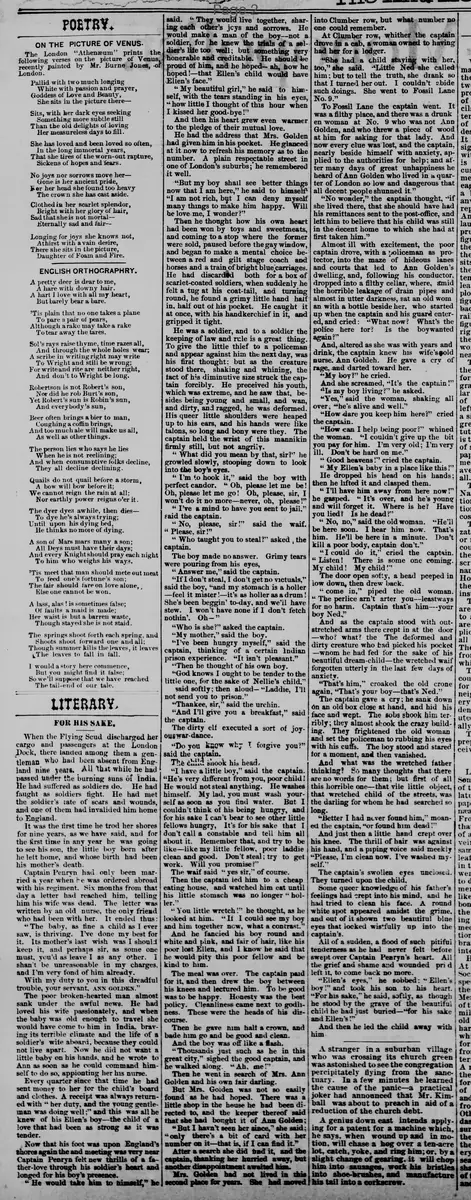
FOR HIS SAKE,
When the Flying Scud discharged her cargo and passengers at the London Dock, there landed among them a gentleman who had been absent from England nine years. All that while he had passed under the burning suns of India. He had suffered as soldiers do. He had fought as soldiers fight. He had met the soldier's fate of scars and wounds, and one of them had invalided him home to England.
It was the first time he trod her shores for nine years, as we have said, and for the first time in any year he was going to see his son, the little boy born after he left home, and whose birth had been his mother's death.
Captain Penryn had only been married a year when he was ordered abroad with his regiment. Six months from that day a letter had reached him, telling him his wife was dead. The letter was written by an old nurse, the only friend who had been with her. It ended thus:
"The baby, as fine a child as I ever saw, is thriving. I've done my best for it. Its mother's last wish was I should keep it, and perhaps sir, as some one must, you'd as lieve I as any other. I shan't be unreasonable in my charges, and I'm very fond of him already.
With my duty to you in this dreadful trouble, your servant, ANN GOLDEN."
The poor broken-hearted man almost sank under the awful news. He had loved his wife passionately, and when the baby was old enough to travel she would have come to him in India, braving its terrible climate and the life of a soldier's wife abroad, because they could not live apart. Now he did not want a little baby on his hands, and he wrote to Ann as soon as he could command himself to do so, appointing her his nurse.
Every quarter since that time he had sent money to her for the child's board and clothes. A receipt was always returned with "her duty, and the young gentleman was doing well;" and this was all he knew of his Ellen's boy—the child of a love that had been as strong as it was tender.
Now that his foot was upon England's shores again the glad meeting was very near. Captain Penryn felt new thrills of a father-love through his soldier's heart and longed for his boy's presence.
"He would take him to himself" he said. "They would live together, sharing each other's joys and sorrows. He would make a man of the boy—not a soldier, for he knew the trials of a soldier's life too well; but something very honorable and creditable. He should be proud of him, and he hoped—ah, how he hoped!—that Ellen's child would have Ellen's face."
"My beautiful girl," he said to himself, with the tears standing in his eyes, "how little I thought of this hour when I kissed her good-bye!"
And then his heart grew even warmer to the pledge of their mutual love.
He had the address that Mrs. Golden had given him in his pocket. He glanced at it now to refresh his memory as to the number. A plain respectable street in one of London's suburbs; he remembered it well.
"But my boy shall see better things now that I am here," he said to himself "I am not rich, but I can deny myself many things to make him happy. Will he love me, I wonder?"
Then he thought how his own heart had been won by toys and sweetmeats, and coming to a stop where the former were sold, paused before the gay window, and began to make a mental choice between a red and gilt stage coach and horses and a train of bright blue carriages.
He had discarded both for a box of scarlet-coated soldiers, when suddenly he felt a tug at his coat-tail, and turning round, he found a grimy little hand half in, half out of his pocket. He caught it at once, with his handkerchief in it, and gripped it tight.
He was a soldier, and to a soldier the keeping of law and rule is a great thing. To give the little thief to a policeman and appear against him the next day, was his first thought: but as the creature stood there, shaking and whining, the fact of his diminutive size struck the captain forcibly. He perceived his youth, which was extreme, and he saw that, besides being young and small, and wan, and dirty, and ragged, he was deformed.
His queer little shoulders were heaped up to his ears, and his hands were like talons, so long and bony were they. The captain held the wrist of this mannikin firmly still, but not angrily.
"What did you mean by that, sir?" he growled slowly, stooping down to look into the boy's eyes.
"I'm to hook it," said the boy with perfect candor. "Oh, please let me be! Oh, please let me go! Oh, please, sir, I won't do it no more—never, oh, please!"
"I've a mind to have you sent to jail," said the captain.
"No, please, sir!" said the waif. "Please, sir!"
"Who taught you to steal?" asked the captain.
The boy made no answer. Grimy tears were pouring from his eyes,
"Answer me," said the captain.
"If I don't steal, I don't get no victuals," said the boy, "and my stomach is a holler—feel it mister!—it's as holler as a drum! She's been beggin' to-day, and we'll have stew. I won't have none if I don't fetch nothin'. Oh—"
"Who is she?" asked the captain.
"My mother," said the boy
"I've been hungry myself," said the captain, thinking of a certain Indian prison experience. "It isn't pleasant."
Then he thought of his own boy.
"God knows I ought to be tender to the little one, for the sake of Nellie's child." said softly; then aloud— "Laddie, I'll not send you to prison."
"Thankee, sir," said the urchin.
"And I'll give you a breakfast," said the captain.
The dirty elf executed a sort of joyous war-dance.
"Do you know why I forgive you?" said the captain.
The child shook his head,
"I have a little boy," said the captain. "He's very different from you, poor child! He would not steal anything. He washes himself. My lad, you must wash yourself as soon as you find water. But I couldn't think of his being hungry, and for his sake I can't bear to see other little fellows hungry. It's for his sake that I don't call a constable and tell him all about it. Remember that, and try to be like—like my little fellow, poor laddie—clean and good. Don't steal; try to get work. Will you promise?"
The waif said "yes sir." of course.
Then the captain led him to a cheap eating house, and watched him eat until his little stomach was no longer "holler."
"You little wretch!" he thought, as he looked at him. "If I could see my boy and him together now, what a contrast."
And he fancied his boy round and white and pink, and fair of hair, like his poor lost Ellen, and I know he said that he would pity this poor fellow and be kind to him.
The meal was over. The captain paid for it, and then drew the boy between his knees and lectured him. To be good was to be happy. Honesty was the best policy. Cleanliness came next to godliness. These were the heads of his discourse.
Then he gave him half a crown, and bade him go and be good and clean.
And the boy was off like a flash.
"Thousands just such as he in this great city," sighed the good captain, and he walked along. "Ah, me!"
Then he went in search of Mrs. Ann Golden and his own fair darling.
But Mrs. Golden was not so easily found as he had hoped. There was a little shop in the house he had been directed to, and the keeper thereof said that she had bought it of Ann Golden;
"But I haven't seen her since " she said: "only there's a bit of card with her number on it—that is, if I can find it."
After a search she did find it. and the captain, thanking her hurried away, but another disappointment awaited him,
Mrs. Golden had not lived in this second place a year. She had moved into Clumber row. but what number no one could remember.
At Clumber row, whither the captain drove in a cab, a woman owned to having had her for a lodger.
"She had a child staying with her, too." she said. "Little Ned she called him: but to tell the truth, she drank so that I turned her out. I couldn't abide such doings. She went to Fossil Lane No. 9."
To Fossil Lane the captain went. It was a filthy place, and there was a drunken woman at No. 9 who was not Ann Golden. and who threw a piece of wood at him for asking for that lady. And now every clue was lost, and the captain, nearly beside himself with anxiety, applied to the authorities for help; and after many days of great unhappiness he heard of Ann Golden who lived in a quarter of London so low and dangerous that all decent people shunned it."
"No wonder." the captain thought, if she lived there. that she should have had his remittances sent to the post-office. and left him to believe that his child was still in the decent home to which she had at first taken him."
Almost ill with excitement, the poor captain drove, with a policeman as protector. into the maze of hideous lanes and courts that led to Ann Golden's dwelling, and. following his conductor. dropped into a filthy cellar, where, amid the horrible leakage of drain pipes and almost in utter darkness, sat an old woman with a bottle beside her, who started up when the captain and his guard entered, and cried: "What now? What's the police here for? Is the boy wanted again?"
And, altered as she was with years and drink. the captain knew his wife's old nurse. Ann Golden. He gave a cry of rage. :and darted toward her.
"My boy?" he cried.
And she screamed, "It's the captain!"
"Is my boy living?" he asked.
"Yes," said the woman, shaking all over; "he's alive and well."
"How dare you keep him here?" cried the captain.
"How can I help being poor?" whined the woman. I couldn't give up the bit you pay for him. I'm very old; I'm very ill. Don't be hard on me."
"Good heavens!" cried the captain. "My Ellen's baby in a place like this!"
He dropped his head on his hands: then he lifted it and clasped them.
"I'll have him away from here now!" he gasped. "It's over, and he's young and will forget it. Where is he? Have you lied? Is he dead?"
"No,no," said the old woman. "He'll be here soon. I hear him now. That's him. He'll be here in a minute. Don't kill a poor body, captain don't."
"I could do it," cried the captain
"Listen! There is some one coming My child! My child!"
The door open softly, a head peeped in low down. then drew back.
"Come in," piped the old woman.
"The perlice arn't arter you—leastways for no harm. Captain that's him—your boy Ned,"
And as the captain stood with out-stretched arms there crept in at the door—who? what? the deformed and dirty creature who had picked his pocket—whom he had fed for the sake of his beautiful dream-child—the wretched waif forgotten utterly in the last few days of anxiety.
"That's him," croaked the old crone again, "That's your boy—that's Ned."
The captain gave a cry; he sank down on an old box close at hand, and hid his face and wept. The sobs shook him terribly; they almost shook the crazy building. They frightened the old woman and set the policeman to rubbing his eyes with his cuffs. The boy stood and stared for a moment. and then vanished.
And what was the wretched father thinking? So many thoughts that there are no words for them; but first of all this horrible one—that vile little object, that wretched child of the streets, was the darling for whom he had searched so long.
"Better I had never found him," moaned the captain, "or found him dead!"
And just then a little hand crept over his knee. The thrill of hair was against his hand, and a piping voice said meekly
"Please. I'm clean now. I've washed myself."
The captain's swollen eyes unclosed. They turned upon the child.
Some queer knowledge of his father's feelings had crept into his mind, and he had tried to clean his face. A round white spot appeared amidst the grime. and out of it shone two beautiful blue eyes that looked wistfully up into the captain's.
All of a sudden. a flood of such pitiful tenderness as he had never felt before swept over Captain Penryn's heart. All the grief and shame and wounded pride left it, to come back no more.
"Ellen's eyes," he sobbed: "Ellen's boy!" and took his son to his heart.
"For his sake," he said, softly, as though he stood by the grave of the beautiful child he had just buried—"for his sake and Ellen's!"
And then he led the child away with him.
What sub-type of article is it?
What themes does it cover?
What keywords are associated?
What entities or persons were involved?
Where did it happen?
Story Details
Key Persons
Location
London
Story Details
Returning soldier Captain Penryn searches for his son, raised by nurse Ann Golden after his wife's death. He forgives a deformed street urchin for theft out of compassion for his imagined son, only to discover the boy is his own neglected child living in poverty. Overcome with emotion, he embraces and takes his son home.