Thank you for visiting SNEWPapers!
Sign up free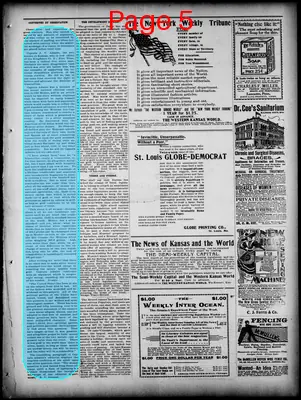
Story
March 20, 1897
Western Kansas World
Wakeeney, Trego County, Kansas
What is this article about?
Captain J. V. Admire, editor and former free silver supporter, changes his views on bimetallism after observing in Mexico that the silver standard leads to rejection of local currency in favor of gold, doubling commodity costs.
Clipping

OCR Quality
98%
Excellent
Full Text
Observation and experience are no great teachers. Men who cannot be moved by any amount of argument, and who refuse to be convinced by any amount of reading, are often converted with celerity when the practical workings of a theory in economics are placed before their eyes.
Captain J. V. Admire, the well known ex-Kansan, who is now editor of the Kingfisher (O. T.) Free Press, has been a radical free silver man. Probably the most disagreeable task which was ever set before him was the necessity of supporting the national Republican platform at the recent election. He did so, but at the same time reserved the right to believe and advocate the doctrine of bimetallism.
Captain Admire was a member of the recent national editorial excursion to Old Mexico, and in an article which he has since written confesses that he expected to equip himself while there with facts and arguments which would enable him to refute the gold standard advocates at every turn.
Upon crossing the Mexican line Captain Admire commenced to observe a chain of facts which is presented to every visitor to a silver standard country. He discovered that the American silver dollar would buy two Mexican silver dollars. He discovered further that the Mexicans utterly rejected the coin of their own realm and figured all of their commercial transactions upon the gold standard, with the result of seeing their national money fluctuate up and down just as does wheat, corn or any other commodity. But we will let Captain Admire tell his own story.
"I have always been," says he, "a bimetallist—really a trimetallist, or, for that matter, an altogether metallist, but I must admit with humility and sorrow that I am now at sea. To have the traditions and teachings of a lifetime overthrown and scattered into innumerable fragments by merely crossing a river a few hundred feet wide is ruthless. But to what other conclusion can one come than that, after all the sophistry of money science, all the stuff about ratios, international agreement, etc., there is no money except that which is either made out of gold or that which the government agrees to redeem in gold, as long as gold continues to be the only measure of value.
"Talk about it all we may—theorize about it all we can—bamboozle ourselves until we are blind—the condition remains. Gold is standard money of the world. Mexico has a silver standard—and yet, phew!—what becomes of theories when experience shows that an American silver dollar of 412.5 grains can be exchanged even up in Mexico—as soon as one crosses the Rio Grande—for Mexican silver coins weighing 807.8 grains. And, even worse than that; when, on account of this difference in the exchange of moneys of the two republics, lying side by side, the cost of commodities is immediately increased 100 per cent."
After reciting his belief that there is no other way to make silver money a standard over the world except by removing the money quality from gold. Captain Admire continues with an argument which is surprisingly strong, considering the newness of his version. It says:
"The United States has been at sea on the subject from first to last. All of the fathers were mystified and bewildered on this subject. All of the political parties of the Union have reared, tossed, and floundered over this question in the wildest and most extravagant manner. There has been ground and lofty tumbling over it by the greatest statesmen of the country—men whose adipose tissues was not adopted to that sort of exercise, and whose gyrations have been of the most undignified character. Sometimes I think they—political parties and political partisans—have purposely lied about this question. They have taught us that it was possible, and altogether proper to have money coined out of the two metals—one of greater value than the other. There is less gold in the world than there is silver, hence, so long as these metals are used as money, one will be money and the other will be a commodity."
The concluding paragraph of Captain Admire's editorial displays the hopeless condition of his mind upon the silver question, thus: "The money question is now barred from these columns until a flash of lightning has further illuminated the benighted horoscope of the editorial department." K. C. Journal.
Captain J. V. Admire, the well known ex-Kansan, who is now editor of the Kingfisher (O. T.) Free Press, has been a radical free silver man. Probably the most disagreeable task which was ever set before him was the necessity of supporting the national Republican platform at the recent election. He did so, but at the same time reserved the right to believe and advocate the doctrine of bimetallism.
Captain Admire was a member of the recent national editorial excursion to Old Mexico, and in an article which he has since written confesses that he expected to equip himself while there with facts and arguments which would enable him to refute the gold standard advocates at every turn.
Upon crossing the Mexican line Captain Admire commenced to observe a chain of facts which is presented to every visitor to a silver standard country. He discovered that the American silver dollar would buy two Mexican silver dollars. He discovered further that the Mexicans utterly rejected the coin of their own realm and figured all of their commercial transactions upon the gold standard, with the result of seeing their national money fluctuate up and down just as does wheat, corn or any other commodity. But we will let Captain Admire tell his own story.
"I have always been," says he, "a bimetallist—really a trimetallist, or, for that matter, an altogether metallist, but I must admit with humility and sorrow that I am now at sea. To have the traditions and teachings of a lifetime overthrown and scattered into innumerable fragments by merely crossing a river a few hundred feet wide is ruthless. But to what other conclusion can one come than that, after all the sophistry of money science, all the stuff about ratios, international agreement, etc., there is no money except that which is either made out of gold or that which the government agrees to redeem in gold, as long as gold continues to be the only measure of value.
"Talk about it all we may—theorize about it all we can—bamboozle ourselves until we are blind—the condition remains. Gold is standard money of the world. Mexico has a silver standard—and yet, phew!—what becomes of theories when experience shows that an American silver dollar of 412.5 grains can be exchanged even up in Mexico—as soon as one crosses the Rio Grande—for Mexican silver coins weighing 807.8 grains. And, even worse than that; when, on account of this difference in the exchange of moneys of the two republics, lying side by side, the cost of commodities is immediately increased 100 per cent."
After reciting his belief that there is no other way to make silver money a standard over the world except by removing the money quality from gold. Captain Admire continues with an argument which is surprisingly strong, considering the newness of his version. It says:
"The United States has been at sea on the subject from first to last. All of the fathers were mystified and bewildered on this subject. All of the political parties of the Union have reared, tossed, and floundered over this question in the wildest and most extravagant manner. There has been ground and lofty tumbling over it by the greatest statesmen of the country—men whose adipose tissues was not adopted to that sort of exercise, and whose gyrations have been of the most undignified character. Sometimes I think they—political parties and political partisans—have purposely lied about this question. They have taught us that it was possible, and altogether proper to have money coined out of the two metals—one of greater value than the other. There is less gold in the world than there is silver, hence, so long as these metals are used as money, one will be money and the other will be a commodity."
The concluding paragraph of Captain Admire's editorial displays the hopeless condition of his mind upon the silver question, thus: "The money question is now barred from these columns until a flash of lightning has further illuminated the benighted horoscope of the editorial department." K. C. Journal.
What sub-type of article is it?
Biography
Curiosity
What themes does it cover?
Fortune Reversal
Deception
What keywords are associated?
Free Silver
Bimetallism
Gold Standard
Mexico
Economic Observation
Currency Exchange
What entities or persons were involved?
Captain J. V. Admire
Where did it happen?
Mexico
Story Details
Key Persons
Captain J. V. Admire
Location
Mexico
Event Date
Recent
Story Details
Captain J. V. Admire, a free silver advocate, observes during a visit to Mexico that the American silver dollar buys two Mexican ones, leading Mexicans to use the gold standard and causing commodity prices to double, converting him to believe gold is the only true standard money.