Thank you for visiting SNEWPapers!
Sign up free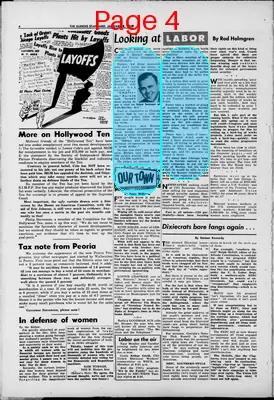
The Illinois Standard
Chicago, Cook County County, Illinois
What is this article about?
Chicago police Captain George T. Barnes' 1948 report claims cooperation in labor disputes, but the article criticizes his labor detail for anti-union bias, cracking heads, and jailing strikers to break strikes, calling for its elimination.
Merged-components note: Images overlap with story on Chicago police labor detail.
Clipping
OCR Quality
Full Text
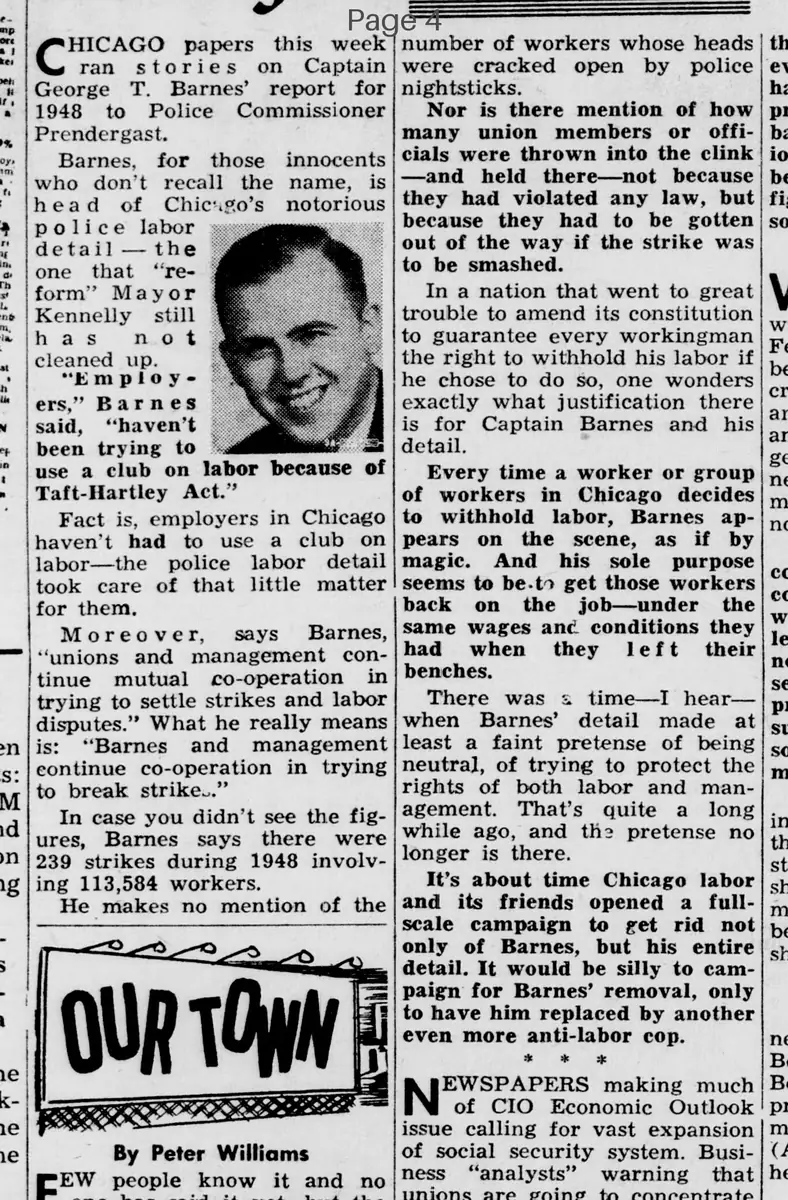
Barnes, for those innocents who don’t recall the name, is head of Chicago’s notorious police labor detail, the one that “reform” Mayor Kennelly still has not cleaned up.
“Employers,” Barnes said, “haven’t been trying to use a club on labor because of Taft-Hartley Act.”
Fact is, employers in Chicago haven’t had to use a club on labor—the police labor detail took care of that little matter for them.
Moreover, says Barnes, “unions and management continue mutual co-operation in trying to settle strikes and labor disputes.” What he really means is: “Barnes and management continue co-operation in trying to break strike.”
In case you didn’t see the figures, Barnes says there were 239 strikes during 1948 involving 113,584 workers.
He makes no mention of the number of workers whose heads were cracked open by police nightsticks.
Nor is there mention of how many union members or officials were thrown into the clink—and held there—not because they had violated any law, but because they had to be gotten out of the way if the strike was to be smashed.
In a nation that went to great trouble to amend its constitution to guarantee every workingman the right to withhold his labor if he chose to do so, one wonders exactly what justification there is for Captain Barnes and his detail.
Every time a worker or group of workers in Chicago decides to withhold labor, Barnes appears on the scene, as if by magic. And his sole purpose seems to be to get those workers back on the job—under the same wages and conditions they had when they left their benches.
There was three times—I hear—when Barnes’ detail made at least a faint pretense of being neutral, of trying to protect the rights of both labor and management. That’s quite a long while ago, and the pretense no longer is there.
It’s about time Chicago labor and its friends opened a full-scale campaign to get rid not only of Barnes, but his entire detail. It would be silly to campaign for Barnes’ removal, only to have him replaced by another even more anti-labor cop.
By Peter Williams
What sub-type of article is it?
What themes does it cover?
What keywords are associated?
What entities or persons were involved?
Where did it happen?
Story Details
Key Persons
Location
Chicago
Event Date
1948
Story Details
Captain Barnes' 1948 report to Commissioner Prendergast touts cooperation in labor disputes amid 239 strikes involving 113,584 workers, but the piece accuses his police detail of anti-labor actions like beating and jailing strikers to aid management, urging its full removal.