Thank you for visiting SNEWPapers!
Sign up free
The Nashville Daily Union
Nashville, Davidson County, Tennessee
What is this article about?
During the Civil War, Union forces released Confederate officers including Generals Buckner and others from Fortress Monroe for an equal exchange, but Confederate authorities in Richmond refused to release Union officers like Colonels Corcoran and Wilcox, breaching the agreement and sparking outrage.
Merged-components note: Merged sequential stories on the same topic of rebel perfidy in prisoner exchanges.
Clipping
OCR Quality
Full Text
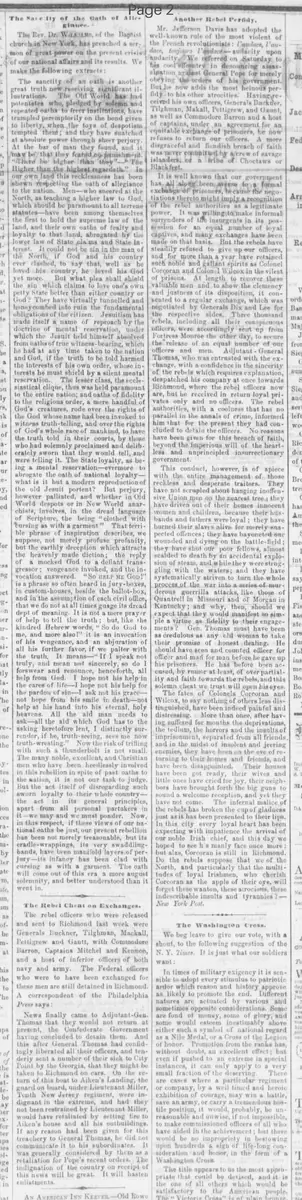
The rebel officers who were released and sent to Richmond last week were Generals Buckner, Tilghman, Mackall, Pettigrew and Gantt, with Commodore Barron, Captains Mitchel and Kennon, and a host of inferior officers of both navy and army. The Federal officers who were to have been exchanged for these men are still detained in Richmond. A correspondent of the Philadelphia Press says:
News finally came to Adjutant-Gen. Thomas that they would not return at present, the Confederate Government having concluded to detain them. And this after General Thomas had confidingly liberated all their officers, and tenderly sent a number of their sick to City Point by the Georgia, that they might be taken to Richmond on cars. On the return of this boat to Aiken's Landing, the guard on board, under Lieutenant Miller, Tenth New Jersey regiment, were indignant in the extreme, and had they not been restrained by Lieutenant Miller, would have retaliated by setting fire to Aiken's house and all his outbuildings. If any reason had been given for this treachery to General Thomas, he did not communicate it to his subordinates. It was generally considered by them as a retaliation for Pope's recent orders. The indignation of the country on receipt of this news will be great. It will hasten enlistments.
Another Rebel Perfidy.
Mr. Jefferson Davis has adopted the well-known rule of the most violent of tyrants: But he now adds the most heinous perfidy to his other atrocities: Having secured his own officers, Generals Buckner, Tilghman, Mackall, Pettigrew, and Gantt, as well as Commodore Barron and a host of captains, under an agreement for an equitable exchange of prisoners, he now refuses to return our officers. A more disgraceful and Rendish breach of faith was never committed by a crew of savage islanders, or a tribe of Choctaws or Blackfeet.
It is well known that our government has all along been averse to a formal exchange of prisoners, because the negotiations thereto might imply a recognition of the rebel authorities as a legitimate power. It was willing to make informal surrenders of the insurgents in its possession for an equal number of loyal captives, and many exchanges have been made on that basis. But the rebels have steadily refused to give up our officers, and for more than a year have retained such noble and gallant spirits as Colonel Corcoran and Colonel Wilcox in the vilest of prisons. At length to recover these valuable men and to show the clemency and justness of its disposition, it consented to a regular exchange, which was negotiated by Generals Dix and Lee for the respective sides. Three thousand rebels, including all their conspicuous officers, were accordingly sent up from Fortress Monroe the other day, to secure the release of an equal number of our officers and men. Adjutant-General Thomas, who was entrusted with the exchange, with a confidence in the sincerity of the rebels which requires explanation, despatched his company at once towards Richmond, where the rebel officers now are, but he received in return loyal privates only and no officers. The rebel authorities, with a coolness that has no parallel in the annals of crime, informed him that for the present they had concluded to detain the officers. No reasons have been given for this breach of faith, beyond the imperious will of the heartless and unprincipled insurrectionary government.
This conduct, however, is of apiece with the entire management of those reckless and desperate traitors. They have not scrupled about hanging inoffensive Union men on the nearest tree: they have driven out of their homes innocent women and children, because their husbands and fathers were loyal: they have burned their slaves alive for merely suspected offences; they have bayoneted our wounded and dying on the battle-field; they have shot our poor fellows, almost scalded to death by an accidental explosion of steam, and while they were struggling with the waters; and they have systematically striven to turn the whole process of the war into a series of murderous guerrilla attacks, like those of Quantrell in Missouri and of Morgan in Kentucky: and why, then, should we expect that they would manifest so simple a virtue as fidelity to their engagements? Gen. Thomas must have been as credulous as any old woman to take their promise of honest dealing. He should have seen and counted officer for officer and man for man before he gave up his prisoners. He has before been accused, by rumor at least, of over partiality and faith towards the rebels, and this solemn cheat we trust will open his eyes.
The fates of Colonels Corcoran and Wilcox, to say nothing of others less distinguished, have been indeed painful and distressing. More than once, after having suffered for months the deprivations, the tedium, the horrors and the insults of imprisonment, separated from all friends and in the midst of insolent and jeering enemies, they have been on the eve of returning to their homes and friends, and have been disappointed. Their houses have been got ready, their wives and little ones have cried for joy, their neighbors have brought forth the big guns to sound a welcome reception, and yet they have not come. The infernal malice of the rebels has broken the cup of gladness just as it has been presented to their lips. In this city every loyal heart has been expecting with impatience the arrival of our noble Irish chief, and this day we hoped to see his manly face once more; but alas, Corcoran is still in Richmond. Do the rebels suppose that we of the North, and particularly that the multitudes of loyal Irishmen, who cherish Corcoran as the apple of their eye, will forget these wanton, these atrocious, these indescribable insults and tyrannies?-- New York Post.
What sub-type of article is it?
What themes does it cover?
What keywords are associated?
What entities or persons were involved?
Where did it happen?
Story Details
Key Persons
Location
Richmond, City Point, Aiken's Landing, Fortress Monroe
Event Date
Last Week
Story Details
Confederate officers were released by Union forces in exchange for Union officers, but rebels detained the Union officers in Richmond, breaching the agreement negotiated by Generals Dix and Lee. This perfidy is seen as retaliation and highlights rebel treachery, delaying releases like those of Colonels Corcoran and Wilcox.