Thank you for visiting SNEWPapers!
Sign up free
The Virginia Gazette
Richmond, Williamsburg, Richmond County, Virginia
What is this article about?
Detailed historical account of the Duchy of Saxe-Gotha, its Ernestine rulers from Ernest the Pious to Frederick III, family tree including Princess Augusta (married to Prince of Wales in 1736), court life, finances, and key locations like Gotha and Altenburg.
Merged-components note: These two components form a single continuous article about the history and court of Saxe-Gotha, which is foreign news from Germany. The second component picks up directly from the first without any break. Changed label from 'story' to 'foreign_news' as it better fits international reports.
Clippings
1 of 2
OCR Quality
Full Text
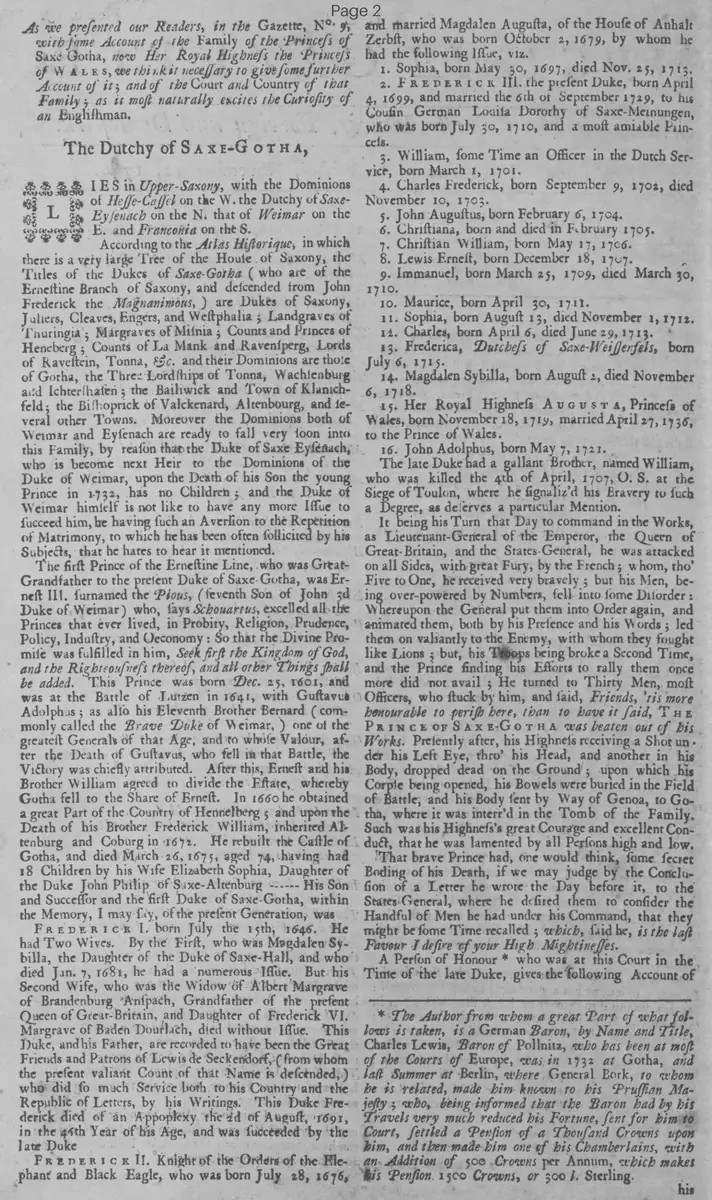
with same Account of the Family of the Princess of
Saxe Gotha, nor Her Royal Highness the Princess
of Wales, we think it necessary to give some further
Account of it; and of the Court and Country of that
Family; as it most naturally excites the Curiosity of
an Englishman.
The Dutchy of Saxe-Gotha,
Lies in Upper-Saxony, with the Dominions
of Hesse-Cassel on the W. the Dutchy of Saxe-
Eisenach on the N. that of Weimar on the
E. and Franconia on the S.
According to the Atlas Historique. in which
there is a very large Tree of the House of Saxony, the
Titles of the Dukes of Saxe-Gotha ( who are of the
Ernestine Branch of Saxony, and descended from John
Frederick the Magnanimous, ) are Dukes of Saxony,
Juliers, Cleves, Bergs, and Westphalia ; Landgraves of
Thuringia : Margraves of Misnia ; Counts and Princes of
Henenberg ; Counts of Lamanck and Ravensperg, Lords
of Ravenstein, Tonna, &c. and their Dominions are those
of Gotha, the Three Lordships of Tonna, Wachlenburg
and Ichtershausen; the Bailiwick and Town of Clannich-
feld: the Bishoprick of Valkenstadt, Altenburg, and se-
veral other Towns. Moreover the Dominions both of
Weimar and Eisenach are ready to fall very soon into
this Family, by reason that the Duke of Saxe Eisenach,
who is become next Heir to the Dominions of the
Duke of Weimar, upon the Death of his Son the young
Prince in 1732, has no Children ; and the Duke of
Weimar himself is not like to have any more Issue to
Succeed him, he having such an Aversion to the Repetition
of Matrimony, to which he has been often sollicited by his
Subjects. that he hates to hear it mentioned.
The first Prince of the Ernestine Line, who was Great-
Grandfather to the present Duke of Saxe-Gotha, was Er-
nest III. surnamed the Pious, (seventh Son of John 2d
Duke of Weimar)who, says Schouartus, excelled all the
Princes that ever lived, in Probity, Religion, Prudence,
Policy, Industry, and Oeconomy : So that the Divine Pro-
mise was fulfilled in him, Seek first the Kingdom of God,
and the Righteousness thereof, and all other Things shall
be added. This Prince Was born Dec. 25, 1601, and
was at the Battle of Lutzen in 1632, with Gustavus
Adolphus ; as also his Eleventh Brother Bernard ( com-
monly called the Brave Duke of Weimar, ) one of the
greatest Generals of that Age, and to whose Valour, af-
ter the Death of Gustavus, who fell in that Battle, the
Victory was chiefly attributed. After this, Ernest and his
Brother William agreed to divide the Estate, whereby
Gotha fell to the Share of Ernest. In 1660 he obtained
a great Part of the Country of Henneberg s and upon the
Death of his Brother Frederick William, inherited Al-
tenburg and Coburg in 1672. He rebuilt the Castle of
Gotha, and died March 26, 1675, aged 74, having had
18 Children by his Wife Elizabeth Sophia, Daughter of
the Duke John Philip of Saxe-Altenburg -.-- His Son
and Successor and the first Duke of Saxe-Gotha, within
the Memory, I may say, of the present Generation, was
FREDERICK I. born July the 15th, 1646. He
had Two Wives. By the First, who was Magdalen Sy-
billa, the Daughter of the Duke of Saxe-Weimar, and who
died Jan. 7, 1681, he had a numerous Issue. But. his
Second Wife, who was the Widow of Albert Margrave
of Brandenburg Anspach, Grandfather of the present
Queen of Great-Britain, and Daughter of Frederick VI.
Margrave of Baden Durlach, died without Issue. This
Duke, and his Father, are recorded to have been the Great
Friends and Patrons of Lewis de Seckendorf,(from whom
the present valiant Count of that Name is descended, )
who did so much Service both to his Country and the
Republic of Letters, by his Writings. This Duke Fre-
derick died of an Apoplexy the 2d of August, 1691,
in the 45th Year of his Age, and was succeeded by 'the
late Duke
FREDERICK II. Knight of the Orders of the Ele-
phant and Black Eagle, who was born July 28, 1677,
and married Magdalen Augusta, of the House of Anhalt
Zerbst, who was born October 2, 1679, by whom he
had the following Issue, viz.
1. Sophia, born May 30, 1697, died Nov. 25, 1713.
2. FREDERICK III. the present Duke, born April
4, 1699, and married the 6th of September 1729, to his
Cousin German Louisa Dorothea of Saxe-Meiningen,
who was born July 30, 1710, and a most amiable Prin-
cess.
3. William, some Time an Officer in the Dutch Ser-
vice, born March 1, 1701.
4. Charles Frederick, born September 9, 1702, died
November 10, 1703.
5. John Augustus, born February 6, 1704.
6. Christiana, born and died in February 1705.
7. Christian William, born May 17, 1706.
8. Lewis Ernest, born December 18, 1707.
9. Immanuel, born March 25, 1709, died March 30,
1710.
10. Maurice, born April 30, 1711.
11. Sophia, born August 13, died November 1, 1712.
12. Charles, born April 6, died June 29, 1713.
13. Frederica, Dutchess of Saxe-Weissenfels, born
July 6, 1715.
14. Magdalen Sybilla, born August 2, died November
6, 1718.
15. Her Royal Highness AUGUSTA, Princess of
Wales, born November 18, 1719, married April 27, 1736,
to the Prince of Wales.
16. John Adolphus, born May 7, 1721.
The late Duke had a gallant Brother, named William,
who was killed the 4th of April, 1707, O. S. at the
Siege of Toulon, where he signaliz'd his Bravery to such
a Degree, as deserves a particular Mention.
It being his Turn that Day to command in the Works,
as Lieutenant-General of the Emperor, the Queen of
Great-Britain, and the States-General, he was attacked
on all Sides, with great Fury, by the French; whom, tho'
Five to One, he received very bravely ; but his Men, be-
ing over-powered by Numbers, fell into some Disorder :
Whereupon the General put them into Order again, and
animated them, both by his Presence and his Words ; led
them on valiantly to the Enemy, with whom they fought
like Lions ; but, his Troops being broke a Second Time,
and the Prince finding his Efforts to rally them once
more did not avail ; He turned to Thirty Men, most
Officers, who stuck by him, and said, Friends, 'tis more
honourable to perish here, than to have it Said, THE
PRINCE OF SAXE-GOTHA was beaten out of his
Works. Presently after, his Highness receiving a Shot un-
der his Left Eye, thro' his Head, and another in his
Body, dropped dead on the Ground ; upon which his
Corpse being opened, his Bowels were buried in the Field
of Battle, and his Body Sent by Way of Genoa, to Go-
tha, where it was interr'd in the Tomb of the Family.
Such was his Highness's great Courage and excellent Con-
duct, that he was lamented by all Persons high and low.
That brave Prince had, one would think, some secret
Boding of his Death, if we may judge by the Conclu-
sion of a Letter he wrote the Day before it, to the
States-General, where he desired them to consider the
Handful of Men he had under his Command, that they
might be some Time recalled ; which, said he, is the last
Favour I desire of your High Mightinesses.
A Person of Honour * who was at this Court in the
Time of the late Duke, gives the following Account of
* The Author from whom a great Part of what fol-
lows is taken, is a German Baron, by Name and Title.
Charles Lewis, Baron of Pollnitz, who has been at most
of the Courts of Europe, was in 1732 at Gotha, and
last Summer at Berlin, where General Bork, to whom
he is related, made him known to his Prussian Ma-
jesty; who, being informed that the Baron had by his
Travels very much reduced his Fortune, Sent for him to
Court, Settled a Pension of a Thousand Crowns upon
him, and then made him one of his Chamberlains, with
an Addition of 500 Crowns per Annum, which makes
his Pension 1500 Crowns, or 200 l. Sterling.
his Court and Ministry, which will serve to convey some Idea of the present State of Saxe-Gotha, under the Administration of his Son the present Duke, Brother to her Royal Highness the Princess of Wales.
As of all the Princes of the Ernestine Branch, the Duke of Saxe Gotha is the most Powerful, so of all the Courts of Saxony, next to Dresden, his is the most numerous and the most magnificent: Nevertheless the Subjects of Saxe Gotha are the least burden'd with Taxes of any State in Germany. To that Prince's wise Management of his Finances, is owing not only his own Happiness, but that of his People, who perfectly adore him; for indeed he treats them more like a Father than a Sovereign, and never makes them sensible of his Power, but when he is to do them Justice. He is a kind good-natur'd Master, easy of Access, regular in his Manners, gives great Application to the Affairs of his Government, loves Reading, understands Books, and is ignorant of nothing a Prince ought to know. As to the Air of his Person, he is handsome and well set. He is civil, but reserved, and seldom speaks to such as are unknown to him, more than Needs must: He aims to know those thoroughly who have Business with him, and when he has found out their Character, he talks to them on such Subjects as he judges they are most acquainted with. He is very regular in his Manner of Living: He rises constantly at Seven o'Clock: and, after spending an Hour in Prayer, and the reading of some pious Treatise, he dresses himself, and gives Audience to his Ministers, and other Persons that want to speak with him. He dines at Noon with the Duchess his Consort, the Princesses, his Children, and other Persons of Distinction: and after having set about an Hour and Half at Table, takes a Walk in the Gardens of his Palace; or if the Weather does not permit, retires to his Closet, and amuses himself with Reading 'til Five o'Clock. Then he repairs to the House of one or other of his Courtiers, where there is an Assembly of all the Nobility; and after having there diverted himself at the Game of Ombre, returns to the Palace, sups in the Manner that he din'd, and at 9 o'Clock retires.
There is a Drawing Room at his Court Three Times a Week, when the Company meet in a grand Room, and make Parties at Ombre and Piquet. At 7 o'Clock, a great Table is spread, which is free for all the Company, where a Carver not only cuts up for that, but all the Gaming Tables, which are spread with Napkins: and those who do not play, sit down at what Table they like best; but the Duke, Duchess and the Princesses, are generally so complaisant as to admit Foreigners to their Table: During Supper, there is a Concert of Music, and at 9 o'Clock all the Company retires.
The present Duke, who succeeded to the Dominions of Saxe-Gotha, by the Death of his Father on the 12th of March 1732, has been in France, Italy, England, Holland, Denmark, Sweden, and all the Courts of Germany, and thereby stor'd himself with such useful Knowledge, and acquir'd such a Character, that it was then foreseen the Subjects of Gotha would be as happy under his Government, as they were under his Father's.
The Duke has all his great Officers of State that are common to Sovereign Princes. The Count de Ronaw was Grand Marshal in the late Duke's Time, and as it was said, his chief Favourite, tho' he had a Quality not very peculiar to Favourites, of being a true and constant Friend to those who profess'd a Friendship for him.
The Revenues of the late Duke were computed at a Million of Crowns per Annum, with which he kept on Foot near 3000 Men, of Regular Troops. His Guards were all cloathed, his Liveries rich, his Tables serv'd with more Elegance than Profusion; his Palace well furnish'd, his Officers punctually paid, and every Body pleased.
Upon his Death, the Duchess Dowager retired with the Princesses her Daughters to Altenbourg, and his Brothers went into the Service of the Emperor, the King of Poland, and the Prince of Hesse Cassel.
The present Duke, who follows the Steps of his Illustrious Father, was pleas'd to appoint M. Backover his Chancellor and President of his Council, M. de Herling, (who is of a noble Family in the Country of Ansbach, and was formerly in the Service of the Duke of Saxe-Weimar,) his Vice-Chancellor. The Count de Ronaw was sent his Envoy to the Diet of Ratisbon. And M. de Damnitz, heretofore in the Service of the Prince of Rudolstadt, and who was also a Major-General, was appointed his Grand Marshal.
Gotha, the Capital City of this Duchy, in Longitude 30. 40. Latitude 51. 2. stands on the Leina, about 18 Miles S.W. from Erfurt, and the same Distance E. from Eisenach, in a fine Corn Country, but so level, that in rainy Weather the Roads are so bad, that 'tis sometimes a Day's Journey to reach to Erfurt. The Town being situate in the Midst of a fine fertile Plain, and the Duke's Castle, or Palace, on a Hill that stands by itself, from the Apartments of the latter, there is a Prospect of vast Extent. Gotha was only a Village 'til 964, when it was fortified by William Archbishop of Mentz, with a Castle, &c. which being demolished by the Emperor Maximilian II. in 1567, was afterwards re-built by Ernest the Duke of Gotha, turnam'd the Pious, who made it one of the largest in Germany, and caused both the Castle and City to be encompassed with Ditches and Ramparts: And it must be added to his Honour, that he undertook and finish'd those great Works, at a Time when Germany was so impoverish'd by intestine Wars, that few of its Princes were able to erect Palaces.
The chief Trade of this Town is in Woad; of which they have Three Sorts. The first they sow about Christmas, the next in the Spring, Summer and Harvest, of which they have Three Crops; the Third grows Wild. This Herb is such a sovereign Balsamick, that it cures Wounds almost with a Touch, if taken in Time. It resembles Plantain, but has a longer Leaf. The Roots being brought over to England, with Clover, Cinquefoil, &c. grow with good Success in Northamptonshire; and other Places of England.
In the Duke's Palace there is a Chamber of valuable Rarities, and a noble Library, of which the late Duke caused a Catalogue to be published of the Manuscripts, that the Learned might know where to have Recourse to them. The Person employ'd to form it, was Dr. Cyprianus, Ecclesiastical Counsellor and Assessor in the Consistory of Gotha. They are for most Part the MSS of Ecclesiastical Authors, Ancient and Modern, specially the Latter. There is a great Number of Papers and Letters in the Latin and German Languages, concerning Luther's Reformation: and several MSS of the vulgar Translation of the Bible. There is a correcter Copy than that at Leipsic, of the Works of Lactantius; another of St. Austin's Treatise of the City of God, which belonged to Willigis Archbishop of Mentz, about Anno 1000: Another of the ancient Capitularies of the Kings of France, with the Salic Laws, and the Laws of the Lombards, Alemains, &c. There are 31 Manuscript Volumes, containing the Abridgments of the Lives of the Emperors of the West, and of the East, their Pictures and Medals, and those of their Families; the Whole collected in 1550, by James de Strada of Mantua. The Medals are very well design'd, and Occo, the famous Antiquary, affirms, in a Letter quoted by Mr. Patin, that every Figure on them, cost a Crown the Engraving. There is a particular Manuscript, which contains a Collection of Tracts by certain Greek Chymists, concerning the so much desir'd Art of making Gold. For the rest, we refer the Curious to the Catalogue itself, and shall pass to Altenbourg, the Capital of the Country of that Name of which the Duke of Saxe-Gotha is the Sovereign, and where he has a handsome Palace, where the Duchess Dowager, and the young Princesses were retired, at the Time that the Right Hon. the Lord Delaware arrived at Gotha, to receive the Princess Augusta: and conduct her to England, to be the happy Bride of his Royal Highness the Prince of Wales. The Peasants of this Country are said to be the richest in all Germany, so that they may almost vie, for Substance, with those of Holland and like the Dutch too, they don't care to spoil the Breed, and care to match their Daughters to any but the Sons of wealthy Farmers.
What sub-type of article is it?
What keywords are associated?
What entities or persons were involved?
Where did it happen?
Foreign News Details
Primary Location
Duchy Of Saxe Gotha
Event Date
1732 1736
Key Persons
Outcome
duke frederick ii died march 12, 1732; prince william killed april 4, 1707 at siege of toulon; various family deaths listed; princess augusta married prince of wales april 27, 1736; dominions of weimar and eisenach expected to pass to saxe-gotha line.
Event Details
Historical overview of the Ernestine branch of Saxony in Saxe-Gotha, from Ernest the Pious (1601-1675) through Frederick I (1646-1691), Frederick II (1677-1732), to current Duke Frederick III (b. 1699, r. 1732-). Details family lineage, titles, dominions, court life under Frederick III, military service of relatives, and cultural aspects of Gotha including trade in woad and palace library.