Thank you for visiting SNEWPapers!
Sign up free
Letter to Editor
September 2, 1837
Camden Commercial Courier
Camden, Kershaw County, South Carolina
What is this article about?
C. F. Durant writes to the editor describing six plans, including a lath grate system, for native American silk worms to wind cocoons more efficiently than European methods. He compares the heavier, superior silk yield of native worms to Asiatic varieties and provides a detailed scientific description of the species, found in New York and New Jersey.
Clipping
OCR Quality
95%
Excellent
Full Text
The Native American Silk Worm-New plan for the Worms to wind the Cocoons.
MR. Editor-
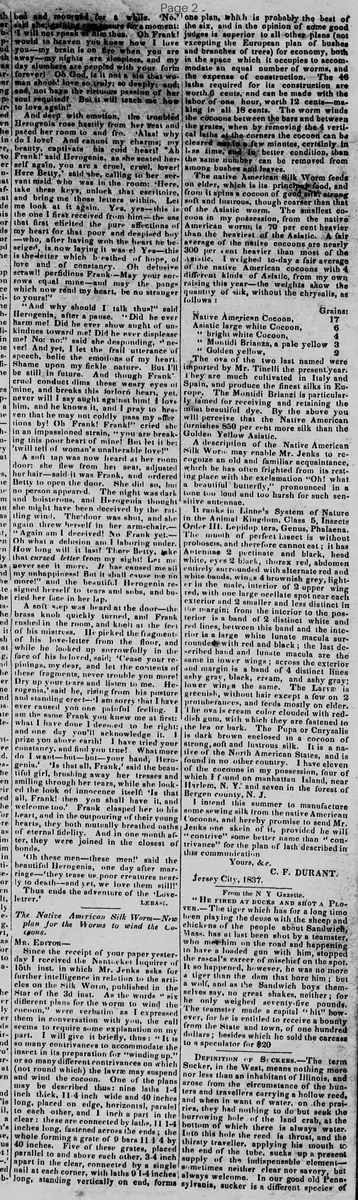
Since the receipt of your paper yesterday I received the Nantucket Inquirer of 15th inst. in which Mr. Jenks asks for further intelligence in relation to the articles on the Silk Worm, published in the Star of the 3d inst. As the words " six different plans for the worm to wind the cocoon." were verbatim as I expressed them in conversation with you, the call seems to require some explanation on my part. I will give it briefly, thus : " It is so many contrivances to accommodate the insect in its preparation for "winding up." or so many different contrivances on which (not round which) the larvae may suspend and wind the cocoon. One of the plans may be described thus: nine laths 1-4 inch thick. 1 1-4 inch wide and 40 inches long, placed on edge, horizontal, parallel to each other, and 1 inch apart in the clear : these are connected by laths, 11 1-4 inches long, fastened across the ends; the whole forming a grate of 9 bars 11 1 4 by 40 inches. Five of these grates, placed parallel to and above each other, 3-4 inch apart in the clear, connected by a single nail at each corner, with laths 9 1-4 inches long, standing vertically on end, forms one plan, which is probably the best of the six, and in the opinion of same good judges is superior to all other plans (not excepting the European plan of bushes and branches of trees) for economy, both in the space which it occupies to accommodate an equal number of worms, and the expense of construction. The 46 laths required for its construction are worth 6 cents, and can be made with the labor of one hour, worth 12 cents-making in all 18 cents. The worm winds the cocoons between the bars and between the grates, when by removing the 4 vertical laths the corners the cocoon can be cleared off in a few minutes, certainly in less time, and in better condition, than the same number can be removed from among bushes and leaves.
The native American Silk Worm feeds on elder, which is its principal food, and from it spins a cocoon of good silk, strong soft and lustrous, though coarser than that of the Asiatic worm. The smallest cocoon in my possession, from the native American worm; is 70 per cent heavier than the heaviest of the Asiatic. A fair average of the native cocoons are nearly 300 per cent heavier than most of the Asiatic. I weighed to-day a fair average of the native American cocoons with 4 different kinds of Asiatic, from my own raising this year--the weights show the quantity of silk, without the chrysalis, as follows :
Grains:
Native American Cocoon, 17
Asiatic large white Cocoon, 7, 19
" bright white Cocoon,
" Montidi Brianza, a pale yellow 6
" Golden yellow, 2
The ova of the two last named were imported by Mr. Tinelli the present year They are much cultivated in Italy and Spain, and produce the finest silks in Europe. The Montidi Brianza is particularly famed for receiving and retaining the most beautiful dye. By the above you will perceive that the Native American furnishes 850 per cent more silk than the Golden Yellow Asiatic.
A description of the-Native American Silk Worm may enable Mr. Jenks to recognize an old and familiar acquaintance, which he has often frighted from its resting place with the exclamation "Oh! what a beautiful butterfly," pronounced in a tone too loud and too harsh for such sensitive antennae.
It ranks in Linne's System of Nature in the Animal Kingdom, Class 5, Insects Order III. Lepidoptera, Genus, Phalaena. The moth of perfect insect is without proboscis, and therefore cannot eat; it has Antennae 2 pectinate and black, head white, eyes 2 black, thorax red, abdomen entirely surrounded with alternate red and white bands, wings 4 brownish grey, lighter in the male, interior of 2 upper wing red, with one large ocellate spot near each exterior and 2 smaller and less distinct in the margin; from the interior to the posterior is a band of 2 distinct white and red lines, between this band and the interior is a large white lunate macula surrounded with red and black; the last described band and lunate macula are the same in lower wings; across the exterior and margin is a band of 4 distinct lines ashy gray, black, cream, and ashy gray; lower wings the same. The Larva is greenish, without hair except a few on 2 protuberances, and feeds mostly on elder. The ova is cream color clouded with reddish gum, with which they are fastened to the leaf or bark. The Pupa or Chrysalis is dark brown enclosed in a cocoon of strong,soft and lustrous silk. It is a native of the North American States, and is found in no other country. I have eleven of the cocoons in my possession, four of which I found on manhattan Island, near Harlem, N. Y: and seven in the forest of Bergen county, N. J.
I intend this summer to manufacture some sewing silk from the native American cocoons, and hereby promise to send Mr. Jenks one skein of it, provided he will "contrive" some better name than "contrivance" for the plan of lath described in this communication.
Yours, &c.
C. F. DURANT.
Jersey City, 1837.
MR. Editor-
Since the receipt of your paper yesterday I received the Nantucket Inquirer of 15th inst. in which Mr. Jenks asks for further intelligence in relation to the articles on the Silk Worm, published in the Star of the 3d inst. As the words " six different plans for the worm to wind the cocoon." were verbatim as I expressed them in conversation with you, the call seems to require some explanation on my part. I will give it briefly, thus : " It is so many contrivances to accommodate the insect in its preparation for "winding up." or so many different contrivances on which (not round which) the larvae may suspend and wind the cocoon. One of the plans may be described thus: nine laths 1-4 inch thick. 1 1-4 inch wide and 40 inches long, placed on edge, horizontal, parallel to each other, and 1 inch apart in the clear : these are connected by laths, 11 1-4 inches long, fastened across the ends; the whole forming a grate of 9 bars 11 1 4 by 40 inches. Five of these grates, placed parallel to and above each other, 3-4 inch apart in the clear, connected by a single nail at each corner, with laths 9 1-4 inches long, standing vertically on end, forms one plan, which is probably the best of the six, and in the opinion of same good judges is superior to all other plans (not excepting the European plan of bushes and branches of trees) for economy, both in the space which it occupies to accommodate an equal number of worms, and the expense of construction. The 46 laths required for its construction are worth 6 cents, and can be made with the labor of one hour, worth 12 cents-making in all 18 cents. The worm winds the cocoons between the bars and between the grates, when by removing the 4 vertical laths the corners the cocoon can be cleared off in a few minutes, certainly in less time, and in better condition, than the same number can be removed from among bushes and leaves.
The native American Silk Worm feeds on elder, which is its principal food, and from it spins a cocoon of good silk, strong soft and lustrous, though coarser than that of the Asiatic worm. The smallest cocoon in my possession, from the native American worm; is 70 per cent heavier than the heaviest of the Asiatic. A fair average of the native cocoons are nearly 300 per cent heavier than most of the Asiatic. I weighed to-day a fair average of the native American cocoons with 4 different kinds of Asiatic, from my own raising this year--the weights show the quantity of silk, without the chrysalis, as follows :
Grains:
Native American Cocoon, 17
Asiatic large white Cocoon, 7, 19
" bright white Cocoon,
" Montidi Brianza, a pale yellow 6
" Golden yellow, 2
The ova of the two last named were imported by Mr. Tinelli the present year They are much cultivated in Italy and Spain, and produce the finest silks in Europe. The Montidi Brianza is particularly famed for receiving and retaining the most beautiful dye. By the above you will perceive that the Native American furnishes 850 per cent more silk than the Golden Yellow Asiatic.
A description of the-Native American Silk Worm may enable Mr. Jenks to recognize an old and familiar acquaintance, which he has often frighted from its resting place with the exclamation "Oh! what a beautiful butterfly," pronounced in a tone too loud and too harsh for such sensitive antennae.
It ranks in Linne's System of Nature in the Animal Kingdom, Class 5, Insects Order III. Lepidoptera, Genus, Phalaena. The moth of perfect insect is without proboscis, and therefore cannot eat; it has Antennae 2 pectinate and black, head white, eyes 2 black, thorax red, abdomen entirely surrounded with alternate red and white bands, wings 4 brownish grey, lighter in the male, interior of 2 upper wing red, with one large ocellate spot near each exterior and 2 smaller and less distinct in the margin; from the interior to the posterior is a band of 2 distinct white and red lines, between this band and the interior is a large white lunate macula surrounded with red and black; the last described band and lunate macula are the same in lower wings; across the exterior and margin is a band of 4 distinct lines ashy gray, black, cream, and ashy gray; lower wings the same. The Larva is greenish, without hair except a few on 2 protuberances, and feeds mostly on elder. The ova is cream color clouded with reddish gum, with which they are fastened to the leaf or bark. The Pupa or Chrysalis is dark brown enclosed in a cocoon of strong,soft and lustrous silk. It is a native of the North American States, and is found in no other country. I have eleven of the cocoons in my possession, four of which I found on manhattan Island, near Harlem, N. Y: and seven in the forest of Bergen county, N. J.
I intend this summer to manufacture some sewing silk from the native American cocoons, and hereby promise to send Mr. Jenks one skein of it, provided he will "contrive" some better name than "contrivance" for the plan of lath described in this communication.
Yours, &c.
C. F. DURANT.
Jersey City, 1837.
What sub-type of article is it?
Informative
Historical
What themes does it cover?
Science Nature
Agriculture
What keywords are associated?
Native American Silk Worm
Cocoon Winding Plans
Silk Yield Comparison
Phalaena Genus
Lath Grate Contrivance
Elder Food Source
Linnean Classification
What entities or persons were involved?
C. F. Durant.
Mr. Editor
Letter to Editor Details
Author
C. F. Durant.
Recipient
Mr. Editor
Main Argument
the native american silk worm produces significantly more and heavier silk than asiatic varieties, and innovative lath grate plans allow efficient cocoon winding superior to european methods in economy and ease of harvest.
Notable Details
Description Of Lath Grate Plan Using 46 Laths Costing 18 Cents
Cocoon Weights: Native 17 Grains Vs. Asiatic Varieties 2 19 Grains
Scientific Classification In Linne's System As Phalaena
Found On Manhattan Island Near Harlem, Ny And Bergen County, Nj
Feeds Primarily On Elder
Promise To Send Sewing Silk To Mr. Jenks