Thank you for visiting SNEWPapers!
Sign up free
The New Hampshire Gazette
Portsmouth, Rockingham County, New Hampshire
What is this article about?
In May 1794, President Washington communicates to Congress reports of British troops under Governor Simcoe planning to build a fort on US territory at Miami Rapids, and a speech by Lord Dorchester inciting Indians against the US. Diplomatic letters between US Secretary of State and British Minister Hammond exchange concerns over encroachments and hostilities.
Merged-components note: These sequential components form a single coherent diplomatic correspondence including Washington's messages to Congress and the exchange of letters between the Secretary of State and the British Minister George Hammond regarding British encroachments on U.S. territory and related hostilities.
Clipping
OCR Quality
Full Text
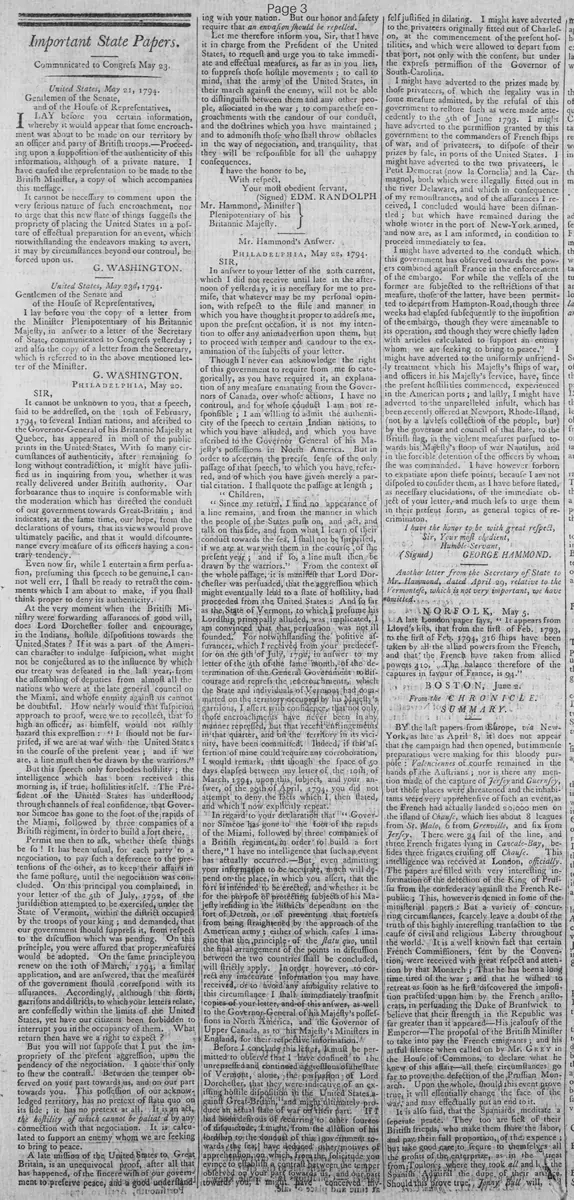
Communicated to Congress May 23.
United States, May 21, 1794.
Gentlemen of the Senate,
and of the House of Representatives,
I LAY before you certain information,
whereby it would appear that some encroachment
was about to be made on our territory by
an officer and party of British troops.—Proceeding
upon a supposition of the authenticity of this
information, although of a private nature, I
have caused the representation to be made to the
British Minister, a copy of which accompanies
this message.
It cannot be necessary to comment upon the
very serious nature of such encroachment, nor
to urge that this new state of things suggests the
propriety of placing the United States in a posture
of effectual preparation for an event, which
notwithstanding the endeavors making to avert,
it may by circumstances beyond our control, be
forced upon us.
G. WASHINGTON.
United States, May 23d, 1794:
Gentlemen of the Senate and
of the House of Representatives,
I lay before you the copy of a letter from
the Minister Plenipotentiary of his Britannic
Majesty, in answer to a letter of the Secretary
of State, communicated to Congress yesterday;
and also the copy of a letter from the Secretary,
which is referred to in the above mentioned letter
of the Minister.
G. WASHINGTON.
PHILADELPHIA, May 20.
SIR,
It cannot be unknown to you, that a speech,
said to be addressed, on the 10th of February,
1794, to several Indian nations, and ascribed to
the Governor-General of his Britannic Majesty at
Quebec, has appeared in most of the public
prints in the United States. With so many circumstances
of authenticity, after remaining so
long without contradiction, it might have justified
us in inquiring from you, whether it was
really delivered under British authority. Our
forbearance thus to inquire is conformable with
the moderation which has directed the conduct
of our government towards Great-Britain; and
indicates, at the same time, our hope, from the
declarations of yours, that its views would prove
ultimately pacific, and that it would discountenance
every measure of its officers having a contrary tendency.
Even now sir, while I entertain a firm persuasion,
presuming this speech to be genuine, I cannot
well err, I shall be ready to retract the comments
which I am about to make, if you shall
think proper to deny its authenticity.
At the very moment when the British Ministry
were forwarding assurances of good will,
does Lord Dorchester foster and encourage,
in the Indians, hostile dispositions towards the
United States? If it was a part of the American
character to indulge suspicion, what might
not be conjectured as to the influence by which
our treaty was defeated in the last year, from
the assembling of deputies from almost all the
nations who were at the late general council on
the Miami, and whose enmity against us cannot
be doubtful. How nearly would that suspicion
approach to proof, were we to recollect, that so
high an officer, as himself, would not rashly
hazard this expression; 'I shall not be surprised,
if we are at war with the United States
in the course of the present year: and if we
are, a line must then be drawn by the warriors.'?
But this speech only forebodes hostility; the
intelligence which has been received this
morning is, if true, hostilities itself. The President
of the United States has understood,
through channels of real confidence, that Governor
Simcoe has gone to the foot of the rapids of
the Miami, followed by three companies of a
British regiment, in order to build a fort there.
Permit me then to ask, whether these things
be so! It has been usual, for each party to a
negotiation, to pay such a deference to the pretensions
of the other, as to keep their affairs in
the same posture, until the negotiation was concluded.
On this principle you complained, in
your letter of the 5th of July, 1793, of the
jurisdiction attempted to be exercised, under the
State of Vermont, within the district occupied
by the troops of your king; and demanded, that
our government should suppress it, from respect
to the discussion which was pending. On this
principle, you were assured that proper measures
would be adopted. On the same principle you
renew on the 10th of March, 1794, a similar
application, and are answered, that the measures
of the government should correspond with its
assurances. Accordingly, although the forts,
garrisons and districts, to which your letters relate,
are confessedly within the limits of the United
States, yet have our citizens been forbidden to
interrupt you in the occupancy of them. What
return then have we a right to expect?
But you will not suppose that I put the impropriety
of the present aggression, upon the
pendency of the negotiation. I quote this only
to show the contrast between the temper observed
on your part towards us, and on our part
towards you. This possession of our acknowledged
territory, has no pretext of status quo on
its side; it has no pretext at all. It is an act,
the hostility of which cannot be palliated by any
connection with that negotiation. It is calculated
to support an enemy whom we are seeking
to bring to peace.
A late mission of the United States to Great
Britain, is an unequivocal proof, after all that
has happened, of the sincere wish of our government
to preserve peace, and a good understanding
with your nation.
PHILADELPHIA, May 22, 1794.
SIR,
In answer to your letter of the 20th current,
which I did not receive until late in the after-
noon of yesterday, it is necessary for me to premise,
that whatever may be my personal opinion
with respect to the style and manner in
which you have thought it proper to address me,
upon the present occasion, it is not my intention
to offer any animadversion upon them, but
to proceed with temper and candour to the examination
of the subjects of your letter.
Though I never can acknowledge the right
of this government to require from me so categorically,
as you have required it, an explanation
of any measure emanating from the Governors
of Canada, over whose actions, I have no
control, and for whose conduct I am not responsible;
I am willing to admit the authenticity
of the speech to certain Indian nations, to
which you have alluded, and which you have
ascribed to the Governor General of his Majesty's
possessions in North America. But in
order to ascertain the precise sense of the only
passage of that speech, to which you have referred,
and of which you have given merely a partial
citation. I shall quote the passage at length;
"Children,
Since my return, I find no appearance of
a line remains, and from the manner in which
the people of the States push on, and act, and
talk on this side, and from what I learn of their
conduct towards the sea, I shall not be surprised,
if we are at war with them in the course of the
present year; and if so, a line must then be
drawn by the warriors." From the context of
the whole passage, it is manifest that Lord Dor-
chester was persuaded, that the aggression which
might eventually lead to a state of hostility, had
proceeded from the United States: And so far
as the State of Vermont, to which I presume his
Lordship principally alluded, was implicated, I
am convinced that that persuasion was not ill
founded. For notwithstanding the positive assurances,
which I received from your predecessor.
on the 9th of July, 1793, in answer to my
letter of the 5th of the same month, of the determination
of the General Government to discourage
and repress the encroachments, which
the State and individuals of Vermont had committed
on the territory occupied by his Majesty's
garrisons, I assert with confidence, that not only
those encroachments have never been in any
manner repressed, but that recent infringements
in that quarter, and on the territory in its vicinity,
have been committed. Indeed, if this assertion
of mine could require any corroboration,
I would remark, that though the space of 50
days elapsed between my letter of the 10th, of
March, 1794, upon this subject, and your answer,
of the 29th of April, 1794, you did not
attempt to deny the facts which I then stated,
and which I now explicitly repeat.
In regard to your declaration that Governor
Simcoe has gone to the foot of the rapids
of the Miami, followed by three companies of
a British regiment, in order to build a fort
there, I have no intelligence that such an event
has actually occurred.—But even admitting
your information to be accurate, much will depend
on the place, in which you assert, that the
fort is intended to be erected, and whether it be
for the purpose of protecting subjects of his Majesty
residing in the districts dependant on the
fort of Detroit, or of preventing that fortress
from being straitened by the approach of the
American army; either of which, cases I imagine
that the principles of the status quo, until
the final arrangement of the points in discussion
between the two countries shall be concluded,
will strictly apply. In order however, to correct
any inaccurate information you may have
received, or to avoid any ambiguity relative to
this circumstance I shall immediately transmit
copies of your letter, and of this answer, as well
to the Governor-General of his Majesty's possessions
in North America, and the Governor of
Upper Canada, as to his Majesty's Ministers in
England, for their respective information.
Before I conclude this letter, I must be permitted
to observe that I have confined to the
unrepressed and continued aggressions of the State
of Vermont, alone, the persuasion of Lord
Dorchester, that they were indicative of an existing
hostile disposition in the United States against
Great-Britain, and might ultimately produce
an actual state of war on their part. If I
had been desirous of recurring to other sources
of disquietude, I might, from the allusion of his
Lordship to the conduct of this government towards
the sea, have deduced other motives of
apprehension, on which from the solicitude you
have evinced to establish contrast between the temper
observed on your part towards us, and on our part
towards you, I am convinced you would have felt yourself
justified in dilating. I might have adverted
to the privateers originally fitted out of Charleston,
at the commencement of the present hostilities,
and which were allowed to depart from
that port, not only with the consent, but under
the express permission of the Governor of
South-Carolina.
I might have adverted to the prizes made by
those privateers, of which the legality was in
some measure admitted, by the refusal of this
government to restore such as were made antecedently
to the 5th of June 1793. I might
have adverted to the permission granted by this
government to the commanders of French ships
of war, and of privateers, to dispose of their
prizes by sale, in ports of the United States. I
might have adverted to the two privateers, le
Petit Democrat (now la Cornelia) and la Citoyenne
Magnol, both which were illegally fitted out in
the river Delaware, and which in consequence
of my remonstrances, and of the assurances I received,
I concluded would have been dismantled:
but which have remained during the
whole winter in the port of New-York armed,
and now are, as I am informed, in condition to
proceed immediately to sea.
I might have adverted to the conduct which
this government has observed towards the powers
combined against France in the enforcement
of the embargo. For while the vessels of the
former are subjected to the restrictions of that
measure, those of the latter, have been permitted
to depart from Hampton-Road, though three
weeks had elapsed subsequently to the imposition
of the embargo, though they were amenable to
its operation, and though they were chiefly laden
with articles calculated to support an enemy
whom we are seeking to bring to peace. I
might have adverted to the uniformly unfriendly
treatment which his Majesty's ships of war,
and officers in his Majesty's service, have, since
the present hostilities commenced, experienced
in the American ports; and lastly, I might have
adverted to the unparalleled insult, which has
been recently offered at Newport, Rhode-Island,
(not by a lawless collection of the people, but)
by the governor and council of that state, to the
British flag, in the violent measures pursued towards
his Majesty's sloop of war Nautilus, and
in the forcible detention of the officers by whom
she was commanded. I have however forborne
to expatiate upon these points, because I am not
disposed to consider them, as I have before stated,
as necessary elucidations, of the immediate object
of your letter, and much less to urge them
in their present form, as general topics of recrimination.
I have the honor to be with great respect,
Sir, Your most obedient,
Humble Servant,
(Signed) GEORGE HAMMOND.
Another letter from the Secretary of State to
Mr. Hammond, dated April 29, relative to the
Vermontese, which is not very important, we have
omitted.
What sub-type of article is it?
What keywords are associated?
What entities or persons were involved?
Where did it happen?
Foreign News Details
Primary Location
Miami Rapids
Event Date
May 1794
Key Persons
Outcome
no confirmation of fort construction; diplomatic exchange highlights mutual accusations of encroachments and hostilities, with us urging preparation for potential war.
Event Details
President Washington informs Congress of reports of British troops under Governor Simcoe planning to build a fort at Miami Rapids on US territory and a speech by Lord Dorchester to Indian nations suggesting imminent war. US Secretary of State questions British Minister Hammond on these actions. Hammond acknowledges the speech's authenticity but attributes British concerns to US encroachments, denies knowledge of the fort, and counters with US support for French privateers and other grievances.