Thank you for visiting SNEWPapers!
Sign up free
Alexandria Daily Gazette, Commercial & Political
Alexandria, Virginia
What is this article about?
In the U.S. House of Representatives on December 19, Mr. McKee speaks in favor of a resolution approving the executive's refusal to communicate further with British Minister Jackson over his offensive language disavowing the Erskine arrangement and insinuating U.S. bad faith. Mr. Wheaton begins an opposing speech, questioning the executive's hasty action amid European belligerents' harms.
Merged-components note: Continuation of the congressional debate on the joint resolution across pages 2 and 3, forming a single narrative story.
Clippings
1 of 2
OCR Quality
Full Text
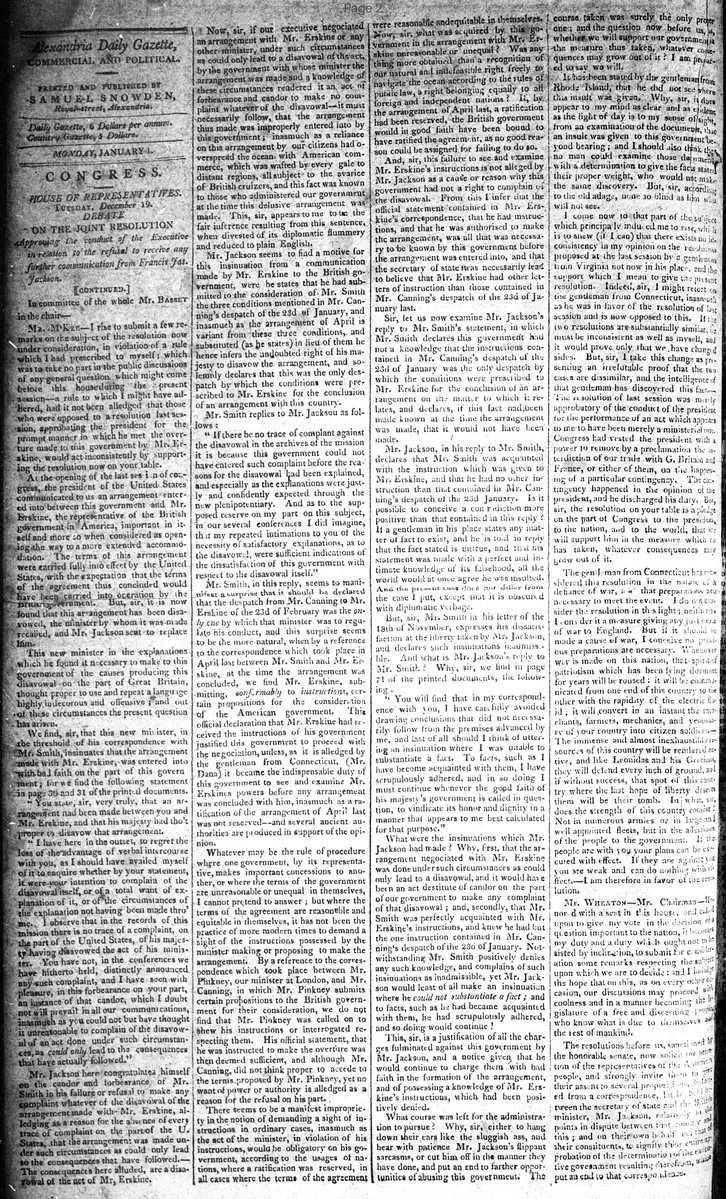
HOUSE OF REPRESENTATIVES
Tuesday, December 19.
DEBATE
ON THE JOINT RESOLUTION
Approving the conduct of the Executive
in relation to the refusal to receive any
further communication from Francis Jas.
Jackson.
continued.
In committee of the whole Mr. Bassett
in the chair
MR. McKEE I rise to submit a few remarks on the subject of the resolution now
under consideration, in violation of a rule
which I had prescribed to myself; which
was to take no part in the public discussions
of any general question which might come
before this house during the present
session--a rule to which I might have adhered, had it not been alleged that those
who were opposed to a resolution last session, approbating the president for the
prompt manner in which he met the overture made to this government by Mr. Erskine, would act inconsistently by supporting the resolution now on your table.
At the opening of the last session of congress, the president of the United States
communicated to us an arrangement entered into between this government and Mr.
Erskine, the representative of the British
government in America, important in itself and more so when considered as opening the way to a more extended accommodation. The terms of this arrangement
were carried fully into effect by the United
States, with the expectation that the terms
of the agreement thus concluded would
have been carried into operation by the
British government. But, sir, it is now
found that this arrangement has been disavowed, the minister by whom it was made
recalled, and Mr. Jackson sent to replace
him.
This new minister in the explanations
which he found it necessary to make to this
government of the causes producing this
disavowal on the part of Great Britain,
thought proper to use and repeat a language
highly indecorous and offensive; and out
of these circumstances the present question
has arisen.
We find, sir, that this new minister, in
The threshold of his correspondence with
Mr. Smith, insinuates that the arrangement
made with Mr. Erskine, was entered into
with bad faith on the part of this government; for we find the following statement
in page 30 and 31 of the printed documents.
"You state, sir, very truly, that an arrangement had been made between you and
Mr. Erskine, and that his majesty had thought
proper to disavow that arrangement.
"I have here in the outset, to regret the
loss of the advantage of verbal intercourse
with you, as I should have availed myself
of it to enquire whether by your statement,
it were your intention to complain of the
disavowal itself, or of a total want of explanation of it, or of the circumstances of
the explanation not having been made thro'
me. I observe that in the records of this
mission there is no trace of a complaint, on
the part of the United States, of his majesty having disavowed the act of his minister. You have not, in the conferences we
have hitherto held, distinctly announced
any such complaint, and I have seen with
pleasure, in this forbearance on your part,
an instance of that candor, which I doubt
not will prevail in all our communications,
inasmuch as you could not but have thought
it unreasonable to complain of the disavowal of an act done under such circumstances, as could only lead to the consequences
that have actually followed."
Mr. Jackson here congratulates himself
on the candor and forbearance, of Mr.
Smith in his failure or refusal to make any
complaint whatever of the disavowal of the
arrangement made with Mr. Erskine, alleging as a reason for the absence of every
trace of complaint on the part of the U.
States, that the arrangement was made under such circumstances as could only lead
to the consequences that have followed.
The consequences here alluded to, are a disavowal of the act of Mr. Erskine.
Now, sir, if our executive negotiated
an arrangement with Mr. Erskine or any
other minister, under such circumstances
as could only lead to a disavowal of the act,
by the government with whose minister the
arrangement was made and a knowledge of
these circumstances rendered it an act of
forbearance and candor to make no complaint whatever of the disavowal--it must
necessarily follow, that the arrangement
thus made was improperly entered into by
this government; inasmuch as a reliance
on this arrangement by our citizens had overspread the ocean, with American commerce, which was wafted by every gale to
distant regions, all subject to the avarice
of British cruisers, and this fact was known
to those who administered our government
at the time this delusive arrangement was
made. This, sir, appears to me to be the
fair inference resulting from this sentence.
when divested of its diplomatic flummery
and reduced to plain English.
Mr. Jackson seems to find a motive for
this insinuation from a communication
made by Mr. Erskine to the British government, where he states that he had submitted to the consideration of Mr. Smith
the three conditions mentioned in Mr. Canning's despatch of the 23d of January, and
inasmuch as the arrangement of April is
variant from these three conditions, and
substituted (as he states) in lieu of them he
hence infers the undoubted right of his majesty to disavow the arrangement, and solemnly declares that this was the only despatch by which the conditions were prescribed to Mr. Erskine for the conclusion
of an arrangement with this country.
Mr. Smith replies to Mr. Jackson as follows:
"If there be no trace of complaint against
the disavowal in the archives of the mission
it is because this government could not
have entered such complaint before the reason for the disavowal had been explained,
and especially as the explanations were justly and confidently expected through the
new plenipotentiary. And as to the supposed reserve on my part on this subject,
in our several conferences I did imagine,
that my repeated intimations to you of the
necessity of satisfactory explanations, as to
the disavowal, were sufficient indications of
the dissatisfaction of this government with
respect to the disavowal itself."
Mr. Smith, in this reply, seems to manifest a surprise that it should be declared
that the despatch from Mr. Canning to Mr.
Erskine of the 23d of February was the only one by which that minister was to regulate his conduct, and this surprise seems
to be the more natural, when by a reference
to the correspondence which took place in
April last between Mr. Smith and Mr. Erskine, at the time the arrangement was
concluded, we find Mr. Erskine, submitting, conformably to instructions, certain propositions for the consideration
of the American government. This
official declaration that Mr. Erskine had received the instructions of his government
justified this government to proceed with
the negociation, unless, as it is alleged by
the gentleman from Connecticut, (Mr.
Dana) it became the indispensable duty of
this government to see and examine Mr.
Erskine's powers before any arrangement
was concluded with him, inasmuch as a ratification of the arrangement of April last
was not reserved--and several ancient authorities are produced in support of the opinion.
Whatever may be the rule of procedure
where one government, by its representative, makes important concessions to another, or where the terms of the government
are unreasonable or unequal in themselves,
I cannot pretend to answer; but where the
terms of the agreement are reasonable and
equitable in themselves, it has not been the
practice of more modern times to demand a
sight of the instructions possessed by the
minister making or proposing to make the
arrangement. By a reference to the correspondence which took place between Mr.
Pinkney, our minister at London, and Mr.
Canning, in which Mr. Pinkney submits
certain propositions to the British government for their consideration, we do not
find that Mr. Pinkney was called on to
shew his instructions or interrogated respecting them. His official statement, that
he was instructed to make the overture was
then deemed sufficient, and although Mr.
Canning, did not think proper to accede to
the terms proposed by Mr. Pinkney, yet no
want of power or authority is alleged as a
reason for the refusal on his part.
There seems to be a manifest impropriety in the notion of demanding a sight of instructions in ordinary cases, inasmuch as
the act of the minister, in violation of his
instructions, would be obligatory on his government, according to the usages of nations, where a ratification was reserved, in
all cases where the terms of the agreement
were reasonable and equitable in themselves.
Now sir, what was acquired by this government in the arrangement with Mr. Erskine unreasonable or unequal? Was anything more obtained than a recognition of
our natural and indefeasible right freely to
navigate the ocean according to the rules of
public law, a right belonging equally to all
foreign and independent nations? It, by
the arrangement of April last, a ratification
had been reserved, the British government
would in good faith have been bound to
have ratified the agreement, as no good reason could be assigned for failing to do so.
And, sir, this failure to see and examine
Mr. Erskine's instructions is not alleged by
Mr. Jackson as a cause or reason why this
government had not a right to complain of
the disavowal. From this I infer that the
official statement contained in Mr. Erskine's correspondence, that he had instructions, and that he was authorised to make
the arrangement, was all that was necessary to be known by this government before
the arrangement was entered into, and that
the secretary of state was necessarily lead
to believe that Mr. Erskine had other letters of instruction than those contained in
Mr. Canning's despatch of the 23d of January last.
Sir, let us now examine Mr. Jackson's
reply to Mr. Smith's statement, in which
Mr. Smith declares this government had
not a knowledge that the instructions contained in Mr. Canning's despatch of the
23d of January was the only despatch by
which the conditions were prescribed to
Mr. Erskine for the conclusion of an arrangement on the matter to which it relates, and declares, if this fact had been
made known at the time the arrangement
was made, that it would not have been
made.
Mr. Jackson, in his reply to Mr. Smith.
declares that Mr. Smith was acquainted
with the instruction which was given to
Mr. Erskine, and that he had no other instruction than that contained in Mr. Canning's despatch of the 23d January. Is it
possible to conceive a contradiction more
positive than that contained in this reply?
It a gentleman in his place states any matter of fact to exist, and he is told in reply
that the fact stated is untrue, and that his
statement was made with a perfect and intimate knowledge of its falsehood, all the
world would at once agree he was insulted.
And the present case does not differ from
the case I put, except that it is obscured
with diplomatic verbiage.
But, sir, Mr. Smith in his letter of the
18th of November, expresses his dissatisfaction at the liberty taken by Mr. Jackson,
and declares such insinuations inadmissible. And what is Mr. Jackson's reply to
Mr. Smith? Why, sir, we find in page
71 of the printed documents, the following:
"You will find that in my correspondence with you, I have carefully avoided
drawing conclusions that did not necessarily follow from the premises advanced by
me, and last of all should I think of uttering an insinuation where I was unable to
substantiate a fact. To facts, such as I
have become acquainted with them, I have
scrupulously adhered, and in so doing I
must continue whenever the good faith of
his majesty's government is called in question, to vindicate its honor and dignity in a
manner that appears to me best calculated
for that purpose."
What were the insinuations which Mr
Jackson had made? Why, first, that the arrangement negotiated with Mr. Erskine
was done under such circumstances as could
only lead to a disavowal, and it would have
been an act destitute of candor on the part
of our government to make any complaint
of that disavowal; and, secondly, that Mr.
Smith was perfectly acquainted with Mr.
Erskine's instructions, and knew he had but
the one instruction contained in Mr. Canning's despatch of the 23d of January. Notwithstanding Mr. Smith positively denies
any such knowledge, and complains of such
insinuations as inadmissible, yet Mr. Jackson would least of all make an insinuation
where he could not substantiate a fact; and
to facts, such as he had become acquainted
with them, he had scrupulously adhered,
and so doing would continue!
This, sir, is a justification of all the charges fulminated against this government by
Mr. Jackson, and a notice given, that he
would continue to charge them with bad
faith in the formation of the arrangement,
and of possessing a knowledge of Mr. Erskine's instructions, which had been positively denied.
What course was left for the administration to pursue? Why, sir, either to hang
down their ears like the sluggish ass, and
bear with patience Mr. Jackson's flippant
sarcasms, or cut him off in the manner they
have done, and put an end to further opportunities of abusing this government. The
course taken was surely the only proper
one; and the question now before us, is,
whether we will support our government in
the measure thus taken, whatever consequences may grow out of it? I am prepared to say we will.
It has been stated by the gentleman from
Rhode Island, that he did not see where
this insult was given. Why sir, it does
appear to my mind as clear and as evident
as the light of day is to my sense of sight
from an examination of the documents, that
an insult was given to this government beyond bearing; and I should also think there
no man could examine those documents
with a determination to give the facts stated
their proper weight, who would not make
the same discovery. But, sir, according
to the old adage, none so blind as him who
will not see.
I come now to that part of the subject
which principally induced me to rise, which
is to shew (if I can) that there exists no inconsistency in my opinion on the resolution
proposed at the last session by a gentleman
from Virginia not now in his place, and the
support which I mean to give the present
resolution. Indeed, sir, I might retort on
the gentleman from Connecticut, inasmuch
as he was in favor of the resolution of last
session and is now opposed to this. If the
two resolutions are substantially similar, it
must be inconsistent as well as myself, and
it would prove only that we have changed
sides. But, sir, I take this change as presenting an irrefutable proof that the two
cases are dissimilar, and the intelligence of
that gentleman has discovered this fact.
The resolution of last session was merely
approbatory of the conduct of the president
for the performance of an act which appears
to me to have been merely a ministerial one.
Congress had vested the president with a
power to remove by a proclamation the interdiction of our trade with G. Britain and
France, or either of them, on the happening of a particular contingency. The contingency happened in the opinion of the
president, and he discharged his duty. But,
sir, the resolution on your table is a pledge
on the part of Congress to the president,
to the nation, and to the world, that we
will support him in the measure which he
has taken, whatever consequences may
grow out of it.
The gentleman from Connecticut has considered this resolution in the nature of a
defiance of war, and that preparations are
necessary to meet the event. I do not consider the resolution in this light; neither do
I consider it a measure giving any just cause
of war to England. But if it should be
made a cause of war, I conceive no previous preparations are necessary. Whenever
war is made on this nation, that spirit of
patriotism which has been lying dormant
for years will be roused: it will be communicated from one end of this country to the
other with the rapidity of the electric fluid: it will convert in an instant the merchants, farmers, mechanics, and yeomanry of your country into citizen soldiers.
The immense and almost inexhaustible resources of this country will be rendered active, and like Leonidas and his Grecians,
they will defend every inch of ground, and
if without success, that spot of this country where the last hope of liberty deserts
them will be their tomb. In what, sir,
does the strength of this country consist?
Not in numerous armies or in large and
well appointed fleets, but in the affections
of the people to the government. If the
people are with you your plans can be executed with effect. If they are against you
you are weak and can do nothing with effect. I am therefore in favor of the resolution.
Mr. Wheaton--Mr. Chairman--Honored with a seat in this house, and called
upon to give my vote in the decision of a
question important to the nation, it becomes
my duty and a duty which ought not to be
resisted by inclination, to submit for consideration some remarks respecting the subject upon which we are to decide: and I indulge the hope that on this, as on every other occasion, our discussions may proceed with
coolness and in a manner becoming the legislature of a free and discerning people,
who know what is due to themselves and
the rest of mankind.
The resolutions before us, sanctioned by
the honorable senate, now solicit the attention of the representatives of the American people, and strongly invite them to give
their assent to several propositions. derived
from a correspondence, between the secretary of state and the British
minister, Mr. Jackson, relating to points in dispute between that country and
this; and on their own behalf and that of
their constituents, to signify their entire approbation of the determination of the executive government resulting therefrom, which
put an end to that correspondence.
Notwithstanding the opinions of several able gentlemen, manifested on a former occasion in this house, to whom much is due, and whose opinions will always have great weight with me when formed on correct principle, that in a government like our own; yet cannot but still hold it as my opinion, that in all governments, springing from and supported by the will of the people, they have a right, and it is even their duty, on great occasions, to signify their approbation or disapprobation of the conduct pursued, or the measures adopted by those in power. For, on the one hand it may be the means of correction of erroneous procedure, so on the other, it may give life and vigor to a sound and honest policy. Whether the one or the other be the case, it would not be illiberal, but unjust, to withhold it. If praise is asked for as an alms, it should always be denied; but when it is fairly and really due, it would not be illiberal, but unjust, to withhold it. The question of praise or dispraise, approbation or disapprobation, either as a private citizen or an individual member of this house, may be considered as of little importance to those who stand in the first ranks in conducting the great concerns of our nation; yet if I could see what has long been my anxious wish to see, and what others imagine they do see, that our executive government had pursued the wisest and most prudent course relative to the subject embraced by these resolutions, it would be highly gratifying to my pride, to be able to furnish a few materials for a monument of their praise. In doing this I should feel much pleasure and satisfaction as did the Egyptian when gathering together a few splinters of a broken boat as a funeral pile for the great Pompey. It is but natural that I should be prejudiced in favor of my own country, the country that gave me birth, and in which I have ever since lived, and of the government I have had some small share in forming, and to the support of which, by all just and proper means in my power, I feel the force of the obligation I am under to promote the interests and happiness of the one, and to give aid and support to the other. I cannot, however, under these impressions, and with these objects in view, either feel the necessity, or make myself willing to break through those eternal and immutable obligations, I am under to my God and my fellow men, always to maintain justice and truth. It is my wish to examine with fairness and candor every subject which it shall become my duty to consider, and that my tongue may always sound the true index of my heart. I know it is a maxim in some governments that the supreme power of the state can do no wrong. I believe, however, that this maxim has not received the sanction of experience in any government. It has sometimes been questioned even in that government to which these resolutions point, and the resolutions themselves are made to decide against it. I should hardly then have expected, that in this early period of our free republic, such a maxim would be received and become current here. May we not yet, sir, humbly and modestly enquire, even though such enquiry would lead to doubt whether our executive government (as this government is but a creature of our power) have done right or wrong in the late hasty step they have taken, especially as we are now called upon, and in pretty strong terms too, to approve of it. If we are yet freemen, and retain any of our discriminating faculties, shall we not examine for ourselves before we venture to express our approbation? If we do not, shall we not be in danger of exhibiting to the world the picture of a convivial, though tasteless company over some sparkling adulteration commending their champaign? For myself, sir, I have examined and thought with modesty and deference for the opinions of others. I am compelled as an honest man to say that what is proposed in these resolutions does not meet my approbation. In giving my reasons I will state some facts but carefully avoid drawing conclusions; leaving that to be done by those to whom they may apply. The belligerents of Europe, anxious to excel in doing each other harm, have both done much harm to us. The French, it is said, have committed some trespasses on our commercial rights, and notwithstanding all our gentle entreaties, show little disposition to compensate for the past or cease from future injuries; until having acquired as much power by sea as they have already by land, they shall have been able to send their floating colonies abroad; and then, if we may judge of the probable effects of the one, from what we have seen or heard of the other, we may easily anticipate what kind of redress will be offered us. If we do not like the fate of Copenhagen, we may have that of Switzerland or Spain. Those harps on which we are now playing, we may be obliged to hang upon the willows, bemoan the loss of a stolen president, and in a different tone, to hail the arrival of a victorious master from the family of the Bonapartes. The French minister is still with us, and for aught I have heard, in full communion, and our accustomed communications with, and civilities towards that nation are not interrupted. For the British government, sir, I feel no partiality; with British subjects I have no connection; or the British nation no affection, but such as I ought to feel for all mankind. From that nation we have endured many wrongs and made as many complaints. But all the means which the wisdom of our government has hitherto devised, or her power executed, for redress, has proved ineffectual to the attainment of that desirable object. A different expedient seems now to be contemplated. All communication with that government through their minister in this country is now suspended, and the way seems fast preparing for commencing open and avowed hostilities with that nation. How far the nature and magnitude of the wrongs we have suffered, or the prospect of redress, may have recourse to war, can justify the measure, deserves well to be considered by those who are to make the declaration.
(Mr. Wheaton's Speech to be continued.)
What sub-type of article is it?
What themes does it cover?
What keywords are associated?
What entities or persons were involved?
Where did it happen?
Story Details
Key Persons
Location
United States House Of Representatives
Event Date
Tuesday, December 19
Story Details
Mr. McKee defends a congressional resolution approving the U.S. executive's refusal to continue communications with British Minister Jackson, citing Jackson's offensive insinuations of U.S. bad faith in the disavowed Erskine arrangement and prior diplomatic practices. He argues consistency with past support and national readiness for potential war. Mr. Wheaton opposes, urging examination of the executive's hasty action amid European threats from both Britain and France.