Thank you for visiting SNEWPapers!
Sign up free
The Liberator
Boston, Suffolk County, Massachusetts
What is this article about?
An anonymous writer signing as 'ALPHONSO' argues that ministers of the gospel have a duty to engage in the anti-slavery cause, treating slavery as a moral, national, and religious evil impeding gospel progress, similar to temperance reform. He calls for preaching, prayer, and moral action against it, from Sedgwick, Mo., February 1835.
Clipping
OCR Quality
Full Text
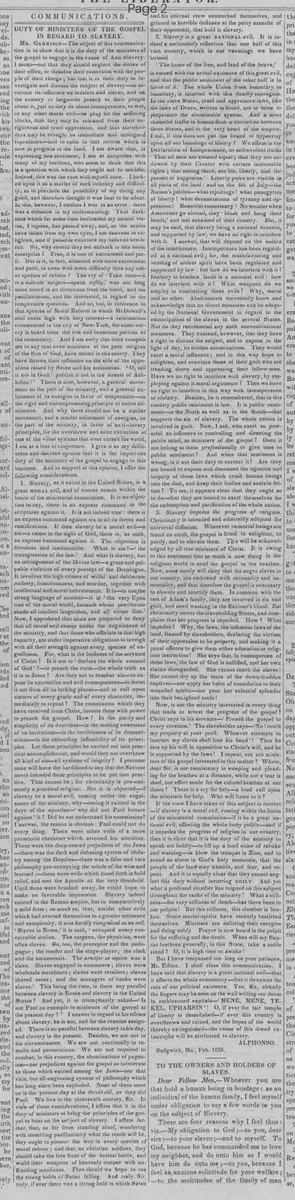
DUTY OF MINISTERS OF THE GOSPEL
Mr. GARRISON—The object of this communication is to show that it is the duty of the ministers of the gospel to engage in the cause of Anti-Slavery. I mean—not that they should neglect the duties of their office, or dissolve their connexion with the people of their charge; but that it is their duty to investigate and discuss the subject of slavery—to ascertain its influence on masters and slaves, and on the country at large—to preach to their people about it, just as they do about intemperance, or war, or any other moral evil—to pray for the suffering blacks, that they may be released from their unrighteous and cruel oppression, and that slaveholders may be brought to immediate and unfeigned repentance—and to unite in that reform which is now in progress in the land. I am aware that, in expressing this sentiment, I am at antipodes with many of my brethren, who seem to think that this is a question with which they ought not to meddle. Indeed, this was the case with myself once. I looked upon it as a matter of such delicacy and difficulty, as to preclude the possibility of my doing any good, and therefore thought it was best to be silent. In this, however, I confess I was in an error : there was a delusion in my understanding. That darkness which for some time beclouded my mental vision, I rejoice, has passed away, and, as the scales have fallen from my own eyes, I am desirous to enlighten, and if possible convince my beloved brethren. Sir, why should they not embark in this noble enterprise ? True, it is one of excitement and peril. But is it, in fact, attended with more excitement and peril, or even with more difficulty than any other species of reform ? The cry of 'Take care— it is a delicate subject—speak softly,' was not long since heard in all directions from the timid, and the pusillanimous, and the interested, in regard to the temperance question. And so, too, in reference to that species of Moral Reform in which McDowall's soul beats high with holy interest—a reformation commenced in the city of New-York, the same outcry is heard from the vile and licentious portion of the community. And I am sorry that truth compels me to say that even ministers of the pure religion of the Son of God, have united in this outcry. They have thrown their influence on the side of the opposition raised by Satan and his emissaries. O. tell it not in Gath! publish it not in the streets of Ashkelon! There is now, however, a general movement on the part of the ministry, and a general enlistment of its energies in favor of temperance—on the rigid and uncompromising principle of entire abstinence. And why there should not be a similar movement, and a similar enlistment of energies, on the part of the ministry, in favor of anti-slavery principles, for the overthrow and utter extinction of one of the vilest systems that ever cursed the world. I am at a loss to conjecture. I give it as my deliberate and decided opinion that it is the imperious duty of the ministers of the gospel to engage in this business. And in support of this opinion, I offer the following considerations.
1. Slavery, as it exists in the United States. is a great MORAL evil, and of course comes within the limits of the ministerial commission. It is no objection to say, there is no express command in the scriptures against it. It is not indeed true : there is an express command against sin in all its forms and ramifications. If then slavery be a moral evil—a sin—a crime in the sight of God, there is, as such an express command against it. The objection is frivolous and inadmissible. What is sin?—'the transgression of the law.' And what is slavery, but an infringement of the Divine law—a gross and palpable violation of every precept of the Decalogue. It involves the high crimes of wilful and deliberate robbery, licentiousness, and murder, together with intellectual and moral imbrutement. It is—to use,the strong language of another—it is 'the very Upas tree of the moral world, beneath whose pestiferous shade all intellect languishes, and all virtue dies.' Now, I apprehend that none are prepared to deny that all moral evil comes under the cognizance of the ministry, and that those who officiate in that high capacity, are under imperative obligations to inveigh with all their strength against every species of ungodliness. For, what is the business of the servants of Christ ? Is it not to ' declare the whole counsel of God'?—to preach the truth—the whole truth as it is in Jesus ? Are they not to combat sin—to expose its enormities and evil consequences—to ferret it out from all its lurking places—and to call upon sinners of every grade and of every character, immediately to repent? The commission which they have received from Christ, invests them with power to preach the gospel. How? In the purity and simplicity of its doctrines—in the melting sweetness of its invitations—in the terribleness of its denunciations—in the unbending inflexibility of its principles. Let these principles be carried out into practical accomplishment, and would they not overthrow all kind of sin—all systems of iniquity? I presume none will have the hardihood to say that the Saviour never intended these principles to be put into practice. That cannot be ; for christianity is pre-eminently a practical religion. But it is objected—if slavery be a moral evil, coming under the cognizance of the ministry, why—seeing it existed in the days of the apostles—'why did not Paul lecture against' it ? Did he not understand his commission? I answer, the reason is obvious: Paul could not do every thing. There were other evils of a more prominent character which arrested his attention. There were the deep-rooted prejudices of the Jews—there was the dark and debasing system of idolatry among the Gentiles—there was a false and vain philosophy pre-occupying the minds of the wise and learned :-these were evils which stood forth in bold relief, and met the Apostle at the very threshold. Until these were brushed away, he could hope to make no favorable impression. Slavery indeed existed in the Roman empire, but in comparatively a mild form; so much so, that, amidst other evils which had erected themselves to a greater eminence and conspicuity, it was hardly recognized as an evil. 'Slaves in Rome,' it is said, 'occupied every conceivable station. The surgeon, the physician, were often slaves. So, too, the preceptor and the pedagogue; the reader and the stage-player; the clerk and the amanuensis. The armiger or squire was a slave. Slaves engaged in commerce; slaves were wholesale merchants; slaves were retailers; slaves shared notes; and the managers of banks were slaves.' This being the case, is there any parallel between slavery in Rome and slavery in the United States? And yet, it is triumphantly asked—'Is not Paul an example to ministers of the gospel at the present day ? ' I answer in regard to his silence about slavery, he is not, and for the reasons assigned. There is no parallel between slavery in his day. and slavery in the present. Besides, we are not in his circumstances. We are not continually in tumults and persecutions. We are not required to combat, in this country, the abominations of paganism—nor prejudices against the gospel so inveterate as those which existed among the Jews—nor that vain, but all-engrossing system of philosophy which has long since been exploded. None of these meet us in the present day at the threshold, as they did Paul. We live in the nineteenth century, Sir. In view of these considerations, I affirm that it is the duty of ministers to bring the principles of the gospel to bear on the subject of slavery. I affirm further, that, so far from standing aloof, wondering with trembling pusillanimity what the result will be, they ought to pioneer the way in every species of moral reform; and that, as christian soldiers, they should take the fore front of the hottest battle, and wield their weapons of heavenly temper with unflinching manliness. Then should we hope to see the strong holds of Satan falling. And truly, Sir, truly, if ever there was a strong hold in which Satan and his infernal crew entrenched themselves, and grinned in horrible defiance at the petty assaults of their opponents, that hold is slavery
2. Slavery is a great NATIONAL evil. It is in deed a melancholy reflection that one half of this vast country, which in our vauntings we have termed 'The home of the free, and land of the brave, is cursed with the actual existence of this great evil, and that the public sentiment of the other half is in favor of it. The whole Union from boundary to boundary, is infected with this deadly contagion. In the slave States, cruel and oppressive laws, like the laws of Draco, written in blood, are in force to perpetuate the abominable system. And a most shameful traffic in human flesh is carried on between those States, and in the very heart of the empire. I ask, if this does not put the brand of hypocrisy upon all our boastings of liberty ? We affirm in the Declaration of Independence, as self-evident truths . That all men are created equal; that they are endowed by their Creator with certain inalienable rights ; that among these. are life, liberty, aud the pursuit of happiness.' Liberty poles are visible in all parts of the land: and on the 4th of July—the Nation's jubilee—what rejoicings! what panegyrics of liberty! what denunciations of tyranny and oppression! Beautiful consistency ! No wonder when Americans go abroad, they ' blush and hang their heads,' and feel ashamed of their country. But, it may be said, that slavery being a national concern, and supported by law, we have no right to interfere with it. I answer, that will depend on the nature of the interference. Intemperance has been regarded as a national evil; for, the manufacturing and vending of ardent spirit have been regulated and supported by law : but how do we interfere with it? Idolatry in heathen lands is a national evil: how do we interfere with it? What weapons do we employ in combatting these evils? Why, moral and no other. Abolitionists universally know and acknowledge that no direct measures can be adopted by the National Government in regard to the emancipation of the slaves in the several States. Nor do they recommend any such unconstitutional measures. They contend, however, that they have a right to discuss the subject, and to expose to the light of day, its hidden abominations. They would exert a moral influence; and in this way hope to enlighten, and convince those of their guilt who are treading down and oppressing their fellow-men. Have we no right to interfere with slavery, by employing against it moral arguments ? Then we have no right to interfere in this way with intemperance or idolatry. Besides, be it remembered, that in this country public sentiment is law. It is public sentiment—in the North as well as in the South—that supports the sin of slavery. The whole nation is involved in guilt. Now, I ask, who exert so powerful an influence in controlling and directing the public mind, as ministers of the gospel ? Does it not belong to them professionally to give tone to public sentiment? And when that sentiment is wrong, is it not their duty to correct it? Are they not bound to expose and denounce the injustice and iniquity of those laws which crush human beings into the dust, and keep their bodies and souls in fetters? To me, it appears clear that they ought so to do—that they are bound to exert themselves for the redemption and purification of the whole nation.
3. Slavery impedes the progress of religion. Christianity is intended and admirably adapted for universal diffusion, Wherever immortal beings are found on earth, the gospel is fitted to enlighten, to purify, and to elevate them. This will be acknowledged by all true ministers of Christ. It is owing to this sentiment that so much is now doing in the religious world to send the gospel to the heathen. Now, none surely will deny that the negro slaves in our country, are endowed with rationality and immortality, and that therefore the gospel is necessary to elevate and sanctify them. In common with the rest of Adam's family, they are involved in sin and guilt, and need washing in the Saviour's blood. But christianity enters the slaveholding States, and complains that her progress is impeded. How ? What impedes ? Why, the laws, the infamous laws of the land, framed by slaveholders, declaring the victims of their oppression to be property, and making it a penal offence to give them either education or religious instruction! She says that, in consequence of these laws, the law of God is nullified, and her own claims disregarded. She cannot reach the slaves! She cannot dry up the tears of the down-trodden captives—nor apply her balm of consolation to their wounded spirits—nor pour her celestial splendor into their benighted souls!
Now, is not the ministry interested in every thing that tends to arrest the progress of the gospel Christ says to his servants—' Preach the gospel to every creature.' The slaveholder says—'No! touch my property at your peril. Whoever attempts to instruct my slaves shall lose his head'!Thus he sets up his will in opposition to Christ's will, and he is supported by the laws! I repeat, are not ministers of the gospel interested in this matter ? Where dear Sir, is our consistency in weeping and pleading for the heathen at a distance, while not a tear is shed, nor effort made for the colored heathen at our doors? There is a cry for help—a loud call upon the ministers for help. Who will listen to it ?
If the view I have taken of this subject is correct —if slavery is a moral evil, coming within the limits of the ministerial commission—if it be a great national evil, affecting the whole body politic—and if it impedes the progress of religion in our country, then it is clear that it is the duty of the ministry to speak out boldly—to lift up a loud voice of rebuke and warning—to blow the trumpet in Zion, and to sound an alarm in God's holy mountain, that the people of the land may tremble, and fear, and repent. And it is equally clear that they cannot neglect this duty without incurring GUILT. And yet what a profound slumber has reigned on this subject throughout the ranks of the ministry! What a stillness—the very stillness of death—has there been in our pulpits! But this stillness, this slumber is broken. Some master-spirits have recently bestirred themselves. Ministers are enlisting their energies and doing nobly. Prayer is now heard in the pulpit for the suffering and the dumb. When will my Baptist brethren generally, in this State, take a noble stand ? O, it is high time to awake!
But I have trespassed too long on your patience, Mr. Editor. I shall close this communication. I have said that slavery is a great national evil—that it affects the whole community—that it threatens the ruin of our political existence. Yes, Sir, already the fingers may be seen on the wall writing our doom in emblazoned capitals—'MENE, MENE, TEKEL, UPHARSIN'! O, if ever the fair temple of liberty is demolished—if ever this country is overthrown and ruined, and the hopes of the world thereby extinguished—the cause of this dread catastrophe will be attributed to slavery.
ALPHONSO.
Sedgwick, Mo., Feb. 1835.
What sub-type of article is it?
What themes does it cover?
What keywords are associated?
What entities or persons were involved?
Letter to Editor Details
Author
Alphonso
Recipient
Mr. Garrison
Main Argument
it is the imperious duty of ministers of the gospel to engage in the anti-slavery cause by investigating, discussing, and preaching against slavery as a moral evil, praying for slaves' release and slaveholders' repentance, and leading moral reform, akin to efforts against temperance or idolatry.
Notable Details