Thank you for visiting SNEWPapers!
Sign up free
Letter to Editor
March 18, 1837
Richmond Palladium
Richmond, Wayne County, Indiana
What is this article about?
A response to 'Switch's' satirical article in the Richmond Palladium criticizing the Thomsonian medical system, defending it using Proverbs 26:4-5 to argue against foolish attacks and asserting the responders' knowledge of medicines.
Clipping
OCR Quality
95%
Excellent
Full Text
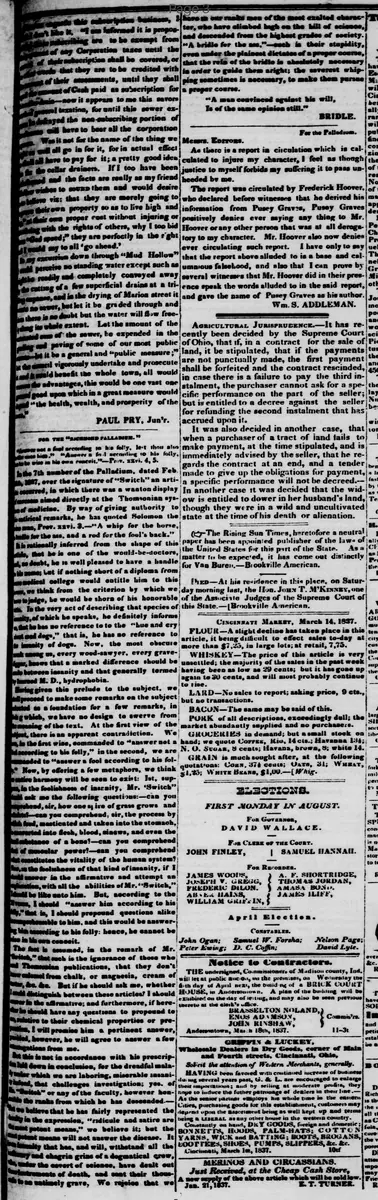
For The Richmond Palladium.
Answer a fool according to his folly, lest thou also be like unto him. Answer a fool according to his folly, he is wise in his own conceit. Prov. xxvi. 4, 5.
In the 7th number of the Palladium, dated Feb. 17, over the signature of 'Switch' an article appeared, in which there was a wanton display aimed directly at the Thomsonian system of medicine. By way of giving authority to his satirical remarks, he has quoted Solomon the wise, Prov. xxvi. 3. 'A whip for the horse, a bridle for the ass, and a rod for the fool's back.' It is facetiously inferred from the shape of this text that he is one of the would-be-doctors, and no doubt, he is well pleased to have a handle to his name; but if nothing short of a diploma from a medical college would entitle him to this we think from the criterion by which we judge, he would be shorn of his honorable title in the very act of describing that species of folly, which he speaks, he definitely informs us that this has no reference to the 'hue and cry about mad dogs,' that is, he has no reference to the propensity of dogs. Now, the most obscure man among us, every wood-sawyer, every grave-digger, knows that a marked difference should be made between insanity and that generally termed by the harped M. D., hydrophobia.
Having given this prelude to the subject, we proceed to make some remarks on the subject quoted as a foundation for a few remarks, in which, we have no design to swerve from the meaning of the text. At the first view of the text, there is an apparent contradiction. We are in the first verse, commanded to 'answer not a fool according to his folly,' in the second, we are commanded to 'answer a fool according to his folly.' Now, by offering a few metaphors, we think entire harmony will be seen to exist: 1st, supposing the foolishness of insanity, Mr. 'Switch' should ask me the following questions: can you comprehend, sir, how one blade of grass grows and another does not? Can you comprehend, sir, the process by which food, masticated and taken into the stomach, is converted into flesh, blood, sinews, and even the substance of a bone? Can you comprehend the source of muscular power? Can you comprehend what constitutes the vitality of the human system?
In the foolishness of that kind of insanity, if I answer in the affirmative and attempt an explanation, with all the abilities of Mr. 'Switch,' I should be like unto him. But, according to the text, I should 'answer him according to his folly,' that is, I should propound questions alike unreasonable to him, and this would be answering him according to his folly: hence, he cannot be wise in his own conceit.
The fact is assumed, in the remark of Mr. 'Switch,' that such is the ignorance of those who read Thomsonian publications, that they don't know chalk from magnesia, cream of tartar, &c. &c. But if he should ask me, whether I could distinguish between these articles? I should answer in the affirmative; and furthermore, if he should have any questions to propound to me relative to their chemical properties or preparations, I will promise him a pertinent answer, provided, however, he will consent to answer a few questions from me.
In this manner is accordance with his prescription, we do in conclusion, for the dreadful malady under which we are laboring. Miserable insanity indeed, that challenges investigation; yes, of 'Switch' or any of the faculty, however homely the ranks from which he has descended. We do believe that he has fairly represented the dog in the expression, 'ridicule and satire are most potent means,' we believe it; but the most potent means will not answer the disease. Insanity that has, and will, withstand all the rage and chagrin grins of a dogmatical crew, who in the courts of science, have dealt out sacraments of death, and sent their thousands to an untimely grave. We rejoice that we have in our ranks men of the sect exalted character, who have climbed high on the hill of science, and descended from the highest grades of society.
'A bridle for the ass.' Such is their stupidity, even under the plainest dictates of a proper course, that the rein of the bridle is absolutely necessary, in order to guide them aright; the severest whipping sometimes is necessary, to make them pursue a proper course.
'A man convinced against his will, is of the same opinion still.'
BRIDLE.
Answer a fool according to his folly, lest thou also be like unto him. Answer a fool according to his folly, he is wise in his own conceit. Prov. xxvi. 4, 5.
In the 7th number of the Palladium, dated Feb. 17, over the signature of 'Switch' an article appeared, in which there was a wanton display aimed directly at the Thomsonian system of medicine. By way of giving authority to his satirical remarks, he has quoted Solomon the wise, Prov. xxvi. 3. 'A whip for the horse, a bridle for the ass, and a rod for the fool's back.' It is facetiously inferred from the shape of this text that he is one of the would-be-doctors, and no doubt, he is well pleased to have a handle to his name; but if nothing short of a diploma from a medical college would entitle him to this we think from the criterion by which we judge, he would be shorn of his honorable title in the very act of describing that species of folly, which he speaks, he definitely informs us that this has no reference to the 'hue and cry about mad dogs,' that is, he has no reference to the propensity of dogs. Now, the most obscure man among us, every wood-sawyer, every grave-digger, knows that a marked difference should be made between insanity and that generally termed by the harped M. D., hydrophobia.
Having given this prelude to the subject, we proceed to make some remarks on the subject quoted as a foundation for a few remarks, in which, we have no design to swerve from the meaning of the text. At the first view of the text, there is an apparent contradiction. We are in the first verse, commanded to 'answer not a fool according to his folly,' in the second, we are commanded to 'answer a fool according to his folly.' Now, by offering a few metaphors, we think entire harmony will be seen to exist: 1st, supposing the foolishness of insanity, Mr. 'Switch' should ask me the following questions: can you comprehend, sir, how one blade of grass grows and another does not? Can you comprehend, sir, the process by which food, masticated and taken into the stomach, is converted into flesh, blood, sinews, and even the substance of a bone? Can you comprehend the source of muscular power? Can you comprehend what constitutes the vitality of the human system?
In the foolishness of that kind of insanity, if I answer in the affirmative and attempt an explanation, with all the abilities of Mr. 'Switch,' I should be like unto him. But, according to the text, I should 'answer him according to his folly,' that is, I should propound questions alike unreasonable to him, and this would be answering him according to his folly: hence, he cannot be wise in his own conceit.
The fact is assumed, in the remark of Mr. 'Switch,' that such is the ignorance of those who read Thomsonian publications, that they don't know chalk from magnesia, cream of tartar, &c. &c. But if he should ask me, whether I could distinguish between these articles? I should answer in the affirmative; and furthermore, if he should have any questions to propound to me relative to their chemical properties or preparations, I will promise him a pertinent answer, provided, however, he will consent to answer a few questions from me.
In this manner is accordance with his prescription, we do in conclusion, for the dreadful malady under which we are laboring. Miserable insanity indeed, that challenges investigation; yes, of 'Switch' or any of the faculty, however homely the ranks from which he has descended. We do believe that he has fairly represented the dog in the expression, 'ridicule and satire are most potent means,' we believe it; but the most potent means will not answer the disease. Insanity that has, and will, withstand all the rage and chagrin grins of a dogmatical crew, who in the courts of science, have dealt out sacraments of death, and sent their thousands to an untimely grave. We rejoice that we have in our ranks men of the sect exalted character, who have climbed high on the hill of science, and descended from the highest grades of society.
'A bridle for the ass.' Such is their stupidity, even under the plainest dictates of a proper course, that the rein of the bridle is absolutely necessary, in order to guide them aright; the severest whipping sometimes is necessary, to make them pursue a proper course.
'A man convinced against his will, is of the same opinion still.'
BRIDLE.
What sub-type of article is it?
Persuasive
Informative
Satirical
What themes does it cover?
Health Medicine
Morality
What keywords are associated?
Thomsonian Medicine
Switch Satire
Proverbs Folly
Medical Debate
Hydrophobia
Traditional Doctors
What entities or persons were involved?
Bridle
The Richmond Palladium
Letter to Editor Details
Author
Bridle
Recipient
The Richmond Palladium
Main Argument
the letter defends the thomsonian system of medicine against 'switch's' satirical criticism by interpreting proverbs 26:4-5 to argue that one should not engage in foolish debates but challenge the critic's knowledge, asserting that thomsonians understand medicines and that traditional doctors have caused harm.
Notable Details
Quotes Proverbs Xxvi. 4,5
References 'Switch's' Article In Palladium Dated Feb. 17
Distinguishes Insanity From Hydrophobia
Critiques M.D.S For Sending Thousands To Untimely Graves